
Key Takeaways
- Declutter before buying any storage products - containers can't fix excess stuff.
- Assign every item a specific home based on where it's actually used.
- Kitchens benefit most from zone-based organization tied to meal prep workflows.
- Closets and bedrooms need regular seasonal reviews to prevent slow re-accumulation.
- Simple, visible systems are easier for all household members to maintain consistently.
- A periodic audit prevents organized spaces from quietly sliding back into chaos.
Start With a Strategy, Not Storage Bins
The single most common organization mistake is buying containers before knowing what you're keeping. Bins and baskets are tools for a finished system - not the starting point. Begin instead by taking a full inventory of each room and deciding what earns a place in your home.
If your home has never had a formal system, starting with a declutter-first approach can prevent you from organizing clutter rather than eliminating it. Once you know what stays, the concept of assigning each area a defined purpose gives your systems structure that holds over time.
Declutter Before You Shop for Storage
Resist the urge to buy bins, baskets, or drawer organizers until after you've decided what stays. Storage products purchased before decluttering often end up organizing things you didn't need to keep. Identify what you own, decide what earns a permanent place, then measure and purchase accordingly.
Not sure which framework fits your style? The plain-language glossary of organizational systems breaks down methods like FIFO, the container method, and KonMari in accessible terms.
Kitchen: The Highest-Traffic Room
The kitchen is where disorganization costs the most time. Group items by workflow: prep tools near the cutting board, cooking utensils next to the stove, and frequently used spices within arm's reach. Store rarely used appliances - bread makers, specialty pans - above the refrigerator or in lower cabinets.
- Countertops: Limit surface items to daily-use appliances only. Every extra object competes for workspace.
- Pantry: Use the FIFO (first in, first out) method - newer items go behind older ones to reduce food waste.
- Drawers: Subdivide with adjustable inserts. Loose utensils in a deep drawer are genuinely unusable.
- Under the sink: Install a tension rod to hang spray bottles; use a small bin for sponges and scrubbers.
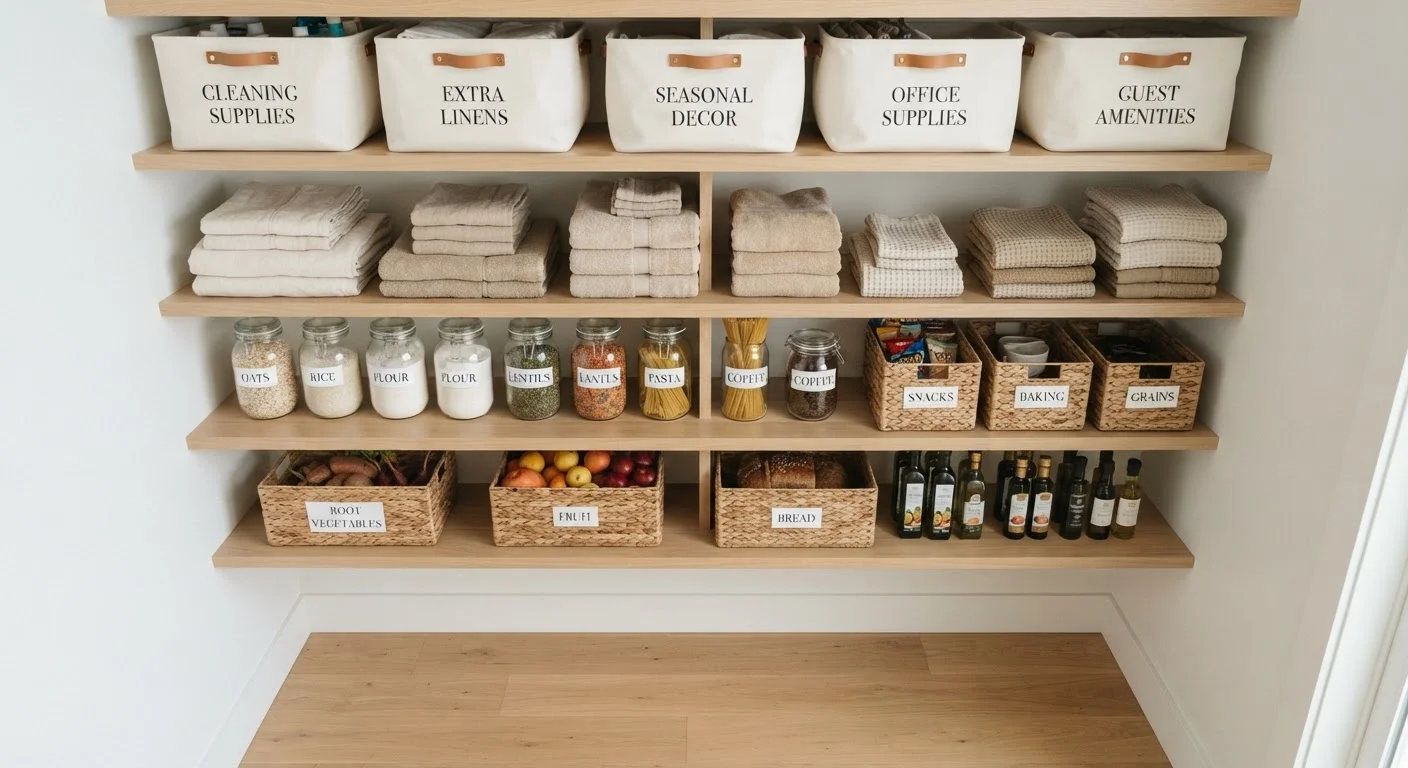
Label shelves rather than just containers. When the shelf itself is labeled, items find their way back even when a bin is in the dishwasher or being refilled.
The breakdown in most systems happens at the return step, not the retrieval step - making the location itself the cue removes dependence on any single container being present.
When setting up a new organizational zone, live with it for two weeks before buying permanent storage. Your actual usage patterns will reveal what you really need.
Pre-purchasing containers based on assumptions often results in wrong sizes, wrong quantities, and wasted money - observing real behavior first is more efficient.
Label shelves, not just containers. When labels are on the shelf itself, items get returned to the right spot even when containers are empty or being washed.
Living Room and Shared Spaces
Shared spaces accumulate items from multiple people with different habits. The solution isn't more rules - it's frictionless systems. Every item that belongs in a shared room needs a specific, obvious home so that putting things away takes no more effort than dropping them somewhere random.
Use furniture with built-in storage: ottomans with lids, console tables with drawers, media units with closed cabinets. Decorative baskets work well for items like remote controls, chargers, and reading glasses - things that migrate but should stay in one zone.
Don't Organize Around Other People's Clutter
If shared spaces are accumulating items that belong to other household members, creating elaborate systems around their possessions won't stick - it just shifts the burden. Address shared ownership of spaces directly, and build systems that all users understand and agree to maintain.
If you live with others who have different tidiness standards, strategies for households with mixed habits can help you build systems that are realistic for everyone - not just the most organized person in the home.
25%
Time spent looking for misplaced items weekly
Research from organizational behavior studies suggests Americans lose significant productive time each week searching for items at home and work.
80%
Of clutter is due to disorganization, not lack of space
Professional organizers commonly cite this pattern: most households have sufficient space but lack functional systems to use it effectively.
Bedrooms and Closets
Bedroom organization centers on the closet, where slow accumulation is the biggest threat. Twice a year - at seasonal transitions - pull everything out and make active decisions. Clothes you haven't worn in 12 months, items that no longer fit, and duplicates are the first candidates to go.
Inside the closet, group by category and then by color within each category. Hanging organizers work well for accessories; shelf dividers prevent folded stacks from collapsing. For under-bed storage, use flat bins with lids and labels - out-of-season clothing and extra bedding are ideal candidates.
“Organization is not about perfection; it's about efficiency, reducing stress, and enabling you to do the things you love. The goal is a home that supports your life - not a showroom that you maintain for its own sake.”
— Peter Walsh, Professional organizer and author on decluttering and home organization
Nightstands deserve their own audit: limit them to a lamp, one book, and a small tray. Everything else is displacement - items that don't have a proper home elsewhere.
Bathrooms and Laundry Areas
Bathrooms are small, high-use spaces where clutter compounds quickly. Keep only current-use products on the counter. Group cabinet contents by category - skincare, medications, hair tools, first aid - and use small bins or drawer dividers within each zone.
Expired medications should be disposed of through a pharmacy take-back program, not flushed. Expired sunscreen, vitamins, and cosmetics follow similar logic: the bathroom is not a storage unit for things you might use someday.
In laundry areas, a three-bin sorting system (lights, darks, colors or delicates) eliminates a sorting step on wash day. Wall-mounted shelves above the washer and dryer reclaim otherwise wasted vertical space for detergent and supplies.
Medication Storage and Disposal Matter
Bathrooms are not ideal for storing medications long-term - heat and humidity accelerate degradation. A cool, dry location like a bedroom drawer or dedicated cabinet is generally preferable. Expired or unused medications should be returned to a pharmacy take-back program rather than flushed or discarded in household trash, where they can pose environmental or safety risks.
Keeping Your Systems Running Long-Term
The hardest part of home organization isn't setting it up - it's preventing drift. Systems erode gradually, not all at once. A single overloaded drawer becomes two, then a cabinet, then a room. The defense is a scheduled review, not heroic weekend purges.
A quarterly glance at each room takes 20 minutes and catches problems while they're small. For a more thorough review, the annual home organization audit checklist provides a structured room-by-room assessment you can work through once a year.
If your home is smaller and storage is a constraint, the approach to organization does shift. Storage solutions scaled to your space explores which principles transfer across square footages and where small-home strategies diverge from larger ones.
Finally, don't let common beliefs derail you. Several widely held organization myths - including the idea that you must purge everything before starting - actively work against sustainable systems. Progress is more useful than perfection.