Storage Solutions That Scale: What Works in Studios, Apartments, and Full-Size Homes

Key Takeaways
- Vertical space is the most underused storage asset in studios and small apartments.
- Modular, multi-function furniture adapts well across different home sizes and layouts.
- Zone-based organization works regardless of square footage - the zones just change in scale.
- Larger homes risk accumulation clutter; intentional systems matter just as much there.
- A few universal principles - visibility, accessibility, and containment - apply to every home size.
Why Storage Strategy Has to Match Your Space
The most common mistake homeowners and renters make is borrowing storage ideas from spaces that look nothing like their own. A walk-in closet system pinned from a design blog won't help if you're working with a 450-square-foot studio. And a single over-door organizer won't cut it in a five-bedroom house with four residents.
Effective storage is less about buying the right container and more about understanding the logic your space demands. That logic shifts depending on square footage, the number of people sharing the home, and how rooms are used. See our guide to common organization myths if you're starting from misconceptions about what tidying actually requires.
The strategies below are organized around real spatial constraints - from studios where every square foot pulls double duty, to full-size homes where the challenge is managing scale rather than scarcity.
Studios: Build Up, Not Out
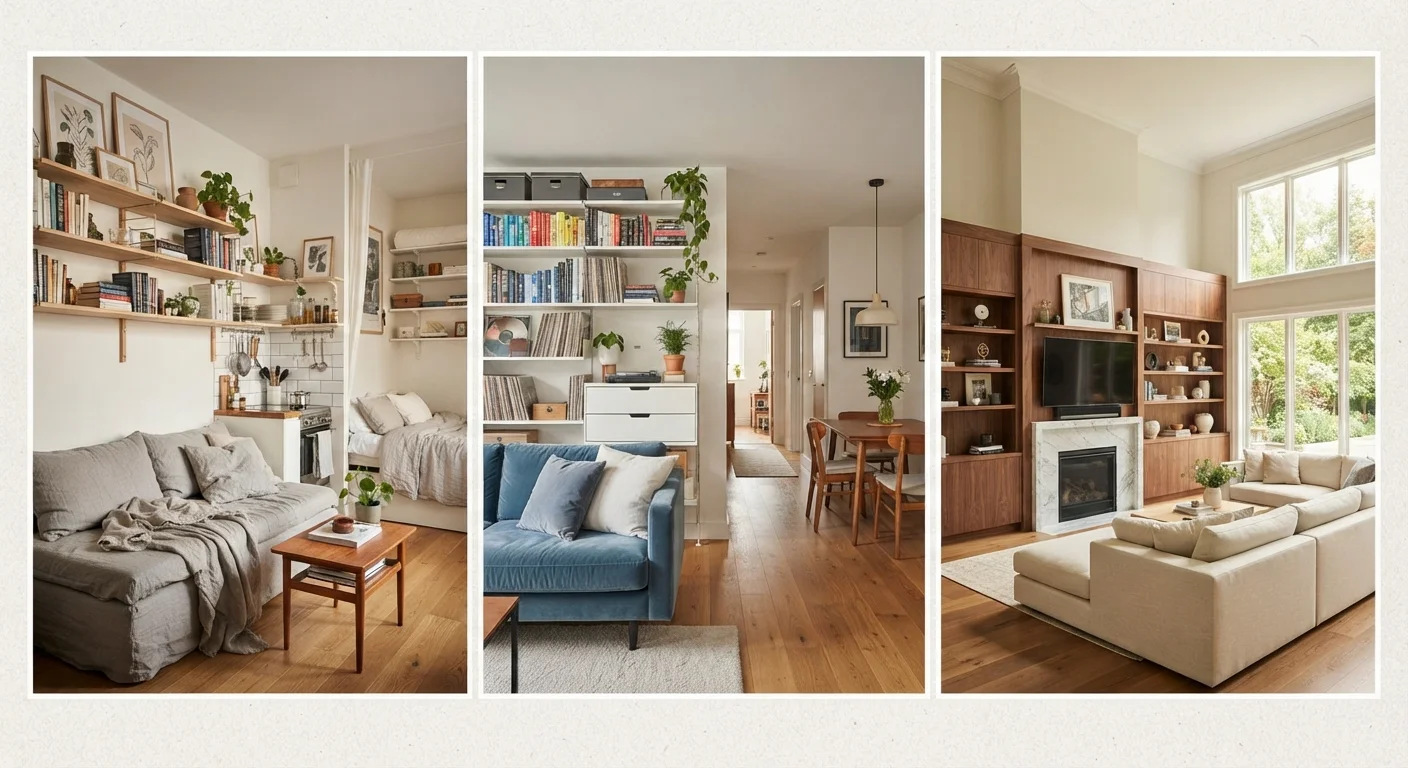
In a studio apartment, floor space is currency. Dedicating any of it to low, wide storage furniture means surrendering the one resource you have least of. The fix is to think vertically - shelving that reaches toward the ceiling, wall-mounted hooks, and tall narrow cabinets all free up the floor while dramatically increasing your usable storage volume.
Open shelving works well in studios because it keeps the space visually light. Closed cabinetry can make walls feel heavy, though it has the advantage of hiding clutter. A practical middle ground is combining open shelving for items used daily with a few closed bins or baskets for things that don't need to be on display.
Lofted beds with storage drawers or shelving underneath are one of the highest-yield options in a true studio, effectively creating a second layer of living space. If structural installation isn't an option, a platform bed frame with built-in drawers achieves a similar result without modification to the unit.
Vertical storage can triple usable space in a studio without touching the floor plan.
Studios and Small Apartments: Furniture That Does Two Jobs
Multi-function furniture isn't a gimmick in a small space - it's a structural requirement. An ottoman with interior storage replaces both a coffee table and a storage bin. A daybed with a trundle covers seating, sleeping, and guest accommodations. A dining table that folds flat against the wall reclaims floor space when meals are finished.
The key when selecting multi-function pieces is to choose based on your actual habits, not an idealized version of them. A fold-out desk sounds efficient, but if the setup-and-breakdown process discourages you from using it, it becomes dead furniture. Prioritize pieces where both functions are easy to access daily.
Storage benches at entryways serve shoes, bags, and seating simultaneously - one of the most consistently useful multi-function investments in small floor plans. Look for versions with lids that open fully, since partial-opening lids tend to make the storage feel inconvenient over time.
Choose multi-function furniture based on real daily habits, not aspirational ones.
Mid-Size Apartments: Zone Your Storage by Activity
In a one- or two-bedroom apartment, you have enough room to establish dedicated zones - but not enough to be careless about how those zones are stocked. The goal is to match storage to the activity that happens in each area, rather than distributing items wherever space opens up.
A reading nook should have its own small storage for books, reading glasses, and a blanket - not a catchall of miscellaneous items that migrated there. A home office corner needs storage calibrated to work supplies, not overflow from the kitchen or bedroom. Zoned living principles make this approach concrete and maintainable across a household.
Mid-size apartments often have one or two awkward spaces - a narrow hallway, an oddly placed alcove, or a deep pantry closet with poor visibility. These spots respond well to purpose-built storage inserts: pull-out shelving in deep pantries, slim rolling carts in narrow hallways, and tension-rod shelf dividers in closets to prevent item pile-up.
In mid-size apartments, storage breaks down when items migrate away from their activity zones.
Mid-Size to Large Homes: Closet Systems Worth Planning
Once you have dedicated closets, the temptation is to treat them as overflow catches rather than intentional systems. A closet without internal structure - just a rod and a shelf - will absorb disorder faster than almost any other space in the home. Adding adjustable shelving, double-hang rods where appropriate, and drawer units to even one main closet has a measurable effect on daily friction.
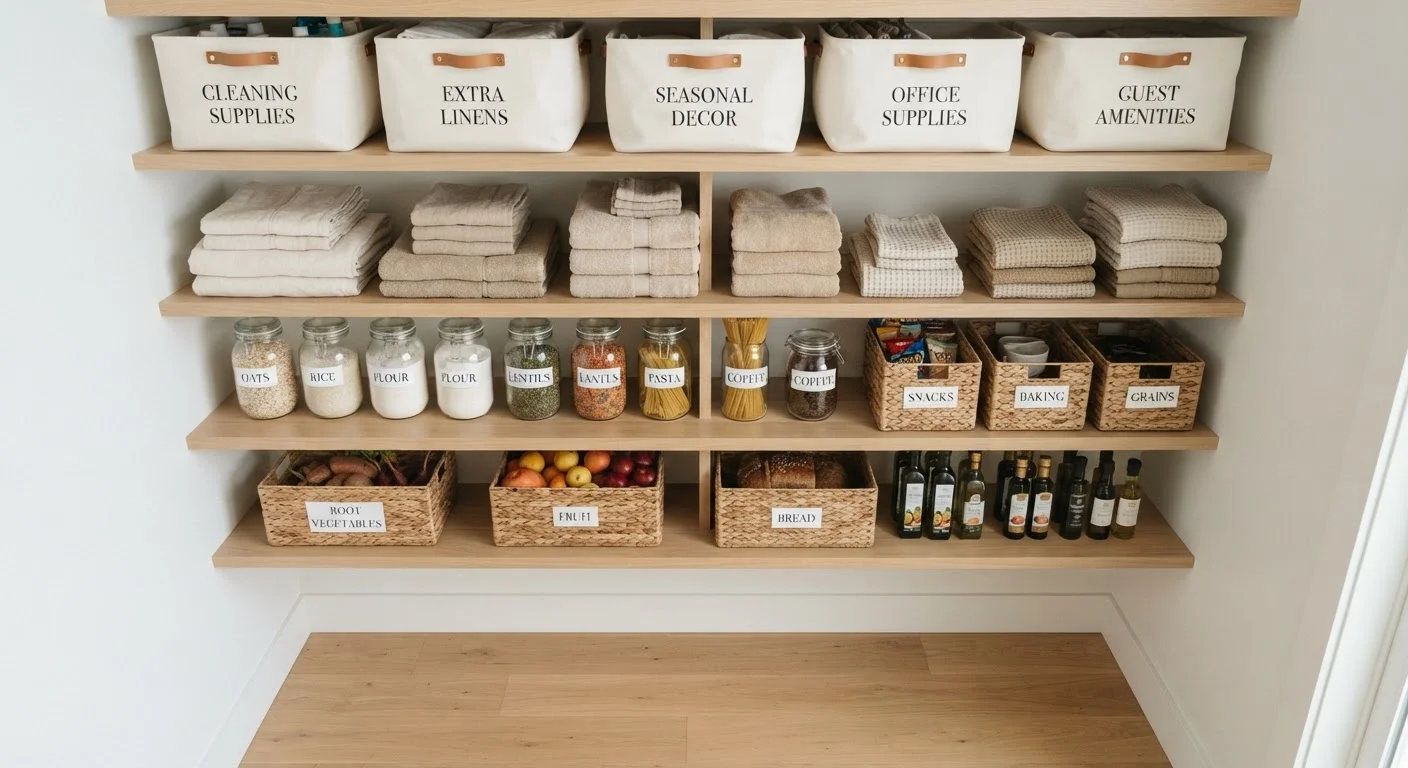
Linen closets and coat closets benefit enormously from clear bins with labels and consistent shelf height assignments. Assign shelves by person or by category and keep that structure consistent - when everyone knows where items live, the system maintains itself with far less daily effort.
If a full closet system isn't in the budget, modular freestanding shelving units placed inside an existing closet accomplish most of the same goals. The home improvement hub covers a range of approaches at different investment levels.
An unstructured closet will absorb disorder faster than almost any other space in the home.
Full-Size Homes: Managing Scale and Preventing Accumulation
Larger homes present the opposite pressure from studios: the problem isn't too little space, it's that space abundance enables unchecked accumulation. When there's always room for one more thing, items enter the home faster than systems can accommodate them. The result is often a home that feels disorganized despite having ample storage.
The most effective approach in larger homes is to treat storage capacity as deliberately finite - even when it isn't. Assign a fixed space to each category of belongings, and when that space fills, use it as a signal to edit rather than expand. A garage that has a dedicated zone for sports equipment, tools, and seasonal items maintains itself far better than one that's used as general overflow.
Seasonal rotation is also a more practical strategy at this scale. Items not in active use - holiday decorations, off-season clothing, rarely used equipment - move to labeled bins in attic or garage storage, freeing everyday storage for what's actually needed. This keeps primary living spaces functional without requiring constant decluttering.
In larger homes, treating storage capacity as finite prevents the slow accumulation that disrupts function.
Putting It All Together
Regardless of where you live, the most durable storage systems share three traits: you can see what's inside, you can reach it without disrupting everything else, and it has a defined boundary so overflow is obvious. When a system starts failing, it's usually one of those three things breaking down first.
Start With One Area, Not the Whole Home
Trying to overhaul storage throughout your home at once is a reliable path to burnout and abandoned systems. Pick the single space that causes the most daily friction - an overcrowded entryway, a chaotic kitchen cabinet, a bedroom closet that doesn't close - and build a working system there first. Success in one area builds both momentum and clarity about what approach suits your household.
If you're sharing your space with others, storage only works when everyone understands the system. Our article on organizing shared spaces with different habits walks through how to build agreements around storage that actually hold up over time.
For a room-by-room breakdown of how these principles apply to specific spaces - kitchens, bedrooms, bathrooms - the room-by-room organization walkthrough offers concrete starting points at any home size.