

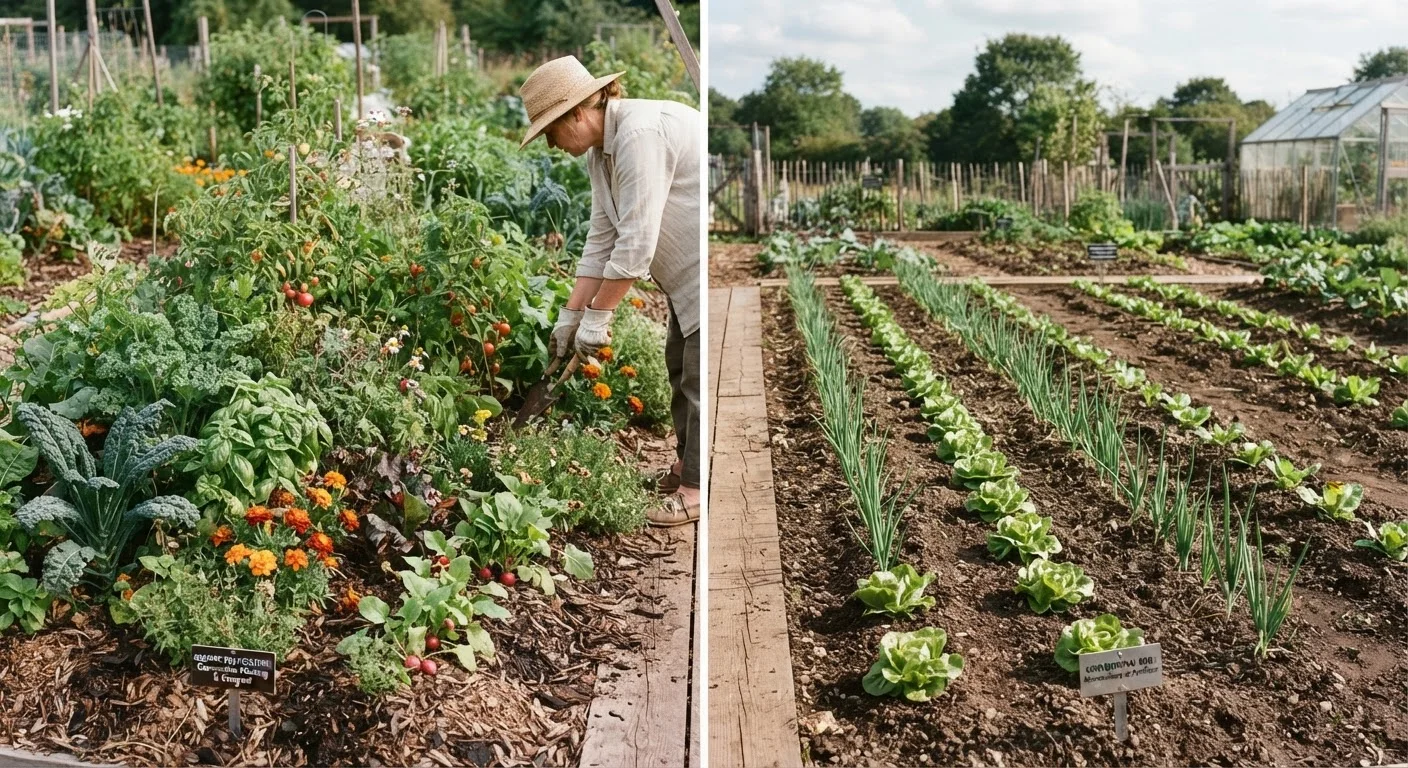
Key Takeaways
- Organic gardening relies on natural inputs and ecological systems; conventional gardening may use synthetic fertilizers and pesticides.
- Both approaches can produce healthy, productive gardens - the right choice depends on your goals and tolerance for variability.
- Soil management philosophy is the core difference: organic methods build long-term soil biology; conventional methods often address immediate nutrient deficiencies.
- Organic pest control requires more proactive planning; conventional options tend to act faster but carry different environmental trade-offs.
- Many home gardeners successfully blend elements of both approaches in what is sometimes called integrated gardening.
Option A
Organic Gardening
The whole-system, ecology-first approach.
Best for: Gardeners who prioritize soil health, biodiversity, and avoiding synthetic inputs in food and ornamental gardens.
Option B
Conventional Gardening
The precision-input, results-driven approach.
Best for: Gardeners who want targeted, predictable control over nutrients, pests, and disease with flexible product options.
If you grow edibles and want to minimize synthetic chemical exposure
Organic Gardening
Organic methods avoid synthetic pesticides and fertilizers, which many food gardeners prefer when growing produce for family consumption.
If you need rapid, targeted control over a severe pest or disease outbreak
Conventional Gardening
Conventional products often act faster and more predictably, making them practical when an infestation or deficiency needs quick resolution.
If you want to build long-term soil fertility with less purchased input over time
Organic Gardening
Compost, cover crops, and organic matter improve soil structure and microbial life, reducing external input needs as soil health matures.
If you garden in a high-pressure environment with limited time for monitoring
Conventional Gardening
Conventional schedules for feeding and pest prevention are often more formulaic, requiring less hands-on ecological observation.
If you want to support pollinators and overall garden biodiversity
Organic Gardening
Avoiding broad-spectrum pesticides and encouraging companion planting tend to support beneficial insects and local wildlife.
Defining the Two Approaches
The terms organic and conventional get used loosely, which causes real confusion. In practical gardening terms, the distinction comes down to what inputs you use and how you think about your garden as a system.
Organic gardening works with naturally derived inputs - compost, aged manure, fish emulsion, neem oil - and emphasizes building soil biology so plants can thrive from the ground up. The philosophy treats soil as a living ecosystem rather than a neutral growing medium to be chemically managed.
Conventional gardening draws on a broader toolkit that includes synthetic fertilizers and pesticides approved for home use. It tends to be more input-specific: address the identified deficiency or pest with the most effective available product, organic or not. The goal is results, and the means are flexible.
It's worth noting that "conventional" does not mean reckless. Many conventional gardeners follow label directions carefully, rotate crops, and incorporate organic matter. And many self-described organic gardeners still make management mistakes. The label describes a philosophy of inputs, not a guarantee of outcomes. See common garden myths debunked for a clear-eyed look at how both camps can fall into evidence-free habits.
Soil Management: Where the Real Difference Lives
Soil philosophy is where organic and conventional gardening diverge most significantly. Organic methods center on feeding the soil food web - the bacteria, fungi, earthworms, and micro-organisms that break down organic matter and make nutrients available to plant roots. Tools include compost, cover crops, mulching, and minimal tillage.
Conventional methods often use water-soluble synthetic fertilizers that deliver nutrients directly to plant roots, bypassing the need to cultivate soil biology. This produces fast, measurable results - a nitrogen-deficient plant can green up within days - but does little to improve the underlying soil structure or microbial community over time.
In practice, soil testing is valuable under either approach. Knowing your soil's actual pH and nutrient profile helps you apply amendments purposefully rather than by guesswork. For a deeper look at what amendments actually do, soil amendments explained covers when and why to use them.
| Criterion | Organic Gardening | Conventional Gardening |
|---|---|---|
| Fertilizer source | Compost, manure, fish emulsion | Synthetic or blended fertilizers |
| Pest control speed | Slower, preventive focus | Faster, targeted intervention |
| Soil biology focus | Central to the approach | Secondary to nutrient delivery |
| Upfront learning curve | Higher - ecological monitoring needed | Lower - product schedules guide timing |
| Long-term soil improvement | Strong with consistent practice | Possible but not inherent |
| Pollinator impact risk | Lower with careful product choice | Higher if synthetic pesticides misapplied |
| Input cost over time | Often decreases as soil improves | Ongoing depending on product use |
Pest and Disease Control
This is often the deciding factor for gardeners. Organic pest management is largely preventive: choose disease-resistant varieties, encourage beneficial insects, rotate crops, and use physical barriers like row covers. When intervention is needed, options include insecticidal soaps, diatomaceous earth, and botanical sprays - all naturally derived but not without their own ecological considerations.
Conventional pest control adds synthetic options - contact insecticides, systemic fungicides - that are generally faster-acting and more precisely targeted to a specific pest or pathogen. The trade-off is potential impact on non-target organisms, including pollinators, if products are misapplied or overused.
"Natural" Does Not Always Mean Safe
Organic certification for gardening inputs refers to the source of ingredients, not their toxicity level. Some naturally derived pesticides can harm beneficial insects or accumulate in soil with repeated use. Always read product labels regardless of whether a product is labeled organic or conventional, and apply only the minimum effective amount.
Neither system eliminates all risk. Some organically approved pesticides, such as copper fungicides used in excess, can accumulate in soil and harm earthworms. The word "natural" does not automatically mean harmless. Read labels under either approach, and apply only what is needed.
Planning Your Garden With Either Method in Mind
Your gardening method will influence decisions from the start - what you plant, how you space it, and how you set up your beds. Organic gardeners often lean toward companion planting (pairing plants that benefit each other), while conventional gardeners may rely more on scheduled spray programs.
Both approaches work across garden formats. Whether you're growing in containers, raised beds, or in-ground plots, the fundamentals of sunlight, drainage, and consistent watering matter far more than which fertilizer you choose. See raised beds vs. in-ground planting to match your setup with the right structure before choosing your inputs. And if you're working with pots and planters, container gardening guidance applies equally to organic and conventional growers.
Many gardeners land somewhere between the two poles - using compost and mulch for soil health, but reaching for a targeted conventional product when a serious pest warrants it. This integrated approach is pragmatic and increasingly common among experienced home growers.
Whatever method you settle on, pairing it with thoughtful plant selection pays dividends. Perennials vs. annuals is a worthwhile read when building a low-maintenance planting plan that works with your chosen management style.
~30%
Of US home gardeners report growing food organically
According to the National Gardening Association's household gardening surveys, roughly a third of food gardeners describe their approach as primarily organic.
3-5 years
Typical timeframe to measurably improve depleted soil with organic inputs
Soil scientists generally note that rebuilding soil organic matter and microbial communities through compost and cover cropping takes multiple growing seasons to show significant measurable change.