

| Recommended inflation source | Driver's door jamb sticker or owner's manual - not the tire sidewall |
| Typical passenger car PSI range | 32-36 PSI (cold) |
| Legal minimum tread depth (most US states) | 2/32 of an inch |
| TPMS warning threshold | ~25% below recommended PSI (US NHTSA requirement for vehicles manufactured after September 2007) |
| New all-season tire tread depth | 10/32" - 11/32" (typical) |
| Pressure increase when driving (hot tires) | 4-8 PSI above cold reading |
Decoding the Sidewall: What All Those Characters Mean
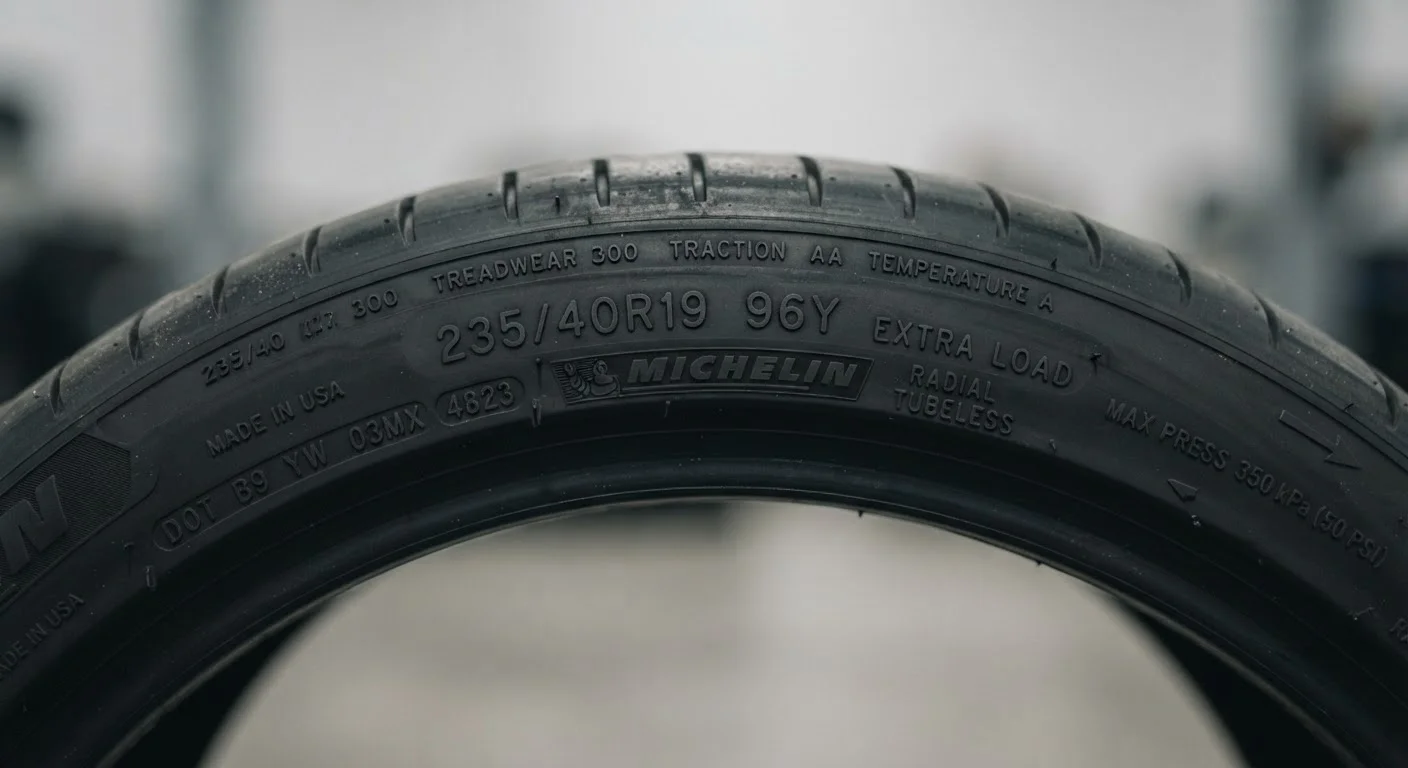
Pick any tire on your vehicle and you'll find a string like P215/65R16 98H molded into the sidewall. Each segment carries precise engineering information - once you know the code, you can verify that a replacement tire matches your vehicle's specifications.
PSI
Pounds per square inch - the unit used to measure tire inflation pressure in the United States. The correct PSI for your vehicle is listed on the door jamb sticker, not on the tire itself.
Aspect Ratio
The tire's sidewall height expressed as a percentage of its section width. A lower aspect ratio means a shorter, stiffer sidewall and typically sharper handling response.
Load Index
A two- or three-digit code that corresponds to the maximum weight a tire can safely support when properly inflated. Always match or exceed the vehicle manufacturer's specified load index when replacing tires.
Speed Rating
A letter code indicating the maximum sustained speed a tire is engineered to handle under its rated load. It also reflects heat tolerance and handling design - do not fit a lower rating than your vehicle requires.
TPMS
Tire Pressure Monitoring System - an electronic sensor system required on all new US passenger vehicles since 2008 that alerts the driver when tire pressure drops about 25% below the recommended level.
Tread Wear Indicator
Small raised bars molded into the tread grooves of a tire at the 2/32-inch depth mark. When the tread surface is level with these bars, the tire has reached its legal minimum depth and must be replaced.
OEM Specification
Original Equipment Manufacturer specification - the tire size, load index, speed rating, and pressure recommended by the vehicle's manufacturer. Deviating from OEM specs can affect safety, handling, and warranty coverage.
- P (or LT)
- The service type prefix. P stands for passenger vehicle; LT denotes light truck. Some tires omit the prefix entirely, indicating a metric "Euro-metric" tire with slightly different load standards.
- 215
- Section width in millimeters - the distance across the widest point of the tire from sidewall to sidewall.
- 65
- Aspect ratio: the sidewall height expressed as a percentage of the section width. A 65 means the sidewall is 65% of 215 mm tall. Lower numbers mean a shorter, stiffer sidewall - common on performance tires.
- R
- Construction type. R means radial, the nearly universal standard for modern passenger tires.
- 16
- Rim diameter in inches. This must match your wheel exactly.
- 98H
- The service description: 98 is the load index and H is the speed rating - both covered below.
If you need to cross-reference these specs against your vehicle's full maintenance intervals, the maintenance schedule guide explains how to read your owner's manual alongside tire recommendations.
Tire Pressure: PSI, TPMS, and the Numbers That Matter
Tire pressure is measured in PSI (pounds per square inch). Two pressure figures appear in your automotive life, and confusing them is a common mistake:
- Recommended pressure - printed on the driver's door jamb sticker or in your owner's manual. This is the correct inflation target for your vehicle, typically 32-36 PSI for most passenger cars.
- Maximum pressure - molded on the tire sidewall itself. This is the tire's structural limit, not the driving target. Never routinely inflate to this number.
| Recommended inflation source | Driver's door jamb sticker or owner's manual - not the tire sidewall |
| Typical passenger car PSI range | 32-36 PSI (cold) |
| Legal minimum tread depth (most US states) | 2/32 of an inch |
| TPMS warning threshold | ~25% below recommended PSI (US NHTSA requirement for vehicles manufactured after September 2007) |
| New all-season tire tread depth | 10/32" - 11/32" (typical) |
| Pressure increase when driving (hot tires) | 4-8 PSI above cold reading |
Always check pressure when tires are cold - meaning the vehicle has been parked for at least three hours or driven fewer than one mile at low speed. Driving heats air inside the tire, raising pressure by 4-8 PSI and skewing your reading.
TPMS (Tire Pressure Monitoring System) is federally mandated on all US passenger vehicles manufactured after September 2007. The dashboard warning light illuminates when any tire drops approximately 25% below the vehicle's recommended PSI - but that threshold is already dangerously low. Don't wait for the light; check pressure monthly and before long trips. For a full pre-trip routine, see the driver safety checklist.
Tread Depth: Reading the Wear Indicators
Tread depth is measured in 32nds of an inch. New all-season tires typically start at 10/32" to 11/32". The legal minimum in most US states is 2/32", but stopping distances deteriorate significantly before you reach that limit.
2/32"
Legal minimum tread depth in most US states
Most tire manufacturers mold wear indicator bars at exactly this depth as a built-in visual alert.
4/32"
Depth where wet-weather grip begins to decline measurably
Independent tire testing has consistently shown stopping distances increase noticeably below this threshold on wet roads.
25%
Pressure drop that triggers a TPMS dashboard warning
Per US NHTSA regulation, TPMS must alert drivers when pressure falls approximately 25% below the vehicle placard recommendation.
Tire manufacturers mold tread wear indicators - small raised bars running perpendicular to the tread grooves - into every tire at the 2/32" mark. When the surface of the tread is flush with these bars, the tire must be replaced.
A practical field check: insert a US penny into the tread groove with Lincoln's head pointing down. If you can see the top of Lincoln's head, tread depth is at or below 2/32" - replace the tire. For an earlier warning, use a quarter: if Washington's head is fully visible, you're near 4/32", where wet-weather performance begins to drop noticeably.
Uneven wear patterns tell their own story. Wear concentrated on the center suggests chronic overinflation; wear on both outer edges points to persistent underinflation; one-sided shoulder wear often indicates misalignment. A qualified mechanic can diagnose the root cause and correct it before the underlying problem damages the new tires.
Load Index and Speed Rating: Safety Limits You Shouldn't Ignore
The two-digit or three-digit load index following the rim size corresponds to a standardized maximum load capacity per tire. For example, a load index of 98 equals 1,653 lbs per tire. Replacing tires with a lower load index than specified is unsafe and can void your vehicle warranty - always match or exceed the OEM (original equipment manufacturer) rating.
The speed rating - a single letter - indicates the maximum sustained speed the tire is designed to handle under its rated load. Common ratings include:
| Symbol | Max Speed | Typical Use |
|---|---|---|
| S | 112 mph | Family sedans, minivans |
| T | 118 mph | Light trucks, family cars |
| H | 130 mph | Sport sedans, coupes |
| V | 149 mph | Performance vehicles |
| W | 168 mph | High-performance sports cars |
Speed ratings also reflect heat tolerance and handling characteristics. Fitting a lower speed-rated tire than specified reduces margin for emergency maneuvers, even if you never exceed that speed. Check your door jamb placard or owner's manual for the minimum acceptable rating, and discuss any substitution with a qualified tire professional.
Just as road signage follows a standardized system designed to communicate critical information at a glance - as covered in road signs every US driver should know - tire markings follow a globally standardized system. Learning them once pays off every time you shop for replacements or rotate your tires.