

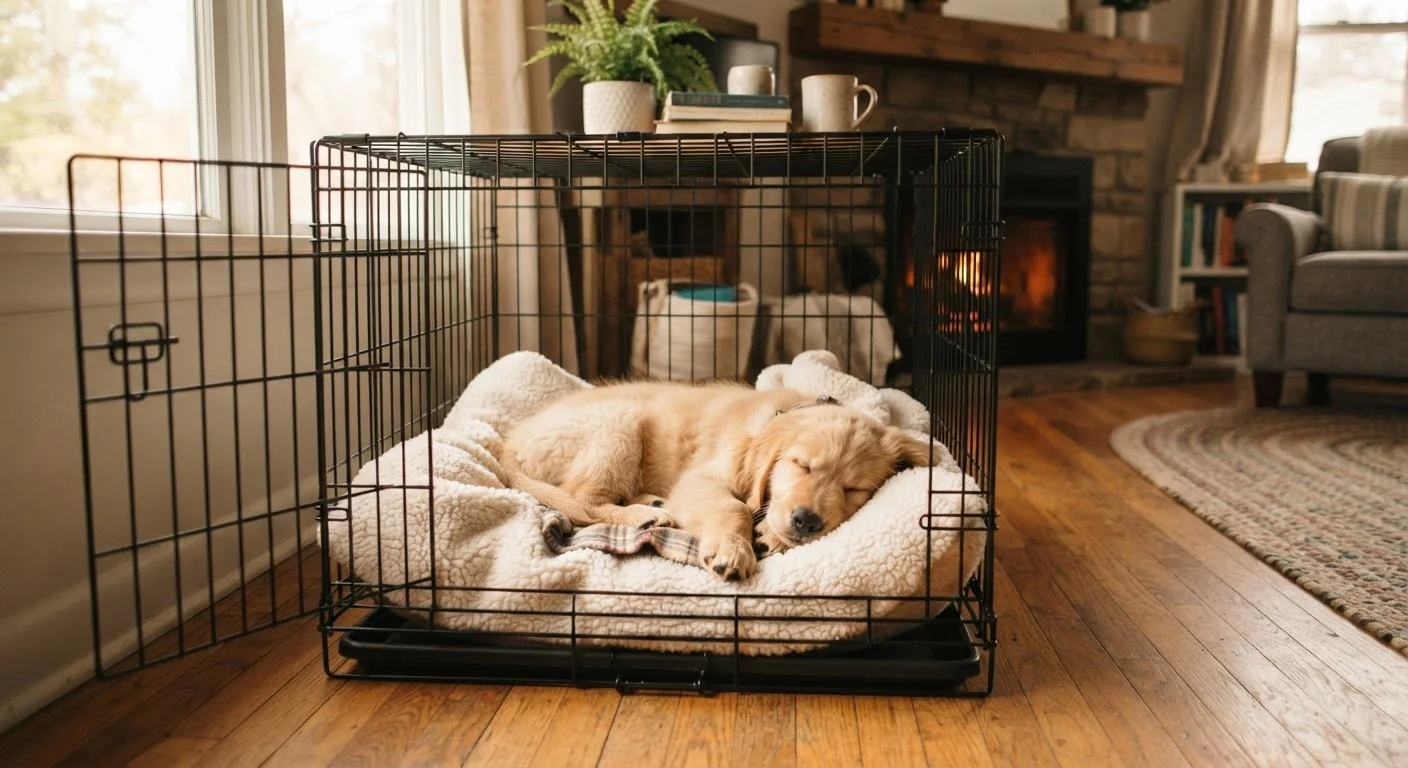
Key Takeaways
- A crate should always be introduced gradually as a positive, voluntary space — never as punishment.
- Crate size matters: too large and it loses its den-like security; too small and it causes stress.
- Puppies under six months cannot hold their bladder for more than a few hours — plan accordingly.
- Prolonged daily crating without adequate exercise and interaction can cause behavioral problems.
- Most dogs can eventually transition to unsupervised freedom once reliably house-trained and calm.
What Crate Training Actually Is — and Isn't
Crate training is the process of teaching a dog to view a crate — a wire, plastic, or fabric enclosure — as a safe, comfortable personal space. Done correctly, it leverages a dog's natural denning instincts: dogs in the wild seek out small, enclosed spaces for rest and security. A properly introduced crate becomes a resource, not a restriction.
What crate training is not is a babysitting shortcut or a disciplinary tool. Using the crate as punishment poisons the association, making the dog anxious rather than settled. The distinction matters enormously — the same enclosure can be a sanctuary or a source of chronic stress depending entirely on how it is introduced. This approach aligns with the evidence-based principles outlined in our guide to positive reinforcement in pet training, which explains why reward-based methods produce more durable behavior changes than aversion-based ones.
The Crate Must Never Be Used as Punishment
Sending a dog to the crate in anger or as a consequence for bad behavior creates a negative emotional association that can take weeks or months to reverse — and in some dogs, it never fully resolves. The crate should predict only neutral or positive events. If you need to manage a dog temporarily after a household incident, calmly redirect them rather than using the crate as a time-out.
Crate training also serves practical purposes: it aids house-training by encouraging bladder control, provides a secure space during travel, protects curious puppies from household hazards, and supports post-surgery recovery when rest is required. These benefits are genuine — but only when the dog has been taught to be comfortable in the space first.
Choosing the Right Crate
Crate selection directly affects how quickly and successfully a dog adapts. The enclosure should be large enough for the dog to stand, turn around, and lie down fully — but not so spacious that a puppy treats one corner as a bathroom. For growing puppies, look for crates that include a divider panel so you can expand the usable space incrementally as the dog grows.
Wire crates offer good ventilation and visibility, which suits social dogs who want to observe their environment. Plastic airline-style crates feel more enclosed and den-like, which some dogs find calming. Soft-sided fabric crates are lightweight and portable but are unsuitable for dogs who chew or scratch persistently.
Make the Crate Comfortable from Day One
Add a worn item of your clothing to the crate bedding when introducing a new puppy or rescue dog. Your scent activates calming signals and helps the dog associate the space with your presence. A durable chew or stuffed food-dispensing toy can also help occupy the dog during the initial closed-door sessions.
Placement matters as much as design. Position the crate in a low-traffic but not isolated area — near the family's main living space during the day, and close to the bedroom at night, especially for puppies. Dogs are social animals; complete isolation amplifies anxiety. For a broader overview of setting up your training environment, see our pre-training preparation checklist.
The Step-by-Step Introduction Process
Rushing this phase is the single most common reason crate training fails. The goal is to build a genuinely positive association before the door is ever closed.
- Open-door exploration: Place the crate in the room with the door open and let the dog investigate at their own pace. Drop high-value treats near, then just inside, the crate entrance. Do not lure or push the dog in.
- Feeding near and in the crate: Move the dog's meals progressively closer to, then just inside, then fully inside the crate over several days. Keep the door open during eating initially.
- Short door closures: Once the dog enters willingly, close the door for 10–30 seconds while they eat or chew a treat, then open it calmly — before any whining begins. Gradually extend durations over days, not hours.
- Stepping away: Begin leaving the room briefly while the dog is settled in the closed crate. Build up to 30-minute absences before attempting any longer stretches.
- Overnight and absence crating: Only introduce longer crating after the dog is reliably calm for 30–60 minutes with you present. Always provide exercise and a toilet break immediately before.
The entire process may take anywhere from a few days to several weeks depending on the dog's history, temperament, and age. Dogs adopted from shelters may need additional patience if they have prior negative associations with confinement.
2–3 hrs
Max daytime crating for puppies under 16 weeks
Veterinary behaviorists generally advise that very young puppies cannot reliably hold their bladder beyond this window during waking hours.
4–6 wks
Typical time to a reliable crate association
Most dogs achieve comfortable, low-stress crating within this range when the introduction process is gradual and reward-based.
70%+
Dogs in shelters with prior confinement stress
Rescue organizations report that many surrendered dogs have had negative crate experiences, underscoring the need for a patient re-introduction approach.
Common Crate Training Pitfalls
Even well-intentioned owners make mistakes that stall or reverse progress. Recognizing these pitfalls is half the battle.
Use a unique verbal cue — such as 'go to your crate' — from the very first session, pairing it consistently with treats. This gives the dog a clear signal and makes future crating requests faster and less stressful.
Consistent cue pairing leverages classical conditioning, allowing the verbal signal itself to predict positive outcomes before the dog even enters the crate.
Feed all meals inside the crate for the first two weeks of training, with the door open. This is the single highest-value association-builder available because feeding is a daily, non-negotiable event.
Food is a primary reinforcer — pairing it with the crate repeatedly and predictably accelerates positive association faster than intermittent treat-dropping alone.
- Crating too long, too soon: Puppies under 16 weeks can typically hold their bladder for roughly two hours during the day. Expecting more leads to accidents inside the crate, which degrades the den association and complicates house-training.
- Releasing the dog during protest: If you open the crate door when a dog whines, you immediately reward the whining. Wait for a brief pause in vocalization before opening — even a few seconds of quiet is enough to reinforce.
- Insufficient exercise beforehand: A dog with excess physical energy cannot settle. A crating session that follows a proper walk or play session is far more likely to succeed than one that doesn't.
- Using the crate as punishment: Sending a dog to the crate when scolding them teaches that the crate predicts negative experiences. This is one of the most damaging mistakes and the hardest to undo.
- Abandoning training after one bad session: Regression is normal, especially during developmental stages or after environmental changes. Consistency over weeks matters more than any single session.
For new owners navigating these challenges alongside other early training priorities, our comprehensive day-one dog training guide provides helpful context on realistic timelines and expectations.
Never Crate a Dog for Eight-Plus Hours Daily
Consistently crating an adult dog for the duration of a full workday — without a midday break — causes physical discomfort, house-training failure, and can contribute to anxiety and depression. If your schedule requires long daily absences, arrange for a dog walker, neighbor check-in, or doggy daycare. Chronic over-crating is a welfare concern, not merely a training setback.
Long-Term Crate Use and Knowing When to Phase It Out
For many dogs, the crate becomes a permanent, voluntarily used retreat — their chosen spot for napping even when the door is always open. This is a healthy outcome. There is no developmental stage at which a dog must stop using a crate if they find it comfortable.
However, crating as a management tool for absences can gradually be phased out once the dog demonstrates three things consistently: reliable house-training, no destructive behavior when briefly unsupervised, and the ability to settle calmly without the crate door closed. This transition is best done incrementally — starting with short absences in a single room before progressing to full house access.
It is worth noting that adult dogs with separation anxiety may need a structured behavior modification program rather than simply a crate — confinement alone does not treat the underlying anxiety. Consult a veterinarian or a certified applied animal behaviorist if your dog displays signs of distress beyond normal initial adjustment.
This article is for general informational and educational purposes only. It is not a substitute for professional veterinary or animal behavior advice. If your dog displays significant behavioral concerns, consult a licensed veterinarian or certified applied animal behaviorist.