

Key Takeaways
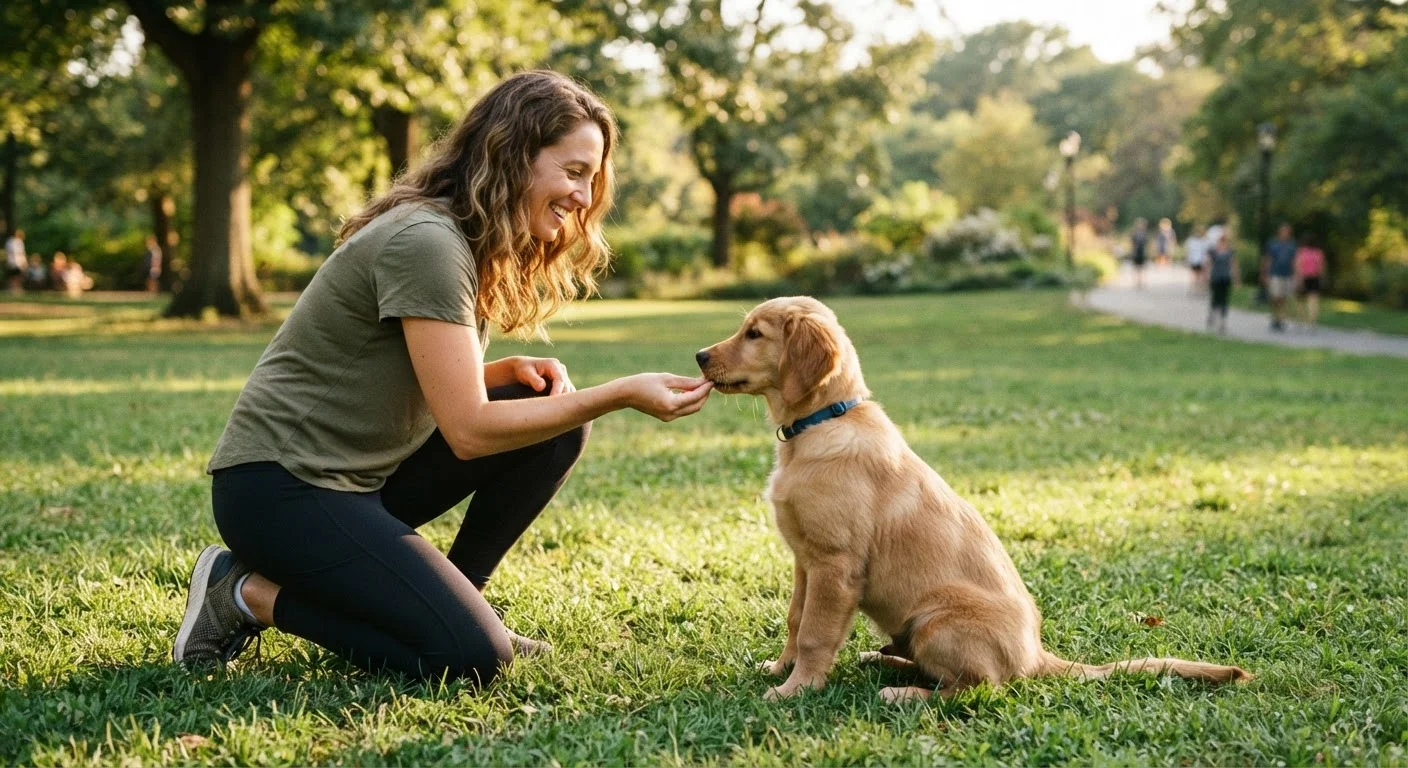
- Training begins from the first moment your dog enters your home — every interaction teaches something.
- Positive reinforcement is the most evidence-supported training method for companion dogs.
- Short, consistent sessions of 5–10 minutes are more effective than occasional long ones.
- Sit, stay, come, leave it, and loose-leash walking are the five foundational skills to prioritize.
- Punishment-based methods can undermine trust and increase anxiety or aggression in dogs.
- A certified professional trainer is the right resource when behavior problems persist or escalate.
Start here
Why Training Starts the Moment Your Dog Comes Home
Build your foundation
Core Principles: How Dogs Actually Learn
Take action
The First Skills to Teach — and in What Order
Choose your tools
Tools, Rewards, and What to Avoid
Set expectations
Realistic Timelines and Managing Expectations
Know your limits
When to Seek Professional Help
Why Training Starts the Moment Your Dog Comes Home
Many new owners assume training begins once they've settled in — maybe next week, once the dog adjusts. In reality, your dog starts learning from minute one. The rules you enforce (or don't) on day one become expectations your dog internalizes. Allowing a puppy to jump up for greetings is teaching that jumping works. Feeding from the table once is teaching that persistence pays off.
This isn't cause for anxiety — it's an opportunity. Consistency early on makes every skill easier to build later. Before your first dedicated session, review the preparation checklist for new owners to set up your space and reward system in advance. Pair training progress with a solid health foundation by following your new pet's first 30-day veterinary roadmap.
Core Principles: How Dogs Actually Learn
Dogs learn primarily through operant conditioning — the association between a behavior and its consequence. When a behavior produces something the dog wants, it becomes more likely. When it produces nothing or something unpleasant, it fades. Positive reinforcement training capitalizes on this by rewarding desired behaviors immediately and consistently.
Positive reinforcement
Adding something the dog values (like a treat or praise) immediately after a desired behavior to make that behavior more likely to happen again.
Operant conditioning
A learning process in which behaviors are shaped by their consequences — behaviors that are rewarded tend to increase, while those that produce no result tend to decrease.
Marker signal
A short, distinct sound (a click or a word like 'yes') used to precisely mark the exact moment a dog performs a correct behavior, before the reward is delivered.
Socialization
The process of gradually and positively exposing a young dog to a wide variety of people, animals, sounds, and environments so they develop confidence and adaptability.
Generalization
A dog's ability to perform a learned behavior reliably across different locations, distractions, and contexts — not just where it was originally trained.
Timing is everything. A reward delivered within one to two seconds of the target behavior clearly communicates what earned the reward. Delayed rewards create confusion. This is why many trainers use a marker signal — a short, distinct sound (like a clicker or a verbal "yes") — to precisely mark the moment of correct behavior before delivering the treat.
Socialization is also a form of training. Carefully exposing your dog to new people, environments, sounds, and animals during the early critical window (roughly 3–14 weeks for puppies) shapes how they respond to novelty for life.
The First Skills to Teach — and in What Order
Prioritize these five foundational behaviors before anything else:
- Sit — The entry point for most training. Teaches your dog that stillness and attention are rewarding.
- Stay — Builds impulse control. Start with one second and build duration gradually.
- Come (recall) — The most safety-critical skill your dog will learn. Always make coming to you rewarding — never call your dog to scold it.
- Leave it — Teaches your dog to disengage from objects or animals on cue. Invaluable for safety on walks.
- Loose-leash walking — A comfortable walk where the leash stays slack. This takes consistent practice but dramatically improves daily life.
End Every Session on a Win
Before wrapping up a training session, ask your dog to do something it knows well and reward it enthusiastically. This ends the session on a positive note and keeps your dog eager for the next one. Five successful repetitions of 'sit' at the end of a tough session is still a win.
Practice each skill in low-distraction environments before adding difficulty. A dog that sits reliably in your kitchen may need retraining in the park — that's normal, not regression. Build generalization intentionally by practicing in new locations.
Tools, Rewards, and What to Avoid
Effective training requires minimal equipment. A standard flat collar or front-clip harness, a 4–6 foot leash, small high-value treats, and a marker signal are sufficient for most foundational work. Treats should be pea-sized — you'll be giving many repetitions per session.
Avoid Punishment-Based Techniques
Physical corrections, harsh verbal reprimands, and aversive tools can suppress behavior in the short term but frequently cause fear, anxiety, and damaged trust between dog and owner. Current veterinary and behavioral science consensus strongly favors reward-based methods. If you're unsure whether a technique is appropriate, consult a certified professional before using it.
Reward value matters. Use your dog's kibble for easy tasks in low-distraction settings, and reserve higher-value rewards like small pieces of chicken or cheese for challenging scenarios or new environments. Understanding what motivates your specific dog gives you flexibility across contexts.
Avoid choke chains, prong collars, and electronic shock collars. A substantial body of veterinary and behavioral science literature links these aversive tools to increased stress, fear, and in some cases aggression — outcomes that undermine the trust training is meant to build. Most professional organizations in companion animal behavior recommend against their use.
Realistic Timelines and Managing Expectations
New owners commonly expect a trained dog within weeks. More accurate: basic cue recognition can develop in days with consistent repetition, but reliable behavior under real-world distractions takes months. Housetraining typically takes 4–6 months for puppies, though individual dogs vary significantly.
Progress is rarely linear. Dogs have off days. A behavior that seemed solid may temporarily fall apart — this is a normal part of learning, not failure. What matters is the trend across weeks, not performance in a single session.
Nutrition plays a quiet but real role: a well-fed, physically comfortable dog learns more readily. If you haven't yet established a feeding routine, the first-time pet feeding guide is a useful companion resource.
When to Seek Professional Help
Most owners can successfully teach foundation behaviors on their own with patience and consistency. But some situations warrant professional input early:
- Any signs of aggression toward people or other animals
- Extreme fear responses that don't improve with gradual exposure
- Separation distress that causes destructive behavior or self-injury
- Resource guarding of food, toys, or spaces
- Lack of meaningful progress after 4–6 weeks of consistent, structured effort
When seeking a trainer, look for credentials from recognized bodies such as the Certification Council for Professional Dog Trainers (CCPDT) or the International Association of Animal Behavior Consultants (IAABC). Ask specifically about their methodology — trainers who rely primarily on positive reinforcement are aligned with current behavioral science consensus.
For complex behavioral issues, a veterinary behaviorist (a veterinarian with board certification in animal behavior) may be the appropriate specialist. Your primary veterinarian can provide a referral. See the broader pet health and care hub for guidance on building your full support team.