

Key Takeaways
- Wet food contains roughly 70–80% moisture, significantly aiding daily hydration compared to kibble's 10%.
- Dry kibble is more calorie-dense per ounce, making portion control and weight management more critical.
- Wet food generally costs more per caloric serving but may support kidney and urinary health in cats.
- Both formats can be nutritionally complete; look for an AAFCO nutritional adequacy statement on the label.
- Many veterinarians support mixed feeding strategies tailored to an individual pet's health status and life stage.
- Neither format is universally superior — the right choice depends on your pet's age, health, and preferences.
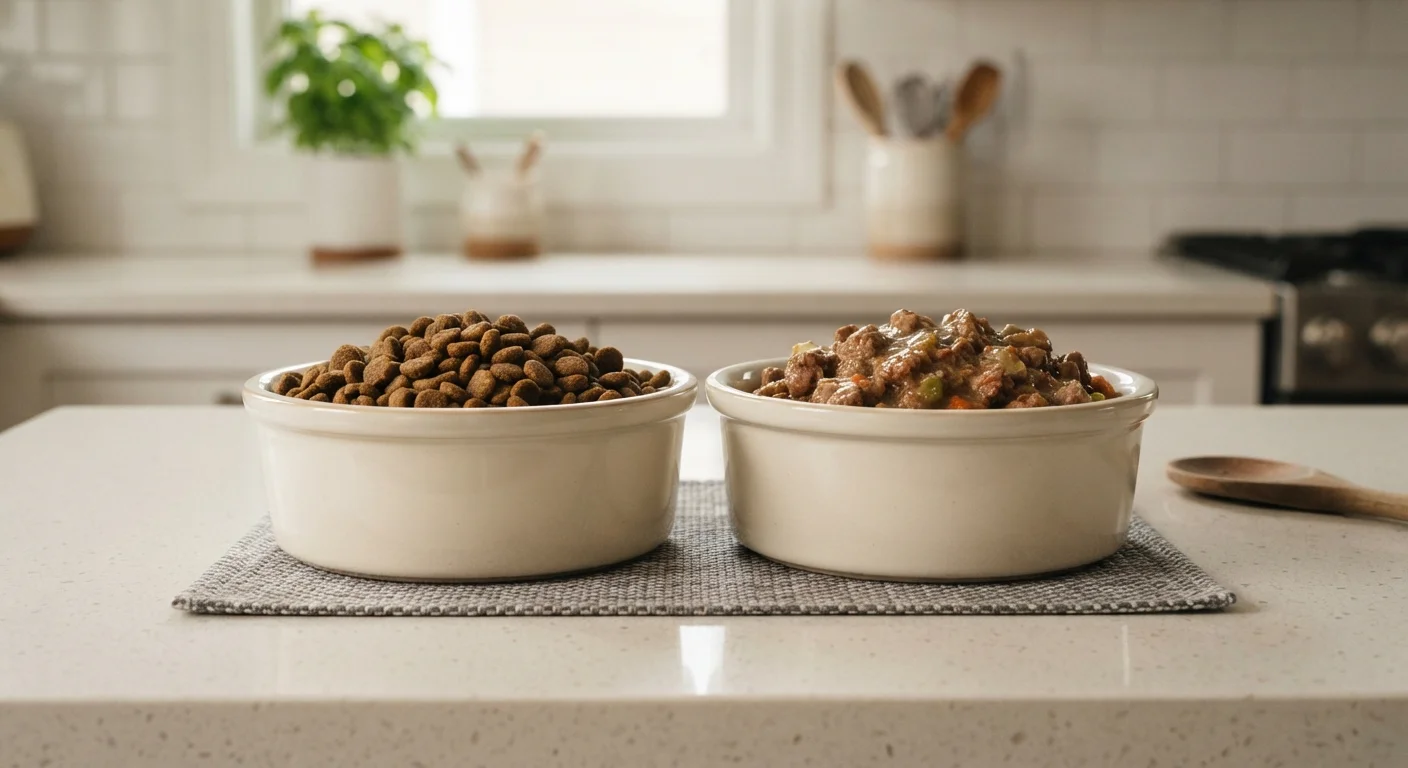
Option A
Dry Kibble
The convenient, calorie-dense everyday staple.
Best for: Owners seeking an affordable, shelf-stable option for healthy adult pets without special hydration or dental concerns.
Option B
Wet Food
The moisture-rich, palatable option for targeted needs.
Best for: Pets requiring extra hydration, seniors with reduced appetite, or animals with urinary tract sensitivities.
If your cat is prone to urinary tract issues or chronic dehydration
Wet Food
The high moisture content in wet food meaningfully increases daily fluid intake, which can help dilute urine and reduce the risk of crystal formation in cats.
If you're managing a pet's weight on a tight schedule
Dry Kibble
Kibble is easy to measure accurately, stays fresh in a bowl longer, and is often available in lower-calorie formulations suited to weight management.
If you have a senior or recovering pet with reduced appetite
Wet Food
Wet food's stronger aroma and softer texture tend to be more palatable and easier to eat for older pets or those with dental pain or illness.
If cost-efficiency and storage convenience are top priorities
Dry Kibble
Kibble offers a lower cost per calorie and can be stored at room temperature for extended periods without spoiling after opening.
If your pet has complex nutritional needs across life stages
Wet Food
Wet formulas often feature higher protein content and fewer carbohydrate fillers, which aligns well with the nutrient-dense needs of growing or geriatric pets.
Moisture Content: The Most Immediate Difference
The single starkest contrast between dry kibble and wet food is water content. Standard dry kibble contains roughly 6–10% moisture, while canned or pouched wet food typically delivers 70–80% moisture. That gap has real physiological implications, especially for cats, who evolved as desert predators with a naturally low thirst drive and tend to obtain most of their hydration through food rather than a water bowl.
For dogs, whose thirst regulation is more robust, the hydration advantage of wet food matters less in most healthy adults — though it remains beneficial for pets managing kidney disease, lower urinary tract conditions, or chronic constipation. Veterinary nutritionists frequently recommend wet food or a mixed diet for cats with feline idiopathic cystitis or early chronic kidney disease precisely because passive hydration through meals is more reliable than expecting the animal to drink enough independently.
Check the AAFCO Statement First
Regardless of format, every commercially prepared pet food should display an AAFCO (Association of American Feed Control Officials) nutritional adequacy statement. This confirms the food meets established nutrient profiles for a specific life stage — such as growth, maintenance, or all life stages. A food labeled 'for intermittent or supplemental feeding only' is not a complete diet and should not be used as a primary food source without veterinary guidance.
It's worth noting that moisture alone doesn't determine overall diet quality. A high-moisture food can still be nutritionally imbalanced. Always verify that any food — wet or dry — carries an AAFCO nutritional adequacy statement appropriate for your pet's life stage.
Calories, Protein, and Macronutrient Density
Because wet food is largely water, it is far less calorie-dense per ounce than kibble. A single ounce of dry kibble may deliver 90–110 kilocalories, whereas the same weight of wet food often provides just 20–30 kilocalories. This means pets eating wet food must consume a larger volume to meet their energy needs — which can actually work in favor of satiety for pets prone to obesity.
On a dry-matter basis (stripping out moisture to compare nutrients directly), the macronutrient profiles of kibble and wet food become more similar, though wet foods still tend to be higher in animal protein and lower in carbohydrates. Many dry kibbles rely on starchy binders — such as corn, rice, or potato — to hold their shape during extrusion, which raises the overall carbohydrate load. This is a relevant consideration for obligate carnivores like cats, who have a limited metabolic capacity to process high dietary carbohydrate. For context on how these needs shift over a pet's lifetime, see our guide to pet nutrition across life stages.
70–80%
Moisture in typical wet pet food
Compared to roughly 6–10% in dry kibble, this difference has a measurable impact on daily fluid intake for cats and dogs.
3–4×
More calories per ounce in dry kibble
On a per-ounce basis, kibble is substantially more energy-dense than wet food, making accurate portion measurement especially important.
~50%
Estimated carbohydrate content in some dry kibbles
Many extruded dry foods contain significant starch from binding ingredients, higher than most wet formulations on a dry-matter basis.
Cost, Convenience, and Practical Feeding Realities
Dry kibble wins on both cost and convenience for most households. A pound of kibble typically delivers significantly more calories per dollar than an equivalent weight of canned food, and an open bag remains shelf-stable for weeks when stored properly in a cool, dry location. Wet food, once opened, must be refrigerated and used within 24–48 hours, adding a logistical layer that matters in multi-pet or busy households.
That said, wet food's palatability advantage is not trivial. Picky eaters, cats with dental pain, and pets recovering from illness or surgery often accept wet food when they refuse kibble entirely. Some owners address both cost and palatability by mixing a small amount of wet food into dry kibble — a strategy that can improve hydration and meal appeal without dramatically increasing the food budget. Before making any diet switch, our pre-switch checklist can help you plan a safe, gradual transition.
| Criterion | Dry Kibble | Wet Food |
|---|---|---|
| Moisture content | ~6–10% | ~70–80% |
| Calories per ounce | ~90–110 kcal | ~20–30 kcal |
| Carbohydrate content | Generally higher | Generally lower |
| Protein density (dry matter) | Moderate | Often higher |
| Cost per calorie | Lower | Higher |
| Shelf life after opening | Weeks (room temperature) | 24–48 hours (refrigerated) |
| Palatability for picky eaters | Moderate | Generally higher |
| Supports urinary tract health | Limited hydration benefit | Strong hydration benefit |
Which Format Suits Which Pet?
There is no single correct answer for every animal. A healthy, active adult dog eating a nutritionally complete dry kibble and drinking freely from a water bowl has no compelling medical reason to switch formats. Conversely, a middle-aged neutered male cat with a history of urinary crystals stands to benefit meaningfully from a predominantly wet diet.
If weight gain is a concern — and metabolic changes with age frequently make it one — the lower calorie density of wet food can help some pets feel full on fewer calories. Our article on why pets gain weight on the same diet explores the metabolic factors that shift caloric needs over time. For owners curious how kibble and wet food compare to less conventional options, our balanced look at raw diets offers a useful broader perspective.
This article is for general informational and educational purposes only and does not constitute veterinary or medical advice. Always consult a licensed veterinarian before making significant changes to your pet's diet, particularly if your pet has an existing health condition.