
Pet Nutrition Labels Decoded: What the Ingredients List Is Actually Telling You

| "95% Rule" threshold | Single named ingredient must be ≥95% of product weight (ex. water) (AAFCO Model Regulations) |
| "Dinner/Entrée" threshold | Named ingredient must be ≥25% of product weight (AAFCO Model Regulations) |
| "With" rule threshold | Named ingredient must be ≥3% of product weight (AAFCO Model Regulations) |
| Ingredient list order | Listed by pre-cooking (as-fed) weight, highest to lowest (AAFCO & FDA pet food labeling requirements) |
| Guaranteed analysis covers | Minimum crude protein & fat; maximum crude fiber & moisture (AAFCO Model Regulations) |
| Life stages recognized by AAFCO | Growth, adult maintenance, all life stages, supplemental/intermittent (AAFCO Official Publication) |
The Six Label Sections Every Pet Owner Should Know
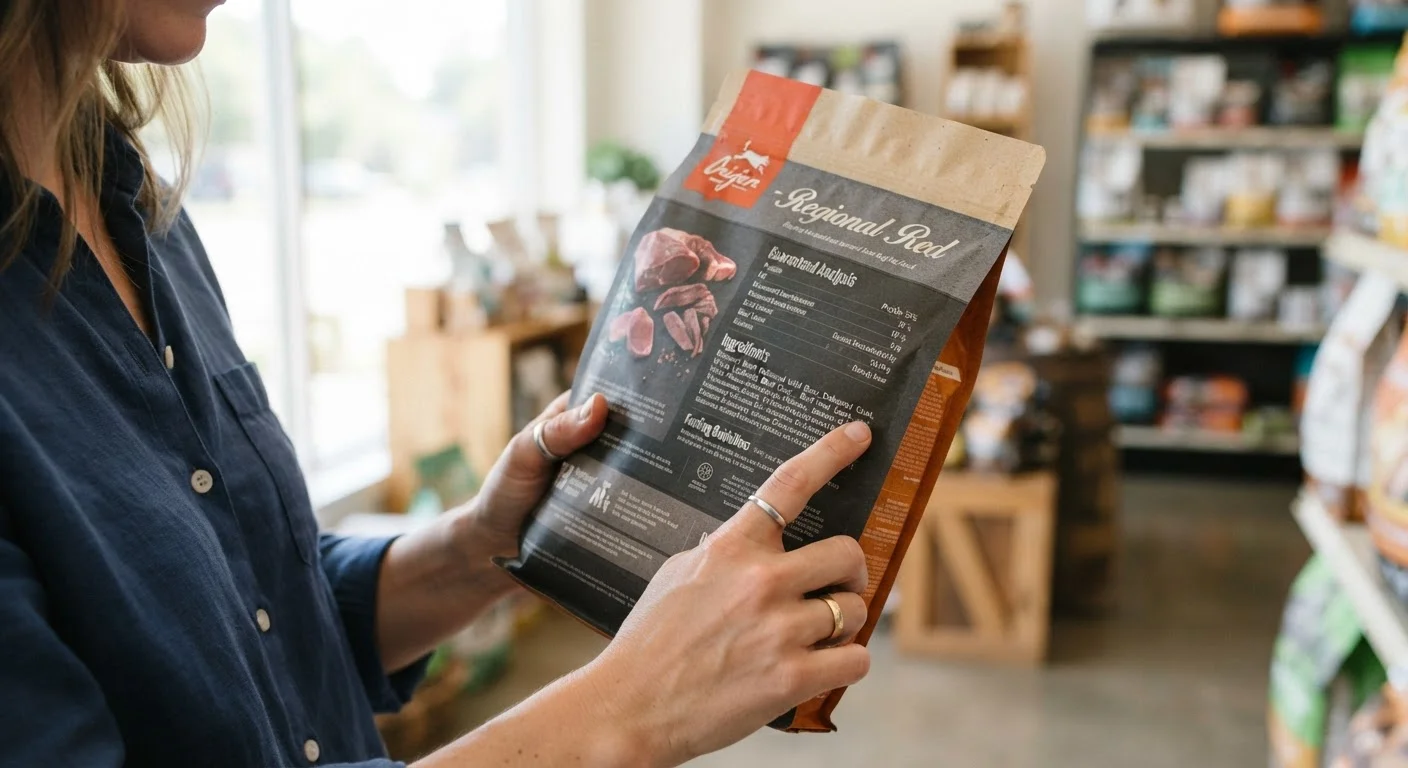
Every commercially sold pet food in the United States must display specific information governed by the AAFCO model regulations and enforced at the state level. Learning to locate and interpret these six areas turns a confusing label into a useful tool.
| "95% Rule" threshold | Single named ingredient must be ≥95% of product weight (ex. water) (AAFCO Model Regulations) |
| "Dinner/Entrée" threshold | Named ingredient must be ≥25% of product weight (AAFCO Model Regulations) |
| "With" rule threshold | Named ingredient must be ≥3% of product weight (AAFCO Model Regulations) |
| Ingredient list order | Listed by pre-cooking (as-fed) weight, highest to lowest (AAFCO & FDA pet food labeling requirements) |
| Guaranteed analysis covers | Minimum crude protein & fat; maximum crude fiber & moisture (AAFCO Model Regulations) |
| Life stages recognized by AAFCO | Growth, adult maintenance, all life stages, supplemental/intermittent (AAFCO Official Publication) |
Product name: The name itself carries regulatory weight. If a single ingredient appears in the name — say, "Salmon Cat Food" — salmon must make up at least 95% of the total product weight (excluding water). Add the word "dinner," "entrée," or "formula" and that threshold drops to 25%. The word "with" (as in "with salmon") requires only 3%. "Flavor" requires only a detectable amount. These naming rules are not marketing conventions — they are AAFCO-defined standards.
Net weight and manufacturer information must appear on the principal display panel and help you compare cost per ounce across products.
For a broader look at nutritional labeling conventions shared with human food, see how nutrition labels work for human foods.
Decoding the Ingredients List
Ingredients are listed in descending order by pre-cooking weight — a regulatory requirement. This means water-heavy ingredients like fresh chicken or beef will appear high on the list even when their contribution of protein after moisture is removed is more modest. This is sometimes called ingredient splitting when manufacturers separate a single ingredient (e.g., chicken meal, chicken by-product meal) to shift it lower on the list.
Crude protein
A measure of total nitrogen-containing compounds in pet food, estimated via a standard laboratory method. It reflects quantity, not the digestibility or quality of protein sources.
Dry matter basis
A method of comparing nutrient content across foods with different moisture levels by mathematically removing all water from the calculation. Essential for comparing wet and dry foods accurately.
Ingredient splitting
The practice of listing a single ingredient in multiple forms (e.g., ground corn, corn gluten meal, corn flour) so each appears separately and lower on the list than if combined.
AAFCO nutritional adequacy statement
A required label declaration indicating whether a pet food is complete and balanced for a specific life stage, based on either feeding trials or formulation to established nutrient profiles.
Named meal (e.g., chicken meal)
A rendered, moisture-removed concentrate of a specifically identified animal species. Named meals are more traceable than generic terms like "poultry meal" and are a concentrated protein source.
By-products
Non-muscle-tissue animal parts such as organs, bone, and blood used in pet food. Nutritional value varies by type; organ meats like liver are nutrient-dense and not inherently inferior.
Named protein sources matter. "Chicken meal" identifies the species; "poultry meal" does not. Specific named meals are considered more traceable and consistent by most veterinary nutritionists, though both can be nutritionally adequate. By-products — organs, bone, and other non-muscle tissue — are not inherently low-quality; liver, for instance, is nutrient-dense. The concern is traceability and consistency rather than automatic inferiority.
Ingredients you may not recognize — like mixed tocopherols (a natural form of vitamin E used as a preservative) or choline chloride (an essential B vitamin) — are often beneficial. Long ingredient lists do not necessarily indicate a poorer diet. For a deeper look at marketing language versus regulatory definitions, see the truth behind popular pet food claims.
Guaranteed Analysis and the AAFCO Nutritional Adequacy Statement
The guaranteed analysis panel lists minimum percentages of crude protein and crude fat, and maximum percentages of crude fiber and moisture. "Crude" refers to the chemical method used to measure each nutrient — not quality. These are guarantees of the floor or ceiling, not averages.
~36%
Dry matter protein in a typical wet food at 8% as-fed
Illustrates why moisture must be factored out before comparing wet and dry pet foods on protein content.
3%
Minimum ingredient amount required for "with" claims
Per AAFCO model regulations governing pet food product naming conventions.
95%
Ingredient threshold for single-protein named products
Per AAFCO model regulations; applies to the named ingredient excluding added water.
To compare a wet food with a dry food meaningfully, you need to convert both to a dry matter basis — removing the water content mathematically. A wet food showing 8% protein at 78% moisture actually contains roughly 36% protein on a dry matter basis, which may be higher than a dry kibble showing 26% protein at 10% moisture (~29% dry matter). Your veterinarian or a board-certified veterinary nutritionist can help you interpret these figures for your pet's specific needs.
The AAFCO nutritional adequacy statement is arguably the most important line on the label. It tells you whether the food is complete and balanced for a specific life stage (growth, adult maintenance, all life stages, or senior/supplemental use). Foods labeled "for supplemental or intermittent feeding" are not intended as sole nutrition sources. Adequacy can be established either through feeding trials or by formulation to meet AAFCO nutrient profiles — both are valid, though feeding trials provide additional real-world data. Learn how AAFCO standards are set and what their limitations are.
This article provides general educational information about pet food labeling and is not a substitute for guidance from a licensed veterinarian or board-certified veterinary nutritionist regarding your specific pet's dietary needs.