
Envelope Budgeting vs. Digital Tracking: Which Approach Builds Better Habits?

Key Takeaways
- Envelope budgeting uses physical cash to create a hard spending limit that is impossible to accidentally exceed.
- Digital tracking tools aggregate transactions automatically, reducing manual effort and surfacing spending patterns over time.
- Research suggests cash payments can feel more psychologically 'painful,' which may reduce impulse purchases.
- Digital tools struggle to change behaviour on their own — consistent review habits determine their effectiveness.
- A hybrid approach — cash envelopes for problem categories, digital tools for the big picture — works for many households.
- Neither method guarantees results; the system you actually use consistently outperforms the one that sounds better in theory.
Option A
Envelope Budgeting
The tactile, friction-based approach to spending control.
Best for: People who overspend digitally and benefit from the physical reality of handling cash.
Option B
Digital Expense Tracking
The automated, data-rich method for modern spenders.
Best for: People comfortable with technology who want real-time visibility across all accounts without handling cash.
If you regularly overspend on discretionary categories like dining or entertainment
Envelope Budgeting
Physical cash limits make overspending structurally impossible. When the envelope is empty, spending stops — no willpower required.
If most of your spending is digital and you want effortless record-keeping
Digital Expense Tracking
Automatic transaction syncing removes manual data entry, letting you monitor dozens of categories across multiple accounts in one place.
If you share finances with a partner and need a shared system
Digital Expense Tracking
Shared app access gives both partners real-time visibility without coordinating physical cash, reducing friction in joint budgeting.
If you are new to budgeting and want to build foundational spending awareness
Envelope Budgeting
The hands-on process of allocating cash forces deliberate category-by-category planning that builds strong budgeting instincts from the start.
If you travel frequently or live in a cashless environment
Digital Expense Tracking
Many transactions — flights, subscriptions, online purchases — don't support cash, making digital tracking the only practical full-picture option.
How Each Method Actually Works
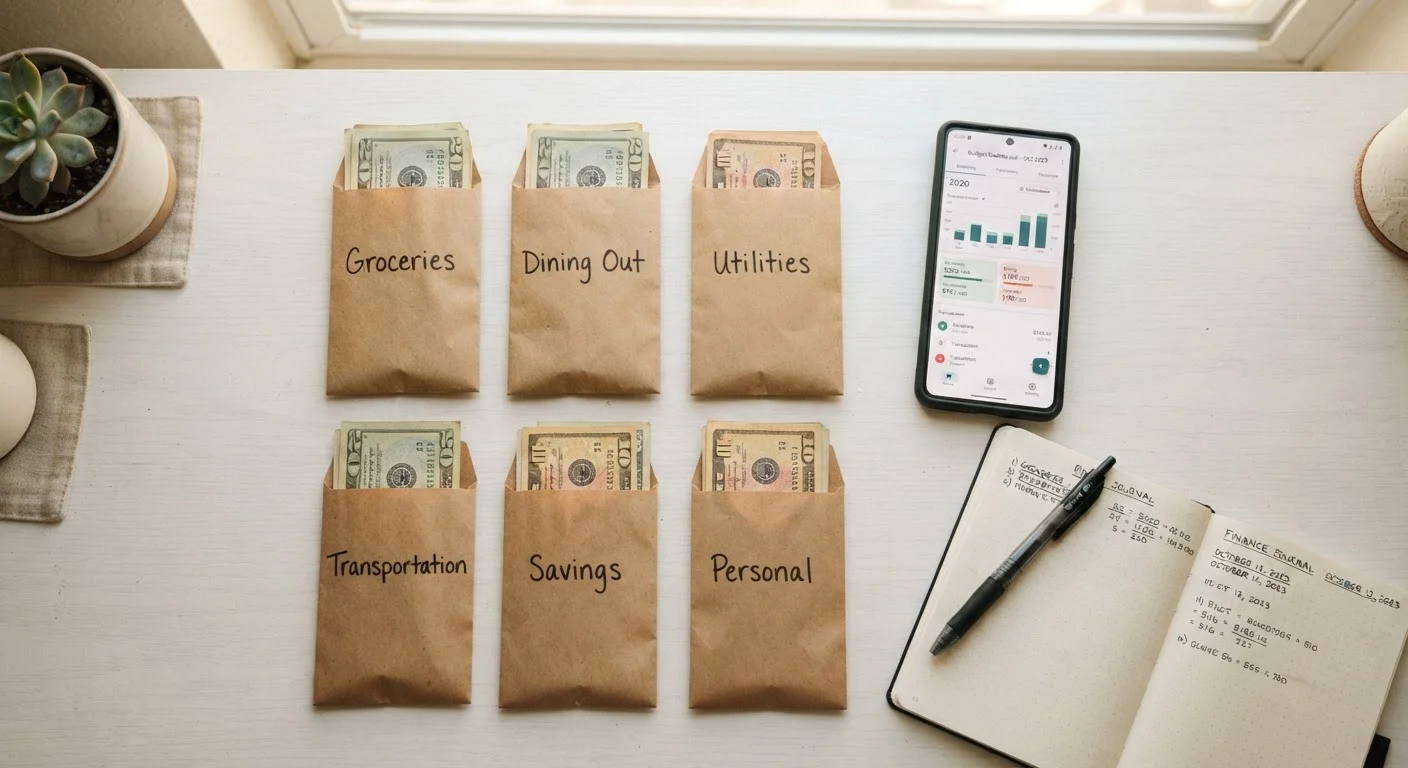
Envelope budgeting is straightforward: at the start of each pay period, you withdraw cash and physically divide it into labeled envelopes — one for groceries, one for gas, one for dining out, and so on. Each envelope holds exactly what you've budgeted for that category. When a category's cash runs out, that spending stops for the period. No transfers, no exceptions.
Digital expense tracking works differently. You connect bank accounts and credit cards to a budgeting app or spreadsheet, and transactions are imported — often automatically — into spending categories. You can see in real time how much you've spent and how much remains across every category. The method requires little cash handling but does require consistent check-ins to be useful.
Both methods are compatible with structured frameworks like zero-based budgeting, where every dollar of income is assigned a specific job before the month begins. The envelope system is, in many ways, a physical implementation of zero-based logic.
| Criterion | Envelope Budgeting | Digital Expense Tracking |
|---|---|---|
| Spending control mechanism | Hard stop — cash physically runs out | Soft alerts — requires self-enforcement |
| Setup effort | Withdraw and sort cash each pay period | Connect accounts; configure categories once |
| Works for online/card spending | No — cash only by design | Yes — all transaction types supported |
| Behavioural friction (spending brake) | High — intentional by design | Low — frictionless by design |
| Historical data and trends | Limited — manual tracking required | Strong — months of data at a glance |
| Shared household use | Requires coordination and communication | Easy — shared app access available |
| Best suited for | Discretionary overspenders, beginners | Digital-first lifestyles, multi-account households |
The Psychology Behind Each Approach
The strongest argument for envelope budgeting is behavioural, not logistical. Studies in consumer psychology — including research published by MIT and the University of Toronto — have found that paying with cash tends to feel more emotionally significant than swiping a card, a phenomenon sometimes called the "pain of paying." That friction can meaningfully reduce discretionary overspending.
Digital tracking, by contrast, is low-friction by design. That's its appeal — but it also means there's no built-in mechanism that prevents overspending. Awareness of a problem and changing behaviour in response to that awareness are two different things. The data is only as useful as the habit of reviewing and acting on it.
~18%
Reduction in discretionary spending with cash
Consumer behaviour research has consistently found that cash payments are associated with lower spending amounts compared to card payments, partly due to the tangible nature of parting with physical money.
74%
Americans who say they overspend at least occasionally
According to survey data from the National Foundation for Credit Counseling, a large majority of US adults report spending more than planned in at least one category on a regular basis.
1 in 3
Budgeters who review their budget monthly or less
Research from the FINRA Investor Education Foundation found that many Americans who report having a budget do not review it consistently, limiting its practical impact on behaviour.
If your budget needs a deeper reset rather than just better tracking, it may also be worth exploring paying yourself first versus budgeting what's left — a philosophical contrast that changes how you prioritise savings before spending decisions are made.
Practical Trade-Offs to Consider
Envelope budgeting has real-world friction. Carrying cash is inconvenient for online purchases, subscription services, and contactless payment environments. Keeping physical cash secure is also a concern, and tracking exact change across envelopes can feel tedious. For households with two income earners, coordinating shared cash envelopes adds another layer of complexity — something explored in depth in our guide on budgeting as a couple.
Digital tracking scales naturally with modern life. It handles subscriptions, card payments, and multiple accounts without any extra effort. The challenge is setup — linking accounts, assigning categories correctly, and committing to regular reviews. Without a monthly review habit, digital tracking becomes a passive log rather than an active budgeting tool. A structured end-of-month budget audit checklist can bridge that gap significantly.
You Don't Have to Choose One Forever
Budgeting methods aren't permanent commitments. Many people start with envelope budgeting to build spending awareness, then transition to digital tools once they have a clearer sense of their patterns. Others move in the opposite direction after finding that app notifications alone weren't changing their habits. Trying both for 30 days each is a reasonable way to discover which creates more consistent behaviour for you specifically.
Many people find a hybrid model most effective: using cash envelopes for two or three problem-spending categories (such as dining and entertainment) while relying on a digital tool for fixed expenses, savings goals, and overall financial visibility.
This article is for general informational purposes only and does not constitute personalised financial advice. Consult a qualified financial professional for guidance specific to your situation.