

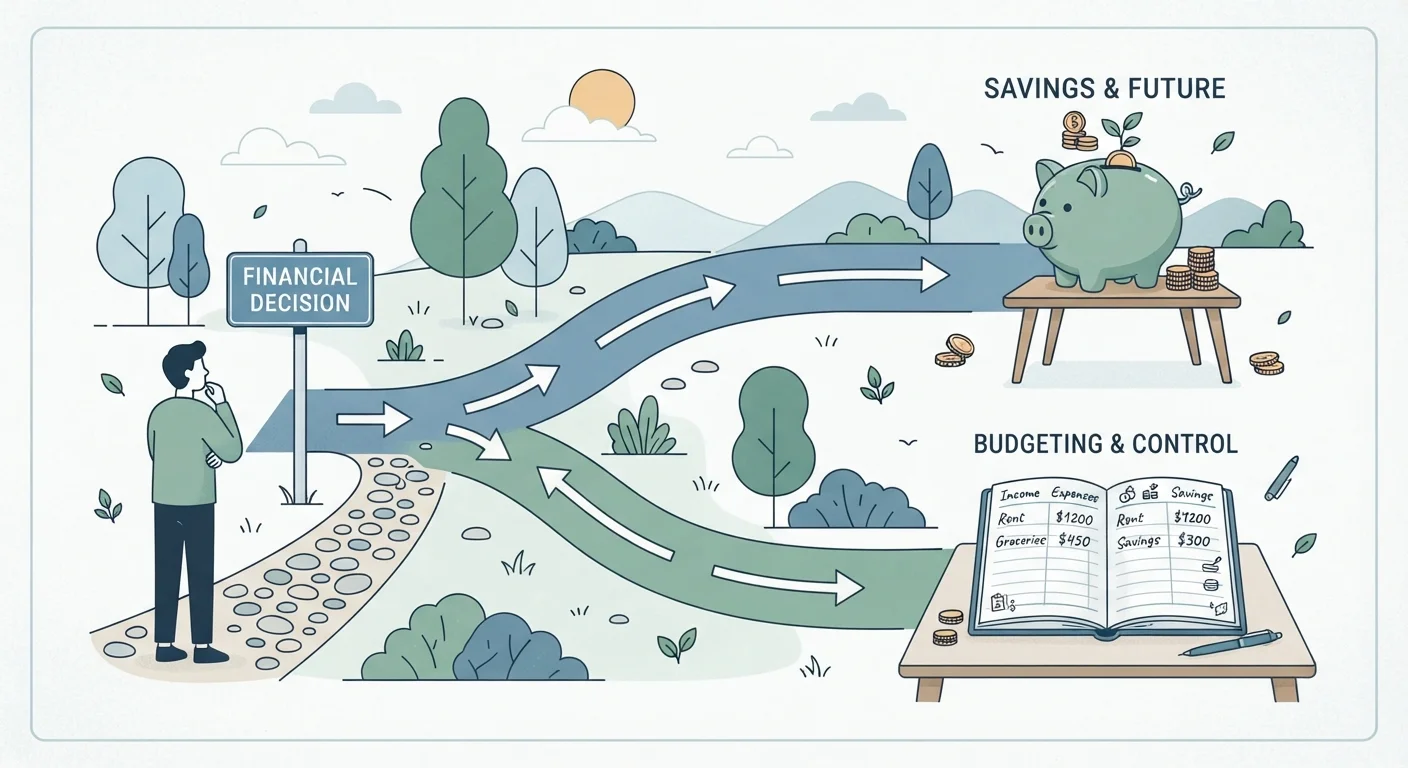
Key Takeaways
- Paying yourself first removes savings decisions from the equation by moving money before you can spend it.
- Budgeting what's left requires disciplined tracking but offers flexible, granular control over all spending.
- Automating a pay-yourself-first system eliminates reliance on willpower as the primary savings mechanism.
- Neither approach is universally superior — income stability and spending habits determine which fits better.
- Both philosophies can be combined: set a fixed savings transfer, then budget the remainder intentionally.
Option A
Paying Yourself First
The automatic, savings-priority approach.
Best for: People who struggle with leftover money disappearing before they can save it.
Option B
Budgeting What's Left
The deliberate, spend-then-save method.
Best for: Detail-oriented planners who want complete visibility into every spending category before committing to a savings amount.
If you consistently find no money left to save at month's end
Paying Yourself First
Moving savings automatically at the start of each pay cycle prevents the 'nothing left over' pattern before it starts.
If you have irregular income or highly variable expenses
Budgeting What's Left
Variable income makes fixed upfront transfers risky; mapping expenses first gives you a realistic saving target each cycle.
If you're building an emergency fund or working toward a defined goal
Paying Yourself First
A fixed, recurring transfer keeps you on a predictable timeline toward a specific savings target without constant recalculation.
If you're managing tight cash flow with several competing obligations
Budgeting What's Left
Fully accounting for expenses before committing to savings reduces the risk of overdrafts or missed bill payments.
If you want a hybrid system that balances structure and automation
Paying Yourself First
Set a modest automatic transfer at payday, then apply a structured budget — such as the 50/30/20 framework — to the remainder.
The Core Logic of Each Approach
Paying yourself first is exactly what it sounds like: before paying rent, utilities, or any discretionary expense, you redirect a defined portion of income directly into savings or an investment account. The premise is behavioral — it treats savings as a non-negotiable bill rather than what's left after life happens. Popularized through personal finance literature and reinforced by automatic transfer strategies, this method works by eliminating the decision point entirely.
Budgeting what's left reverses the sequence. You map out all expected expenses first — housing, food, transportation, debt payments — and whatever remains after that accounting is your savings pool. This approach is common among people who use structured frameworks like percentage-based budgets or zero-based budgeting, where every dollar gets assigned before the month begins.
Both approaches share the same underlying goal — consistent saving — but they differ fundamentally in what they treat as the default. One makes spending the residual; the other makes savings the residual.
Head-to-Head: Key Differences at a Glance
The practical differences between these two philosophies become clear when you examine how each handles common financial scenarios.
| Criterion | Paying Yourself First | Budgeting What's Left |
|---|---|---|
| Savings sequence | Saved before expenses | Saved after expenses |
| Automation potential | High — transfers run automatically | Lower — requires manual calculation |
| Spending visibility | Limited unless paired with tracking | High — all categories mapped explicitly |
| Willpower required | Minimal — system enforces saving | Higher — discipline needed each cycle |
| Best income type | Steady, predictable income | Variable or irregular income |
| Risk of overdraft | Possible if transfer is too large | Lower — expenses verified first |
| Flexibility | Less flexible month-to-month | More flexible, adjusts to each month |
One important nuance: paying yourself first doesn't mean ignoring expenses. It means you trust — or verify in advance — that your remaining income covers obligations. If that calculation doesn't hold, reducing the upfront savings transfer is necessary to avoid overdrafts or missed bills.
Where Paying Yourself First Has the Edge
The strongest argument for paying yourself first is psychological. Research in behavioral economics consistently shows that people adapt their spending to available funds — a concept sometimes called lifestyle creep. When savings leave your account before you see them as spendable, you naturally calibrate to what remains. This is why the approach pairs so effectively with employer-sponsored retirement plans: contributions are deducted from pay before it hits your bank account, making saving feel effortless.
~57%
Americans save less than they intend each month
Federal Reserve survey data has consistently found that a majority of US adults report saving less than planned, often because spending absorbs available income before savings occur.
401(k)
Default enrollment lifts participation dramatically
Studies cited by the CFPB and academic researchers show automatic enrollment in employer retirement plans significantly increases participation rates compared to opt-in systems, illustrating the power of pay-yourself-first defaults.
The approach also reduces decision fatigue. There's no monthly negotiation over how much to save. A fixed transfer runs automatically, and your attention shifts to managing the rest. For people who identify with the myth that they'll save once they earn more — a pattern explored in common savings misconceptions — this method removes the delay entirely. Once savings are funded, the remaining balance can support emergency fund goals or flow into foundational investing.
Where Budgeting What's Left Has the Edge
For households with unpredictable cash flow — freelancers, hourly workers, or dual-income couples where one earner has variable hours — committing to a fixed upfront transfer carries real risk. If income comes in low one month, a pre-scheduled savings transfer can push an account into overdraft or force a payment shortfall. In these situations, budgeting what's left provides a safety valve: you account for essentials first, then determine what's genuinely available to save.
This approach also builds financial literacy more actively. Tracking every spending category forces you to confront trade-offs explicitly — a skill that pays dividends when managing shared finances (see budgeting as a couple) or when applying methods like envelope budgeting or digital tracking. When done rigorously, budgeting what's left can match or exceed pay-yourself-first results — the challenge is maintaining consistency month after month without an automatic system enforcing the habit.
Variable Income? Adjust Your Transfer Floor
If your income fluctuates, consider setting your automatic savings transfer based on your lowest expected monthly income rather than your average. This protects you from overdrafts in lean months while still ensuring consistent saving. In higher-income months, you can manually top up your savings with the surplus — combining the structure of automation with the flexibility of active budgeting.
One practical compromise: treat paying yourself first as the mechanism and budgeting what's left as the verification step. Set an automatic transfer on payday, then run a monthly budget to confirm your spending stays within what remains. This hybrid approach captures the behavioral advantages of automation while maintaining the spending awareness of deliberate budgeting.
This article is for general informational and educational purposes only and does not constitute personalized financial advice. Consult a qualified financial professional for guidance specific to your situation.