

Key Takeaways
- Neither gym nor home training is universally superior - consistency matters more than location.
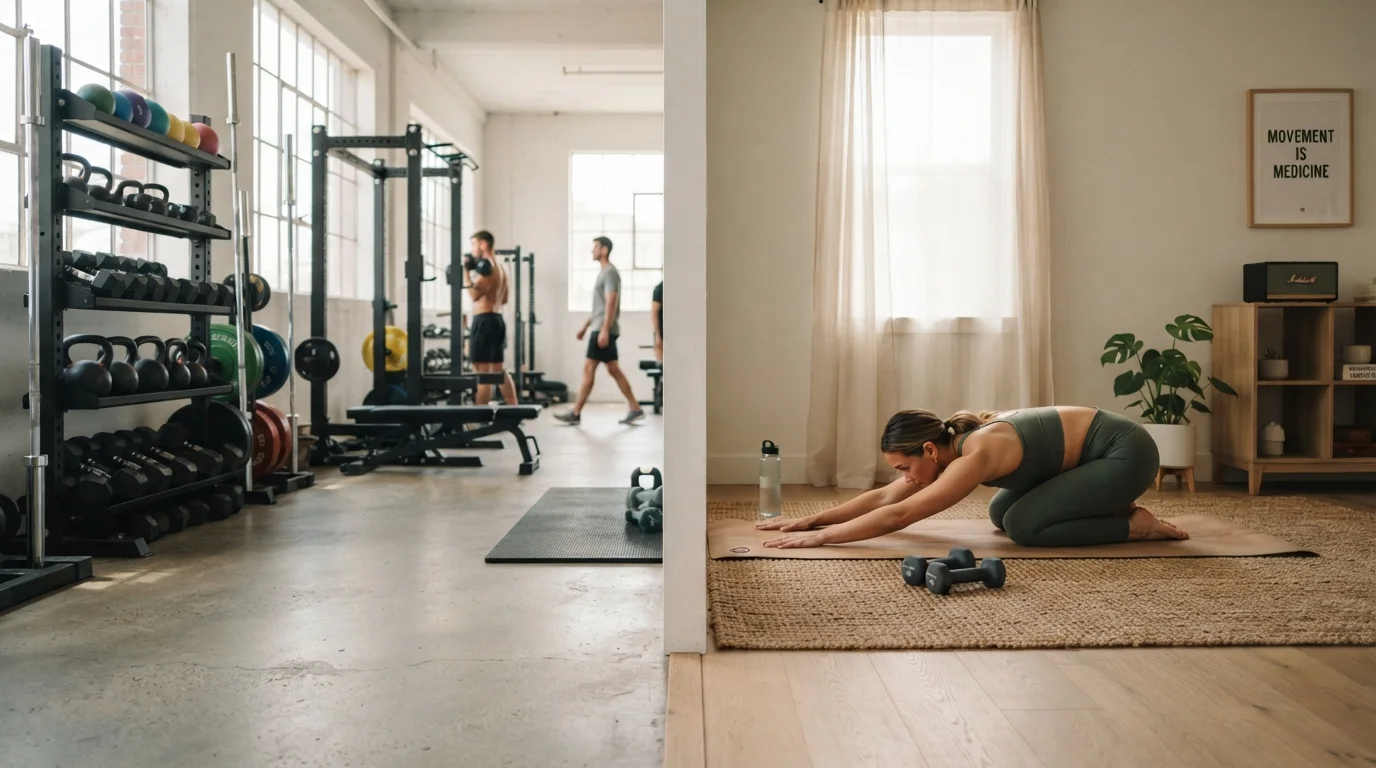
- Gyms offer equipment variety and professional support; home setups offer convenience and zero commute.
- Cost, space, schedule, and personal motivation style are the most useful factors when deciding.
- Many people find that combining both environments gives them the most sustainable routine.
- Always consult a qualified fitness professional before starting any new exercise program, especially with existing health conditions.
Option A
Gym Workouts
The fully equipped, socially energized training environment.
Best for: People who thrive on variety, professional guidance, and the motivation that comes from training around others.
Option B
Home Workouts
The flexible, low-barrier alternative built around your life.
Best for: Individuals who prioritize convenience, privacy, and eliminating the friction of commuting to exercise.
If you're a beginner who wants coaching and accountability
Gym Workouts
Access to certified trainers and structured classes provides technique guidance that reduces injury risk when you're learning foundational movements.
If your schedule is unpredictable or you have young children at home
Home Workouts
Eliminating travel time and operating on your own timetable makes it far easier to maintain consistency when life is demanding.
If you want to build significant strength or muscle mass
Gym Workouts
Progressive overload - adding weight over time - is much easier with access to a full range of barbells, plates, and cable machines.
If cost is a primary constraint
Home Workouts
A modest investment in versatile equipment like resistance bands and adjustable dumbbells can deliver effective training with no recurring membership fees.
If you want the widest variety of cardio and recovery options
Gym Workouts
Treadmills, rowing machines, pools, saunas, and stretching areas are standard in many facilities and impractical to replicate at home.
What Each Environment Actually Offers
The gym-versus-home debate is rarely about which setting produces better results in isolation - it's about which one you'll actually use. Both environments are capable of supporting meaningful fitness progress when approached with structure and intention.
A commercial gym's primary advantage is breadth. You get access to free weights across a wide load range, cardio machines, resistance cables, group fitness classes, and often certified personal trainers on the floor. That infrastructure matters most for goals that require progressive overload - gradually increasing resistance over weeks and months - and for people who benefit from professional cues on form. Many gyms also offer amenities like showers and locker rooms that make it practical to train before work.
Home workouts trade equipment depth for frictionless access. Your workout starts the moment you step into your living room or spare bedroom. Research consistently identifies convenience as one of the strongest predictors of exercise adherence, which means a modest home setup used five days a week can outperform an expensive gym membership used twice. For those curious about what's possible with minimal kit, our guide to bodyweight training covers both the real capabilities and the genuine limits of equipment-free exercise.
| Criterion | Gym Workouts | Home Workouts |
|---|---|---|
| Equipment variety | Extensive - full weight range, machines, cardio | Limited to what you invest in |
| Recurring cost | Monthly membership fee required | Upfront equipment cost only |
| Convenience | Requires travel and scheduling | Available immediately, any time |
| Professional guidance | Trainers and classes available | Self-directed or via online resources |
| Privacy | Shared public space | Fully private |
| Social motivation | High - community and group energy | Low - solo by default |
| Space required at home | None | Some floor and storage space needed |
| Best for progressive overload | Strong - wide load increments available | Moderate - depends on equipment owned |
Cost, Space, and Practical Logistics
Financial and logistical realities shape this decision as much as fitness philosophy does. Gym memberships in the US typically run anywhere from roughly $10 per month at budget chains to $100 or more at premium facilities - a meaningful recurring expense that adds up over years. Home equipment carries upfront costs but no ongoing fees; a pair of adjustable dumbbells and a resistance band set can handle a surprisingly broad training range.
Space is the other real constraint. Effective home training doesn't require a dedicated room, but it does require enough floor area to move freely and store equipment safely. If your living situation is genuinely tight, a gym removes that problem entirely. It's worth noting that creative storage solutions can expand what's feasible at home - see our coverage of vertical versus horizontal storage for ideas on maximizing small spaces.
~40%
Adults who cite inconvenience as barrier to exercise
CDC physical activity data consistently identifies lack of time and access as among the most commonly reported barriers to regular exercise among US adults.
2-3x
Typical gym membership cost vs. basic home setup over 2 years
Over a two-year period, recurring membership fees at mid-range gyms often exceed the cost of a functional basic home training setup, though individual circumstances vary widely.
Commute time is an often-underestimated factor. A gym that's 20 minutes away adds 40 minutes of travel to every session. For someone training four days a week, that's nearly three hours weekly - time that can be recovered entirely with a home setup.
Motivation, Social Environment, and Mental Wellbeing
Environment influences effort. Many people train harder in a gym because the social energy, background activity, and implicit norms of a fitness space prime them to work. Group fitness classes in particular can provide a sense of community and structured accountability that's genuinely difficult to replicate solo at home.
On the other hand, some individuals - whether introverted, self-conscious about fitness level, or recovering from an injury - find gyms stressful rather than motivating. For them, the privacy of a home environment isn't a limitation; it's what makes training sustainable at all. Neither preference is wrong, and honest self-assessment here matters more than any general recommendation.
You Don't Have to Choose Permanently
Many people find that a hybrid approach - maintaining a modest home setup for weekday convenience while using a gym for weekend sessions with heavier equipment or classes - combines the strengths of both environments. There's no rule requiring an all-or-nothing commitment. Trial periods, pay-per-visit options, and community recreation centers can help you test what works before making a long-term investment in either direction.
Mental health benefits of exercise - including reduced anxiety symptoms and improved mood - are well-documented regardless of training location. The mechanism appears to be the activity itself, not the setting. If you're ready to translate your chosen environment into a structured weekly plan, our weekly movement planning guide offers a practical framework for building a routine around your real schedule.
This article is for general informational and educational purposes only and does not constitute medical or fitness advice. Consult a qualified healthcare provider or certified fitness professional before beginning any new exercise program, particularly if you have existing health conditions or injuries.