

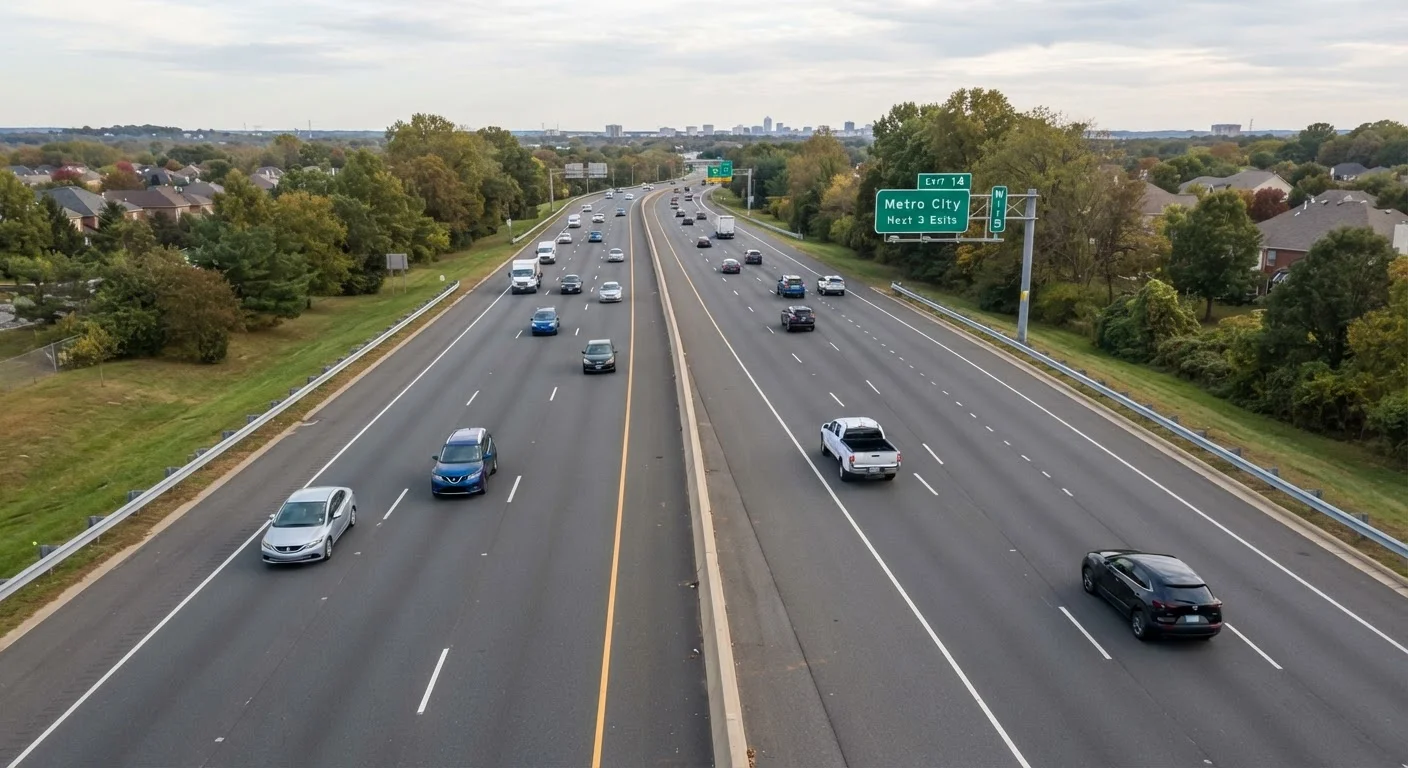
Key Takeaways
- The 3-second rule is the minimum safe following distance under ideal conditions.
- Rain, fog, heavy loads, and fatigue all require extending your following gap.
- Tailgating is a leading contributing factor in rear-end collisions, which account for roughly 29% of all crashes.
- Larger vehicles like trucks and SUVs need more stopping distance than passenger cars.
- Maintaining a cushion ahead also reduces the risk of chain-reaction pile-ups.
Safe Following Distance
Safe following distance is the gap a driver intentionally maintains between their vehicle and the one ahead. It gives you enough time and space to react and stop safely if the car in front brakes suddenly. The most widely taught standard in the US is the 3-second rule - a minimum gap measured in time, not feet.
Stopping distance is the sum of reaction distance (how far you travel before your foot hits the brake) and braking distance (how far the vehicle travels once braking begins). A 3-second gap accounts for both under normal conditions.
How the 3-Second Rule Actually Works
Most drivers learned the 3-second rule in driver's ed, but far fewer apply it consistently on the road. The principle is straightforward: choose a stationary reference point ahead - a road sign, a bridge, or a painted marking - and count the seconds between when the vehicle in front passes it and when you do. If you reach that point in fewer than 3 seconds, you're too close.
The reason this rule uses time rather than distance is deliberate. At 30 mph, 3 seconds equals about 132 feet. At 65 mph, that same 3 seconds stretches to approximately 286 feet. A time-based rule automatically adjusts to your speed, so it stays valid whether you're navigating a school zone or merging onto an interstate.
Critically, 3 seconds is a minimum, not an ideal. It accounts for average reaction time (roughly 1.5 seconds) and standard braking distance on dry pavement. It leaves almost no margin for error - which is why safety researchers often describe it as a floor, not a target. For more context on how stopping physics works, see The Science Behind Stopping Distance.
~29%
Share of US crashes that are rear-end collisions
According to NHTSA crash data, rear-end collisions consistently represent nearly one in three traffic crashes on US roads.
1.5 sec
Average driver reaction time
Traffic safety research places average driver reaction time at approximately 1.5 seconds - the time before braking even begins.
2-3×
Increase in stopping distance on wet pavement
Studies on wet-road braking consistently show stopping distances two to three times longer than on dry roads at the same speed.
When to Add More Space
Conditions that reduce traction, visibility, or vehicle responsiveness all shrink your effective safety margin - meaning your already-minimal 3-second gap can become dangerously insufficient.
- Wet or icy roads: Stopping distances can increase by 2 to 3 times on wet pavement and up to 10 times on ice compared to dry conditions. A 4- to 6-second gap is a practical minimum in rain; more in snow or ice.
- Towing or hauling: Added weight extends braking distance significantly. A pickup truck towing a loaded trailer may need twice the stopping distance of the same truck unloaded.
- Following large vehicles: Trucks and buses block forward sightlines, limiting how early you can detect hazards ahead. Increase your following distance to preserve a clear view of the road.
- Driver fatigue or distraction: Reaction time increases when you're tired. If your alertness is even slightly impaired, a 3-second gap may not give you enough time to respond.
- High-speed roads: At highway speeds, events unfold faster. A conservative 4-second gap is a reasonable default on freeways.
Use the 4-Second Rule as Your Default
Rather than treating 3 seconds as the goal, consider making 4 seconds your everyday default. This provides a more comfortable reaction buffer under normal conditions and means that when conditions deteriorate slightly - a damp road, heavier traffic, an unfamiliar route - you already have extra margin without needing to consciously adjust.
These adjustments are part of the broader mindset of defensive driving - anticipating hazards before they become emergencies.
Why Tailgating Is So Dangerous
Tailgating - following so closely that any sudden braking guarantees a collision - is one of the most normalized risky behaviors on US roads. It often stems from frustration, time pressure, or simply the habit of unconsciously matching the bumper-to-bumper spacing of surrounding traffic.
Rear-end collisions make up a significant share of all crashes in the US. The National Highway Traffic Safety Administration (NHTSA) consistently identifies following too closely as a major contributing factor. Beyond the immediate collision, tailgating increases the likelihood of chain-reaction crashes, where a single braking event cascades through multiple vehicles behind it.
There is also a mechanical reality: even a vehicle in perfect condition with well-maintained brakes cannot stop instantaneously. Understanding that physics is non-negotiable is central to treating following distance as a safety necessity rather than an optional courtesy. This connects directly to driving habits that quietly raise your crash risk - tailgating rarely feels dangerous until it's too late.
“The single most effective thing a driver can do to prevent rear-end crashes is to create and maintain adequate space ahead. Space buys time, and time is what allows a driver to react.”
— NHTSA Traffic Safety Research, National Highway Traffic Safety Administration
When you find yourself being tailgated, the safest response is to gradually increase your own following distance from the car ahead. This creates a larger buffer for your own braking and reduces the chance of a multi-car impact if you need to stop suddenly.
Applying Safe Spacing in Real Traffic
Consistent spacing in real-world traffic takes conscious practice, especially on busy roads where other drivers may cut into your gap. Resist the impulse to close the space when someone merges in front of you - simply ease off the accelerator and rebuild the cushion. A gap that invites merging drivers is working exactly as intended.
On multi-lane roads, following distance interacts with lane discipline and merging behavior. Smooth, well-timed lane changes create fewer disruptions to traffic flow and reduce sudden braking events that ripple back through traffic. See Lane Changing Done Right for the correct technique.
Finally, following distance is one input in a larger system of spatial awareness. Knowing who has right-of-way at intersections and how to position yourself in complex merges also reduces your exposure to conflict - topics covered in Right-of-Way Rules Decoded.
Your Following Distance Affects Drivers Behind You
Maintaining a larger gap ahead doesn't just protect you - it benefits the entire line of traffic. When you keep space cushions, you brake less sharply and less often, which reduces the accordion effect where braking cascades backward through traffic. Smooth spacing is both a personal safety habit and a contribution to overall traffic flow.