

| Leading cause of intersection crashes | Failure to yield right-of-way (NHTSA crash causation data) |
| Roundabout injury reduction vs. signalized intersections | Up to 75% (Insurance Institute for Highway Safety (IIHS)) |
| Direction of traffic flow in US roundabouts | Counterclockwise |
| Right-of-way at uncontrolled intersections | Driver to the right proceeds first (Standard US traffic law principle) |
| Pedestrian right-of-way | Always at marked crosswalks; in most states at unmarked crosswalks too |
| Merge responsibility | Merging driver yields to through traffic (Uniform Vehicle Code) |
Intersections: Four-Way Stops and Uncontrolled Crossings
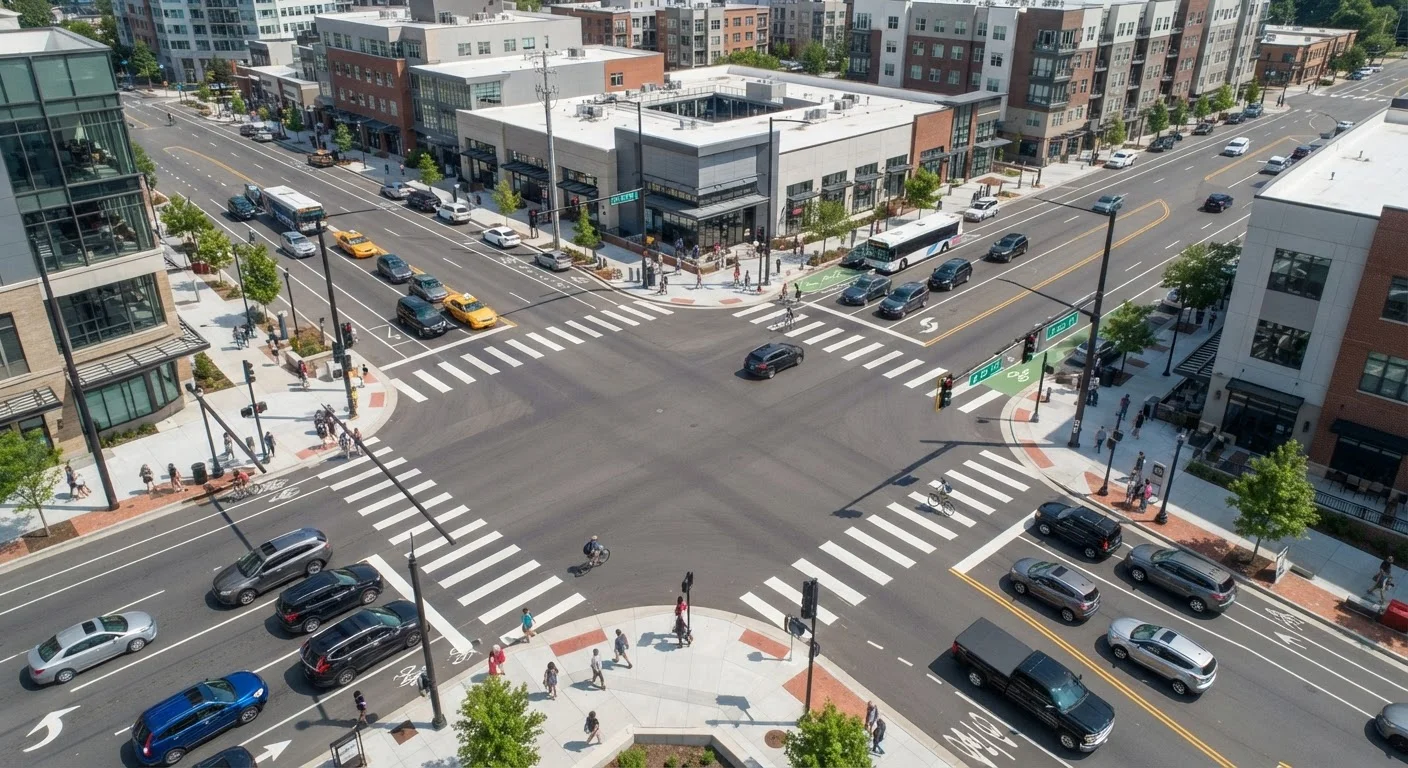
Intersections are where most right-of-way confusion - and crashes - happen. Understanding the hierarchy of rules removes most of that uncertainty.
Four-Way Stops
At a four-way stop, the driver who arrives and stops first proceeds first. When two vehicles arrive simultaneously, the driver on the left yields to the driver on the right. If three or more vehicles arrive at once, the same principle cascades: look to your right and yield if someone is there.
Uncontrolled Intersections
At intersections with no signs or signals - common in residential areas - you must yield to any vehicle already in or closer to the intersection. If you arrive at the same time as another driver, again yield to the driver on your right. Approach slowly enough to stop if needed.
Traffic Signals
A green light does not override all right-of-way obligations. You must still yield to pedestrians in the crosswalk and to vehicles lawfully in the intersection when your signal changes. A flashing red is treated as a stop sign; a flashing yellow means slow down and proceed with caution.
Misreading signs is a common contributor to intersection errors. See our guide to road signs every US driver should know for a full breakdown of signal types and their required actions.
Right-of-way
The legal right to proceed through a roadway before another driver. It is always yielded or taken - never assumed as absolute protection from responsibility.
Uncontrolled intersection
An intersection with no stop signs, traffic signals, or yield signs. Drivers must rely on right-of-way rules to determine who proceeds first.
Yield
To slow down or stop as needed and allow another driver, cyclist, or pedestrian to proceed before you enter a lane or intersection.
Roundabout
A circular intersection where traffic flows counterclockwise around a central island. Entering drivers yield to vehicles already circulating inside.
Merge
The act of transitioning from one lane into an adjacent, moving lane of traffic - typically on highways or at lane endings.
Four-way stop
An intersection where all approaches have stop signs. Vehicles proceed in the order they arrived, with ties broken by the vehicle to the right.
Roundabouts: Who Yields, Who Goes
Roundabouts follow a single, consistent rule: traffic already circulating inside the roundabout has the right-of-way. Drivers entering from any approach must yield - stopping if necessary - until a safe gap opens in the circulating flow.
| Leading cause of intersection crashes | Failure to yield right-of-way (NHTSA crash causation data) |
| Roundabout injury reduction vs. signalized intersections | Up to 75% (Insurance Institute for Highway Safety (IIHS)) |
| Direction of traffic flow in US roundabouts | Counterclockwise |
| Right-of-way at uncontrolled intersections | Driver to the right proceeds first (Standard US traffic law principle) |
| Pedestrian right-of-way | Always at marked crosswalks; in most states at unmarked crosswalks too |
| Merge responsibility | Merging driver yields to through traffic (Uniform Vehicle Code) |
Key Roundabout Behaviors
- Do not stop inside the roundabout unless traffic is backed up and you cannot clear the circle - stopping mid-roundabout creates rear-end risk.
- Signal your exit. Use your right turn signal as you pass the exit just before yours, so circulating drivers can anticipate your departure.
- Multi-lane roundabouts: Choose your lane before entering based on your exit direction - right lane for right or straight exits, left lane for left or U-turns. Lane changes inside a roundabout are not permitted.
- Large vehicles may need to use the full width of the roundabout or a truck apron. Give them space and do not enter alongside them.
The safety benefit of roundabouts is well-documented: eliminating high-speed T-bone and left-turn conflicts dramatically cuts serious injury crashes compared to signalized intersections.
Merging: Highway On-Ramps and Lane Endings
Merging is where right-of-way rules and driving skill intersect most visibly. The legal principle is straightforward: the merging driver yields to traffic already in the target lane. The practical skill is matching speed and finding a gap.
Right-of-Way Is Yielded, Not Demanded
Having the legal right-of-way does not make you immune from a collision or from legal responsibility. If another driver is about to violate your right-of-way, the safer choice is always to yield rather than assert your position. Defensive driving means anticipating errors by others, not counting on them to follow the rules.
Highway On-Ramps
Use the full length of the acceleration lane to reach highway speed before merging. Signal early, check your mirrors and blind spot, and merge into a gap - do not force through traffic to brake. A vehicle traveling at 65 mph covers about 95 feet per second; a late, slow merge gives almost no time for adjustment.
Through traffic has the right-of-way, but cooperative driving - highway drivers easing slightly to open a gap - reflects what the FHWA calls a zipper merge in lane-drop situations, which research suggests reduces backup length and friction. For a deeper look at safe following gaps and speed judgment, see the anatomy of a safe following distance.
Lane Endings and Zipper Merges
When a lane ends due to construction or road design, drivers in both lanes should use the full lane until the merge point, then alternate - one from each lane - in a zipper pattern. Cutting in early is not required; staying in a closing lane until the merge point is legal and efficient. Review the full sequence of checks for lane transitions in our lane changing guide.
Left Turns Across Traffic
A left-turning driver - even with a green light - must yield to oncoming traffic and to pedestrians crossing the street they are turning onto. This is one of the most frequently misunderstood right-of-way rules and a leading cause of intersection collisions. Wait for a clear gap; do not rely on oncoming drivers to slow.
Combining right-of-way knowledge with broader awareness of habits that quietly raise your crash risk - like rolling stops and misjudged gaps - builds the full defensive-driving picture.