

Key Takeaways
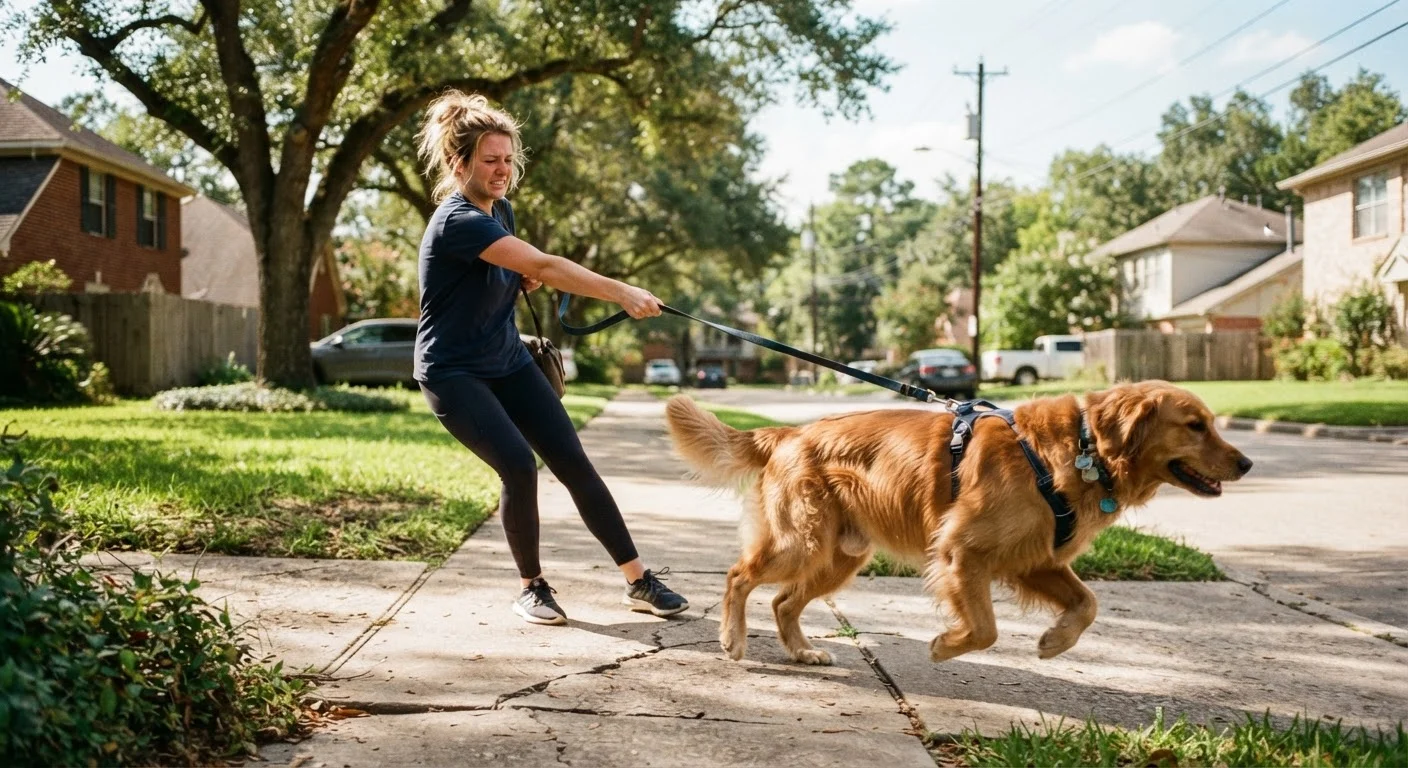
- Dogs pull on leashes because forward movement naturally rewards the behavior, not out of stubbornness or dominance.
- Punishment-based corrections can increase anxiety and make leash manners harder to establish long-term.
- Consistency and reinforcing loose-leash moments — even briefly — are the foundation of lasting improvement.
- Equipment like front-clip harnesses can manage pulling immediately while training takes hold.
The Real Reason Dogs Pull
Leash pulling is rarely about a dog asserting dominance or ignoring commands out of spite. The behavioral explanation is far simpler: pulling works. When a dog lunges toward a smell, another dog, or an interesting patch of grass, the leash tension often gives way as the owner steps forward. The dog reaches the thing it wanted. That outcome reinforces the pulling.
This is operant conditioning at its most straightforward — behavior that produces a desired result is repeated. Dogs aren't calculating; they're learning from consequences. To understand how this mechanism shapes all pet behavior, see our guide to positive reinforcement in pet training.
There's also a physiological component. Dogs naturally walk faster than humans, and their olfactory world is vastly richer than ours. Every walk is filled with compelling sensory information pulling their attention forward. The leash is an unfamiliar constraint on instincts that evolved without it.
#1
Most common complaint in dog training
Leash pulling consistently ranks as the top behavior issue reported by dog owners seeking professional training help, according to surveys of certified trainers.
~63%
Dogs that pull on leash regularly
Surveys of US dog owners suggest a majority report their dog pulls on the leash at least some of the time during walks.
Mistakes That Make Leash Pulling Worse
Most owners inadvertently strengthen pulling through well-meaning but counterproductive responses. Recognizing these patterns is the first step toward changing them.
Continuing to walk while the dog pulls.
Why it happens: Owners want to complete the walk and assume the dog will eventually settle down. Stopping feels disruptive and awkward in public.
Using leash jerks or collar corrections to punish pulling.
Why it happens: This approach is widely recommended in older training literature and feels intuitively logical — an unpleasant consequence should discourage the behavior.
Inconsistently allowing pulling in some situations but not others.
Why it happens: Owners allow pulling when they're in a hurry or when the destination seems important — rushing to a car, heading home quickly. This seems harmless in the moment.
Starting training in high-distraction environments.
Why it happens: Most leash training happens on regular walks, where dogs encounter dogs, squirrels, bikes, and strangers simultaneously — exactly the conditions that trigger pulling.
Relying on equipment alone without pairing it with training.
Why it happens: Front-clip harnesses and head halters provide immediate relief, leading owners to believe the problem is solved without further work needed.
It's also worth noting that leash pulling exists alongside other impulse-control challenges. Dogs who guard resources or overreact to stimuli on walks share a common thread: arousal that outpaces learned coping. Our article on understanding and managing resource guarding in dogs covers related strategies for impulse regulation.
What Science-Based Training Actually Looks Like
Effective leash training doesn't require expensive equipment or perfect timing from day one. It requires understanding what you're reinforcing.
The core principle: reward the dog for a loose leash, not just for sitting or heeling on command. Any moment the leash goes slack — even for two seconds — mark it with a verbal cue or clicker and follow with a treat. You're building a history of loose-leash moments being worth the dog's attention.
Front-clip harnesses redirect a pulling dog's momentum toward you rather than forward. They don't teach leash manners on their own, but they reduce the physical advantage the dog has while training is in progress. This makes consistent reinforcement easier to apply.
Head Halters Require Careful Introduction
Head halters can be effective tools but must be introduced gradually using positive association — not placed on a dog and immediately used to redirect. A dog that hasn't been conditioned to accept a head halter may paw at it, rub its face on the ground, or become distressed. Take several sessions to build comfort before using it on walks.
Short, frequent practice sessions outperform long, frustrating walks. Five minutes of focused training in a low-distraction environment builds skills faster than thirty minutes of reactive pulling in a busy park. Gradually increase the difficulty — more distractions, longer duration — only when the dog is reliably succeeding at the current level.
Many owners find that consistent improvement takes weeks, not days. That timeline is normal. Dogs need many repetitions across varied contexts before a behavior generalizes. If progress has stalled, a certified professional dog trainer or veterinary behaviorist can assess the specific dynamics at play. A similar principle applies to building any long-term habit — gradual, realistic expectations beat all-or-nothing approaches, as explored in our article on why people quit routines and what actually helps.
This article is for general informational and educational purposes only and is not a substitute for guidance from a certified professional dog trainer or veterinary behaviorist. If your dog displays anxiety, reactivity, or aggression on leash, consult a qualified professional before proceeding with training.