

Key Takeaways
- A 1% annual fee difference can cost an investor tens of thousands of dollars over a 30-year horizon.
- Fees compound against you just as returns compound for you — the drag accelerates over time.
- Expense ratios, adviser fees, fund loads, and account fees are the four main fee categories to examine.
- Passively managed index funds typically carry far lower expense ratios than actively managed funds.
- Minimising fees is one of the few investment variables entirely within your control.
Investment Fees
Investment fees are charges deducted from your portfolio — by funds, brokers, or advisers — in exchange for managing or facilitating your investments. They are typically expressed as a percentage of assets per year (called an expense ratio) or as flat dollar charges. Because these fees come out of your returns before you see them, their true cost is often invisible until you do the math.
The expense ratio on a mutual fund or ETF is expressed as an annual percentage of net assets and is deducted daily from the fund's NAV (net asset value), meaning you never write a check — the cost is simply baked into your reported performance figures.
Why Fees Matter More Than Most Investors Realize
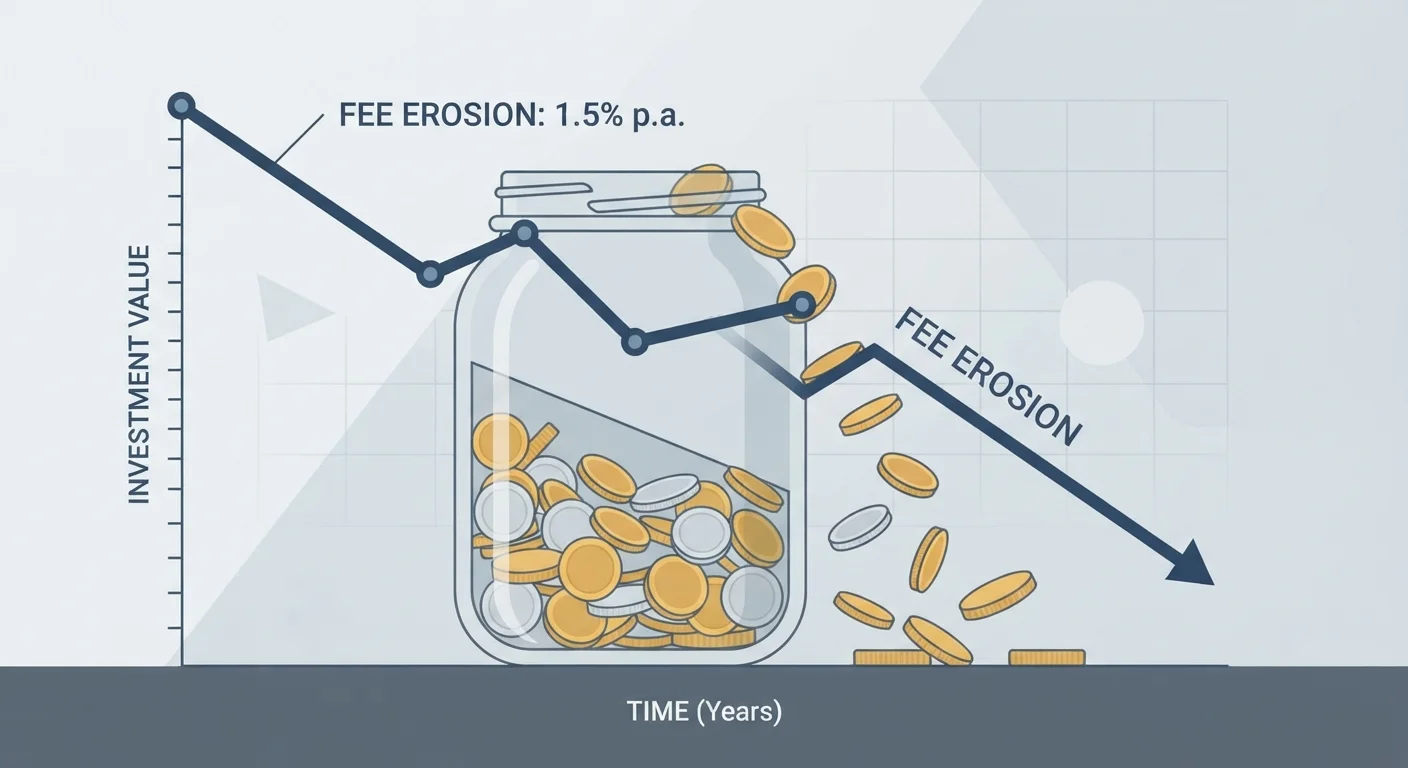
Most investors focus on picking the right assets or timing the market. Far fewer scrutinise fees — and that blind spot is expensive. Fees don't just reduce your returns by a fixed dollar amount each year; they reduce the base on which future returns are calculated. That's the compounding effect working in reverse.
Consider a straightforward example: two investors each start with $50,000 and earn a gross annual return of 7%. One invests in a fund with a 0.10% expense ratio; the other with a 1.10% expense ratio — a difference of exactly one percentage point. After 30 years, the low-fee investor ends with roughly $374,000. The high-fee investor ends with approximately $265,000. The fee difference consumed more than $109,000 — nearly the size of the original portfolio, twice over.
This isn't speculation. It's basic compound mathematics. As explained in our guide to compound interest, the same mechanism that builds wealth over time also amplifies the drag of recurring costs. Understanding fees is therefore inseparable from understanding how long-term investing actually works.
~$109,000
Lost to fees on a $50,000 portfolio over 30 years
Based on a 1 percentage point fee difference (0.10% vs 1.10%) applied to a $50,000 portfolio growing at 7% annually — illustrating compound fee drag over a typical retirement horizon.
Under 0.10%
Expense ratio for many broad-market index funds
Passively managed index ETFs tracking broad US or global markets routinely charge well below 0.10% annually, a fraction of the cost of most actively managed alternatives.
Over 80%
Active US equity funds underperforming their benchmark over 15 years
According to S&P Dow Jones Indices' SPIVA reports, the majority of actively managed US equity funds have historically trailed their respective benchmark indices over 15-year periods, net of fees.
The Four Fee Categories Every Investor Should Know
Investment costs don't always arrive with a clear label. Here are the four main categories to examine before committing capital:
- Expense ratios: The annual cost of owning a mutual fund or ETF, expressed as a percentage of assets. This is deducted automatically from the fund's value — you never see a bill. Broad-market index funds often charge under 0.10%; actively managed funds commonly charge 0.50%–1.00% or more. Our comparison of index and actively managed funds covers how those cost differences interact with historical performance.
- Adviser fees: Financial advisers typically charge either a percentage of assets under management (AUM) — commonly 0.50%–1.25% annually — or flat/hourly fees. AUM-based fees apply to your entire portfolio every year, making them a substantial recurring cost.
- Sales loads: Some mutual funds charge a commission when you buy (front-end load) or sell (back-end load). These are separate from the expense ratio and can consume 3%–5.75% of your investment upfront.
- Account and transaction fees: Annual account maintenance fees, trading commissions, and inactivity fees may apply depending on the brokerage or account type. Many mainstream brokerages have eliminated trading commissions on stocks and ETFs, but account-level fees can persist, particularly for smaller balances or certain retirement account structures.
If you're new to how these costs interact with different account structures, our beginner's guide to investing provides the foundational context.
Use the 'Net Return' Frame When Comparing Funds
When evaluating any fund, subtract the expense ratio from the fund's stated gross return to approximate your net return. A fund returning 8.5% gross with a 1.20% expense ratio delivers roughly 7.30% net — while an index fund returning 8.3% gross at 0.05% delivers 8.25% net. The lower-return fund is actually the better net outcome. Always compare after fees, not before.
The Active vs. Passive Cost Gap
One of the most consistent findings in investment research is that actively managed funds — those where portfolio managers select securities in an attempt to beat a benchmark — charge substantially more than passively managed index funds, yet rarely outperform them over long periods after fees are accounted for.
The S&P Indices Versus Active (SPIVA) scorecards published by S&P Dow Jones Indices regularly show that the majority of actively managed domestic equity funds underperform their benchmark index over 10- and 15-year periods, net of fees. The fee disadvantage is a structural drag that active managers must overcome every year simply to break even with an index.
This doesn't mean active management is never justified — certain specialised strategies or market segments may present meaningful opportunities. But for the core of a long-term portfolio, the evidence consistently favours cost minimisation. A fund that charges 1.00% annually must outperform a 0.05% index fund by 0.95% every year just to deliver the same net return. That bar is hard to clear consistently over decades.
“Costs matter in investing. Paying unnecessary fees is one of the surest ways to reduce your long-term returns. The mathematics are unambiguous: money that goes to fees is money that cannot compound for you.”
— John C. Bogle, Founder of Vanguard and pioneer of low-cost index investing
How to Evaluate and Reduce the Fees You're Paying
Reducing fees doesn't require complex strategy. It requires reviewing what you currently pay and making informed comparisons. Here's a practical approach:
- Locate your expense ratios. Every fund's expense ratio appears in its prospectus and on most brokerage fund-detail pages. Add up the weighted average across your holdings.
- Check for loads. If any fund in your portfolio charges a front- or back-end load, identify whether a no-load equivalent with a comparable strategy exists.
- Understand your adviser's fee structure. Ask explicitly whether fees are charged as a percentage of AUM, flat fee, or hourly rate — and what services those fees cover. A fiduciary adviser is legally required to act in your interest; a broker operating under a suitability standard is not.
- Review account-level fees. Check your brokerage's fee schedule. Maintenance fees on small accounts, paper statement fees, and inactivity fees can add up quietly.
- Consider tax drag alongside investment fees. Frequent trading inside taxable accounts generates taxable events. As covered in our article on taxable brokerage accounts, tax efficiency is a form of cost management that runs parallel to fee minimisation.
Lowering fees is one of the few levers in investing where the outcome is certain — not a probability. Every dollar not paid in fees stays invested and continues compounding.
This article is for general informational and educational purposes only. It does not constitute personalised investment, financial, tax, or legal advice. Past investment performance does not guarantee future results. Consult a qualified, licensed financial professional before making decisions about your own investments or financial situation.