

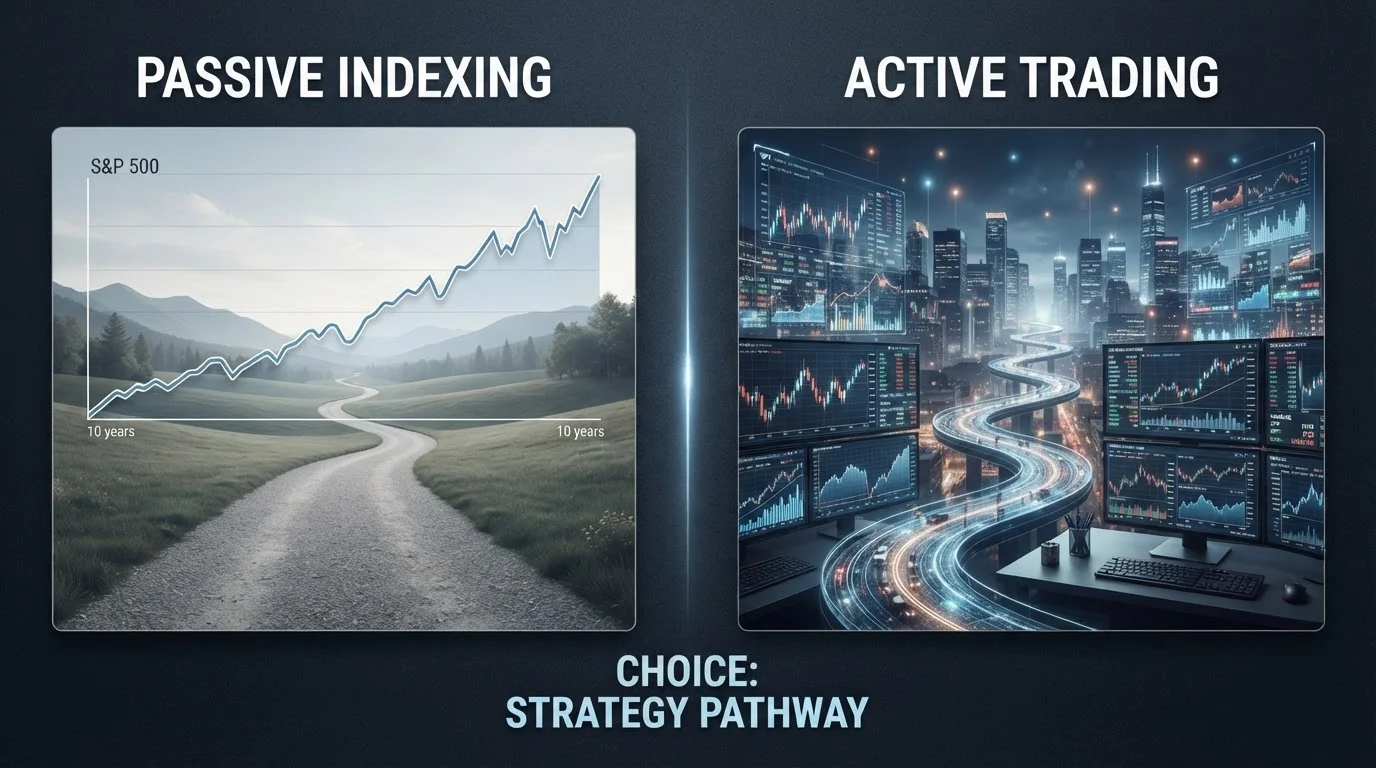
Key Takeaways
- Index funds consistently outperform the majority of actively managed funds over long time horizons, net of fees.
- The average actively managed fund charges significantly higher expense ratios than comparable index funds.
- Higher fees compound against you over decades, often erasing any performance advantage active managers produce.
- A small minority of active managers do beat their benchmark, but identifying them in advance is extremely difficult.
- Your investment timeline, tax situation, and risk tolerance all factor into which approach fits your portfolio.
Option A
Index Funds
The low-cost, passive approach that tracks the market.
Best for: Long-term investors who want broad diversification and minimal fees without hands-on management.
Option B
Actively Managed Funds
The professional-driven approach that seeks to beat the market.
Best for: Investors who believe skilled managers can outperform benchmarks and are willing to pay higher fees for that potential.
If you are a beginning investor building long-term wealth
Index Funds
Broad diversification, low costs, and decades of evidence supporting market-matching returns make index funds the practical starting point for most new investors.
If you want exposure to specialized or niche markets not covered by broad indexes
Actively Managed Funds
Some niche categories — such as certain emerging markets or alternative asset classes — may lack deep, liquid index options, making active management a pragmatic consideration.
If minimizing investment costs is your top priority
Index Funds
Index funds routinely carry expense ratios well below 0.10%, versus 0.60%–1.00% or more for many active funds — a gap that compounds significantly over 20–30 years.
If you have a shorter time horizon and a specific market thesis
Actively Managed Funds
Over shorter windows, some active managers can add value by repositioning quickly in volatile markets, though this is not reliably predictable and involves higher costs.
How Each Fund Type Actually Works
An index fund is a pooled investment vehicle — available as a mutual fund or exchange-traded fund (ETF) — designed to replicate the holdings and performance of a specific market index, such as the S&P 500 or the Bloomberg U.S. Aggregate Bond Index. Because the portfolio simply mirrors the index, turnover is low and there is no need for a team of analysts making active buy and sell decisions. That structural simplicity is the source of the cost advantage.
An actively managed fund, by contrast, employs a portfolio manager and a research team whose explicit goal is to outperform a designated benchmark. They analyze securities, time market entries and exits, and adjust holdings based on economic outlooks or company fundamentals. This labor and expertise costs money — reflected directly in the fund's expense ratio and, sometimes, in sales loads or redemption fees.
Before going further, if you are still getting oriented to the fundamentals of investing, see our comprehensive investing primer for a jargon-free grounding in how markets and accounts work.
| Criterion | Index Funds | Actively Managed Funds |
|---|---|---|
| Management style | Passive — mirrors an index | Active — manager selects holdings |
| Typical expense ratio | 0.03%–0.10% | 0.50%–1.00%+ |
| Portfolio turnover | Low | High |
| Tax efficiency | Generally higher | Generally lower |
| Long-run benchmark performance | Matches benchmark (net of fees) | Most underperform benchmark net of fees |
| Transparency of holdings | High — index is public | Varies; disclosed periodically |
| Minimum investment | Often very low or $0 (ETF share price) | Varies; often $1,000–$3,000+ |
What the Performance Data Shows
The S&P Dow Jones Indices SPIVA (S&P Indices Versus Active) report is one of the most rigorously maintained datasets on this question. Consistently, across most equity categories and time periods, the majority of actively managed funds underperform their respective benchmark index after fees. Over a 15-year horizon, the data has repeatedly shown that roughly 85–90% of large-cap U.S. active funds fail to beat the S&P 500 on a net-of-fees basis.
This underperformance is not a quirk of one era. It holds across U.S. large-cap, mid-cap, and small-cap categories, as well as many international equity categories. Bond funds show a similar, though sometimes narrower, gap.
~88%
Active large-cap funds underperforming S&P 500
According to the S&P SPIVA U.S. Scorecard, approximately 88% of actively managed large-cap U.S. funds underperformed the S&P 500 over a 15-year period, net of fees.
0.06%
Average index fund expense ratio
Morningstar's annual fee research reports the asset-weighted average expense ratio for passive U.S. equity funds has fallen to around 0.06%, a fraction of active fund costs.
< 25%
Active funds with persistent outperformance
S&P Persistence Scorecard data consistently shows fewer than one in four top-performing active funds repeat that ranking over a subsequent five-year period.
It is important to note what the data does not say: it does not claim no active manager ever outperforms. A meaningful minority does. The challenge is that past outperformance shows low persistence — meaning the managers who beat their benchmark in one period are not reliably the same ones who do so in the next. Research published by Vanguard and others has found that selecting future outperformers based on past returns is, for most investors, an unreliable strategy.
For a deeper look at how fees mechanically reduce returns over time, see our article on the real cost of investing fees.
The Fee Gap and Why It Compounds
Fees are where the index fund advantage becomes most concrete and quantifiable. According to Morningstar's annual fee study, the asset-weighted average expense ratio for actively managed U.S. equity funds has been roughly 0.60%–0.70%, while comparable index funds average closer to 0.05%–0.10%. That gap may look modest on paper, but compounding turns it into a substantial drag.
Consider a simplified illustration: on a $50,000 portfolio growing at 7% annually over 30 years, a 0.60% annual fee difference results in tens of thousands of dollars less in ending wealth. You are not just paying fees — you are paying the foregone growth those dollars would have generated. This is explored further in our article on how investment fees erode returns.
Tax Location Matters for Active Funds
Because actively managed funds trade more frequently, they tend to distribute more short-term and long-term capital gains to shareholders each year. In a taxable brokerage account, those distributions create a tax bill even if you did not sell any shares. Holding active funds inside a tax-advantaged account — such as a traditional IRA or Roth IRA — can blunt this effect. Index funds, with their low turnover, generate fewer taxable events, giving them an additional edge in taxable accounts.
Active funds also tend to generate higher taxable distributions due to more frequent portfolio turnover, which can create an additional cost for investors holding them in taxable brokerage accounts rather than tax-advantaged accounts like IRAs or 401(k)s.
When Active Management May Still Have a Role
The evidence favors index funds for most investors most of the time — but that is not the same as saying active management is without merit in every circumstance. There are a few situations where active funds merit consideration:
- Inefficient or illiquid markets: In niche areas such as frontier emerging markets, small private credit markets, or certain alternative asset categories, price discovery may be less efficient, giving skilled managers a larger potential edge.
- Factor-based or thematic strategies: Some active funds pursue specific exposures — such as quality, value, or low volatility — that may not be fully replicated by a simple cap-weighted index, though factor-based index products have grown significantly.
- Downside protection mandates: Certain absolute-return or flexible-allocation funds explicitly target volatility reduction rather than benchmark outperformance, which is a different goal than a pure index fund pursues.
Even within these cases, scrutinize fees carefully and look for a clear, durable rationale for why the manager's edge is likely to persist. A common investing misconception is that complexity equals superior returns — our piece on investing myths keeping Americans on the sidelines addresses this and related beliefs directly.
Once you have decided on an approach, your next practical step is opening the right account. Our roadmap to your first investment account walks through that process from start to funded.
This article is for general informational and educational purposes only and does not constitute personalized investment, tax, or financial advice. All investing involves risk, including the possible loss of principal. Consult a qualified financial professional for guidance specific to your situation.