

| Asset classes covered | Stocks, bonds, cash equivalents |
| Historical S&P 500 annualized return | ~10% (before inflation) (Long-run historical average; past performance does not guarantee future results) |
| Recommended emergency cash reserve | 3–6 months of expenses (Common personal finance guidance; varies by individual circumstances) |
| Primary risk of cash holdings | Inflation erosion over time |
| Bond price relationship to interest rates | Inverse — prices fall when rates rise |
| Minimum suggested stock investment horizon | 5+ years (General guidance to absorb market volatility) |
Why Asset Classes Matter
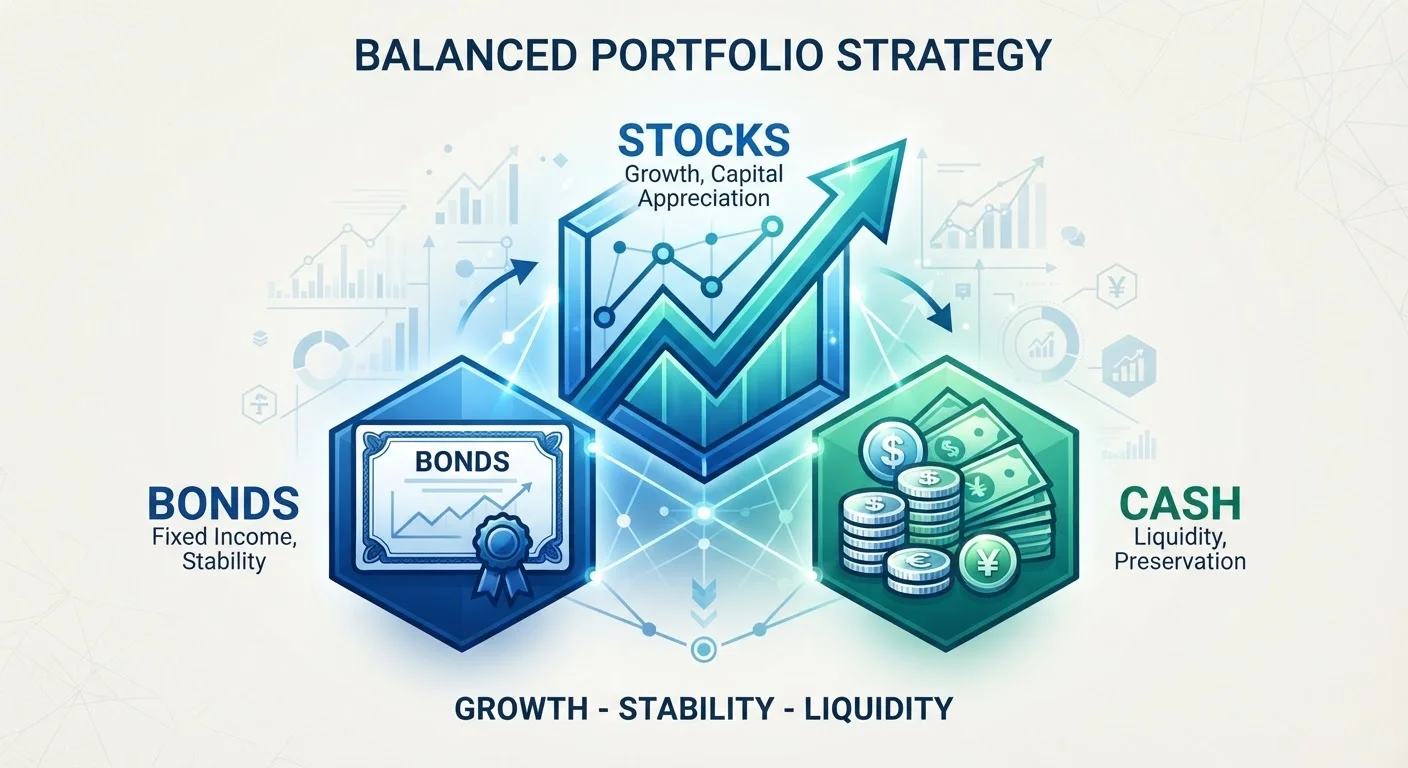
Whether you have $500 or $500,000 invested, your portfolio is almost certainly made up of some combination of three core asset classes: stocks, bonds, and cash. Each behaves differently in various market environments, which is exactly why most investors hold all three. Understanding what each one does — and doesn't do — is the foundation of sound investing.
| Asset classes covered | Stocks, bonds, cash equivalents |
| Historical S&P 500 annualized return | ~10% (before inflation) (Long-run historical average; past performance does not guarantee future results) |
| Recommended emergency cash reserve | 3–6 months of expenses (Common personal finance guidance; varies by individual circumstances) |
| Primary risk of cash holdings | Inflation erosion over time |
| Bond price relationship to interest rates | Inverse — prices fall when rates rise |
| Minimum suggested stock investment horizon | 5+ years (General guidance to absorb market volatility) |
This isn't about picking winners. It's about understanding the role each asset class plays so you can make informed decisions about how to structure your own holdings. For a broader primer on getting started, see Investing from Scratch — a comprehensive guide to fundamental investing concepts.
Stocks: Ownership and Growth Potential
A stock (also called a share or equity) represents partial ownership in a company. When a business grows and becomes more profitable, shareholders generally benefit — either through a rising share price, dividend payments, or both. Historically, equities have delivered higher long-term returns than other major asset classes, though that comes with meaningfully higher short-term volatility.
The S&P 500 — a broad index of large US companies — has delivered an annualized average return of roughly 10% before inflation over many decades, according to widely cited historical data. But that average masks years where stocks fell 30%, 40%, or more. An investor who panics and sells during a downturn can lock in losses that a patient investor riding out the same period would have recovered from.
~10%
S&P 500 long-run annualized return (pre-inflation)
Based on widely cited multi-decade historical data; past performance does not guarantee future results.
3–6 months
Recommended liquid cash reserve before investing
A broadly accepted personal finance guideline for financial resilience before taking on investment risk.
Inverse
Relationship between bond prices and interest rates
When interest rates rise, existing bond prices fall — a fundamental fixed-income principle recognized by the Federal Reserve and financial regulators.
Stocks are generally suited to money you won't need for at least five years, giving you time to absorb market swings. To understand the market mechanics behind stock prices, see What the Stock Market Actually Is.
Bonds: Lending and Stability
When you buy a bond, you're lending money to an issuer — a corporation, a municipality, or the federal government — in exchange for periodic interest payments and the return of your principal at a set maturity date. Bonds are generally less volatile than stocks and provide predictable income, making them a stabilizing force in a portfolio.
They're not risk-free, however. Bond prices fall when interest rates rise (and vice versa), and corporate bonds carry the risk that the issuer defaults. Credit ratings — issued by agencies like Moody's or S&P — reflect the perceived default risk of a bond issuer. US Treasury bonds are considered among the lowest-risk fixed-income instruments because they're backed by the federal government's ability to tax and borrow.
Stock (Equity)
A security representing partial ownership in a company. Stockholders may benefit from price appreciation and dividend payments, but also bear the risk of losses if the company underperforms.
Bond (Fixed Income)
A debt instrument in which the investor lends money to an issuer (government or corporation) in exchange for periodic interest payments and return of principal at maturity.
Asset Class
A broad category of investments that share similar characteristics and behave similarly in the marketplace. Stocks, bonds, and cash are the three primary asset classes.
Liquidity
How quickly and easily an asset can be converted to cash without significantly affecting its price. Cash is perfectly liquid; real estate is highly illiquid.
Diversification
The practice of spreading investments across different asset classes, sectors, or geographies to reduce the impact of any single investment's poor performance on the overall portfolio.
Yield
The income generated by an investment, expressed as a percentage of its cost or current market value. For bonds, yield typically refers to the interest payment relative to the bond's price.
Bonds typically act as a counterweight to equities: in many (though not all) market downturns, high-quality bond prices rise as investors seek safety. How much of your portfolio should be in bonds depends heavily on your time horizon and risk tolerance — topics explored in depth in Asset Allocation Across Life Stages.
Cash and Cash Equivalents: Liquidity and Safety
Cash — including money in savings accounts, money market accounts, and short-term Treasury bills — offers the highest liquidity and lowest volatility of the three asset classes. It doesn't grow meaningfully in real terms over the long run, but it preserves purchasing power in the short term and ensures you have funds available without having to sell investments at an inopportune time.
Holding some cash in a portfolio serves two practical purposes: it provides an emergency cushion so you're not forced to liquidate stocks or bonds during a market drop, and it gives you dry powder to deploy opportunistically. Most financial planning guidance suggests keeping three to six months of living expenses in accessible cash before investing aggressively — though the right amount depends on individual circumstances.
Cash Loses Ground to Inflation Over Time
While cash feels safe, its purchasing power erodes gradually as prices rise. A dollar today buys less than a dollar did ten years ago. This is why financial guidance consistently treats cash as a short-term buffer — not a long-term wealth-building strategy. High-yield savings accounts and Treasury bills can help reduce (but not eliminate) inflation drag on idle cash.
Inflation is cash's chief long-term enemy. Money sitting idle loses purchasing power over time. That's why cash is generally treated as a short-term holding rather than an investment strategy. For guidance on building the savings habit that makes all investing possible, see Budgeting & Saving.
Putting It Together: The Case for Diversification
No single asset class performs best in every environment. Stocks may surge when the economy is expanding but sell off sharply in a recession. Bonds often hold steady or appreciate when equities fall — though the relationship isn't guaranteed. Cash preserves value during crises but generates minimal return during bull markets.
Holding a mix of all three — adjusted to your age, goals, and risk tolerance — is how investors smooth out the ride without abandoning growth. A classic heuristic is subtracting your age from 110 to estimate a stock allocation (e.g., 75% stocks at age 35), with the remainder in bonds and cash. But rules of thumb are just starting points. If you're skeptical about whether investing is even for you, common investing myths are worth addressing first.
Building a portfolio isn't a one-time decision — it's an ongoing process. Understanding what each building block does is step one. Managing the risk those building blocks carry is step two: Understanding Investment Risk lays out a practical framework for thinking about that clearly.
This article is for general informational and educational purposes only and does not constitute personalized investment, tax, or legal advice. Consult a qualified financial professional before making decisions specific to your financial situation.