

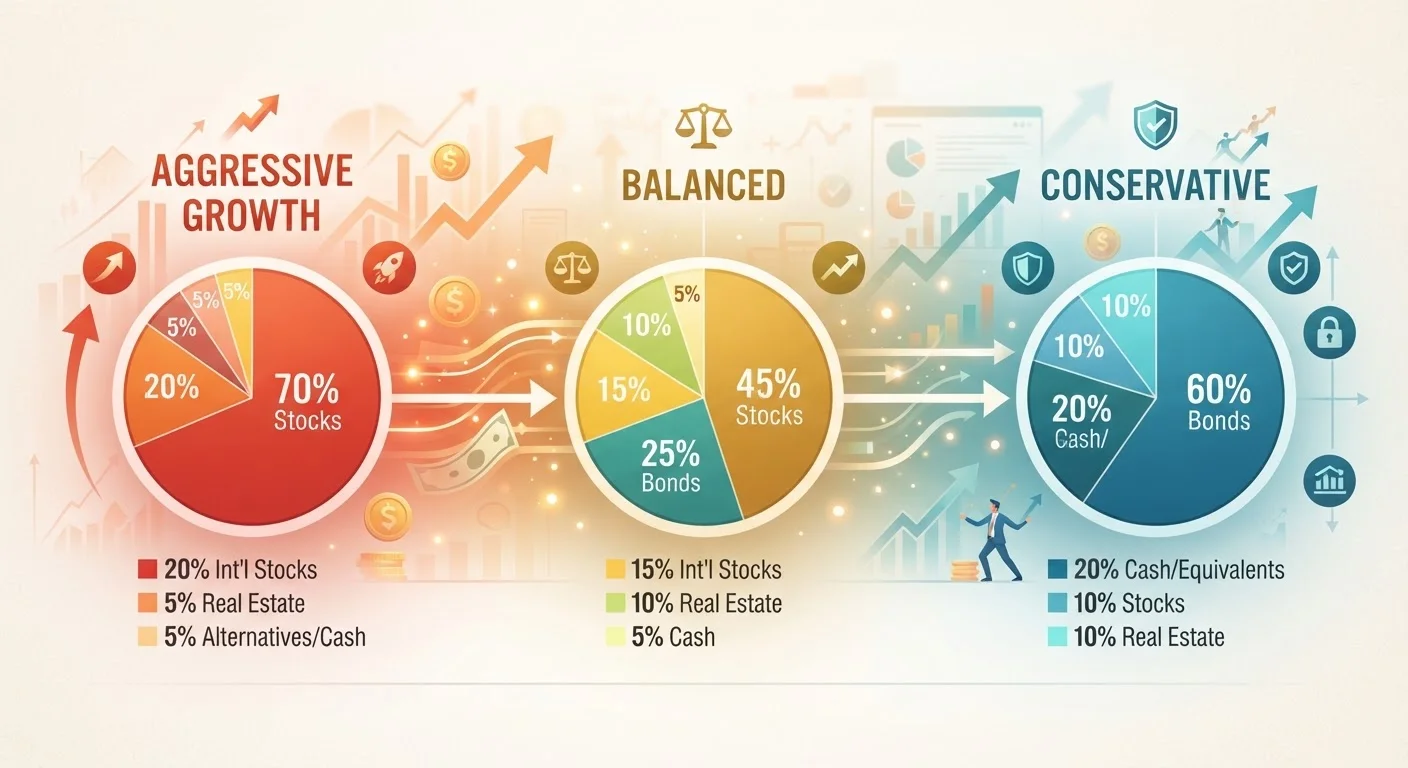
Key Takeaways
- Younger investors can generally afford more equity exposure because time absorbs short-term market volatility.
- As retirement approaches, gradually shifting toward bonds and stable assets helps protect accumulated wealth.
- Life events — not just age — should trigger allocation reviews, including job changes, marriage, and inheritance.
- Rebalancing at least annually keeps your portfolio aligned with your intended risk level.
- No single allocation formula fits every person; individual risk tolerance and goals matter as much as age.
Why Asset Allocation Changes Matter
Asset allocation — how you divide your investments among stocks, bonds, and cash — is one of the most consequential decisions in personal finance. Research consistently shows that allocation decisions explain the majority of a portfolio's long-term return variability, far more than individual security selection.
The core principle is straightforward: your capacity to absorb investment risk decreases as your time horizon shortens. A 28-year-old who watches a portfolio drop 30% has a decade or more to recover. A 62-year-old facing the same loss, who plans to begin withdrawals in three years, does not have that luxury. For a strong foundation on investing fundamentals before diving into allocation, see our comprehensive beginner's guide.
This article covers general principles — not personalized advice. Your specific situation, goals, and risk tolerance should guide decisions made with a qualified financial adviser.
Early Career: Lean Into Growth (20s–30s)
In your 20s and early 30s, time is your most powerful financial asset. Decades of compounding returns mean even modest contributions can grow substantially. This long runway justifies a higher allocation to equities (stocks), which carry more volatility but historically deliver stronger long-term returns than bonds or cash.
A commonly cited rule of thumb — subtract your age from 110 or 120 to estimate your stock percentage — suggests something like 80–90% equities for someone in their late 20s. This is a rough heuristic, not a prescription. Your actual allocation should also reflect your personal risk tolerance. Someone who would panic-sell during a market correction may benefit from a slightly more conservative mix, even at a young age.
Start with higher equity exposure in your 20s and reduce it gradually over decades.
A longer time horizon means more opportunity to recover from market downturns. Historically, equities have outperformed other asset classes over long periods, making early exposure valuable for wealth accumulation.
Rebalance your portfolio at least once per year to maintain your intended allocation.
Market movements naturally drift your portfolio away from its target mix. Without rebalancing, a strong equity run can leave you overexposed to stocks just before a downturn — taking on more risk than you intended.
Revisit your allocation whenever a major life event changes your financial picture.
Age is only one input. Marriage, divorce, a new child, job loss, or an inheritance can meaningfully shift your risk capacity and investment goals.
Account for inflation risk even in conservative portfolios near or in retirement.
Holding too much in cash or short-term bonds can erode purchasing power over a 20–30-year retirement. Some equity exposure helps counter inflation's long-term drag.
Use tax-advantaged accounts strategically when deciding where to hold different asset types.
Asset location — which accounts hold which assets — can meaningfully affect after-tax returns. Tax-inefficient assets like bonds may be better held in tax-deferred accounts.
Alongside building your portfolio, it's worth developing sound budgeting and saving habits that keep contributions consistent.
Mid-Career: Balance Growth With Protection (40s–50s)
The middle decades of a working life are when many people hit peak earnings — but also face competing financial demands: mortgages, college costs, aging parents. Your portfolio should still grow, but this phase calls for a gradual and deliberate shift toward a more balanced allocation.
Rather than a single dramatic rebalancing, the shift should happen incrementally — perhaps increasing bond exposure by a few percentage points every few years. A diversified mix at this stage might look more like 60–70% equities and 30–40% fixed income (bonds), though individual circumstances vary significantly.
90%+
Portfolio variability explained by asset allocation
A widely cited 1986 study by Brinson, Hood, and Beebower published in the Financial Analysts Journal found that asset allocation policy explained more than 90% of variability in portfolio returns over time.
20–30 years
Typical retirement duration for US adults
According to the Social Security Administration, a 65-year-old today can expect to live, on average, into their mid-to-late 80s — underscoring the need for growth assets even in retirement.
Diversification across asset classes becomes especially important here. A portfolio heavily concentrated in one sector or geography carries risks that become harder to recover from as retirement approaches.
“The most important decision you'll make in investing is your asset allocation. How you divide your money among stocks, bonds, and cash is far more important than which specific securities you pick.”
— John Bogle, Founder of The Vanguard Group and pioneer of index fund investing
Near and In Retirement: Prioritize Stability (60s and Beyond)
As you approach retirement — typically within five to ten years of your target date — capital preservation rises in priority. A significant market downturn early in retirement can permanently impair a portfolio through a phenomenon known as sequence-of-returns risk: withdrawing funds during a down market locks in losses before the portfolio has a chance to recover.
A common approach is to hold at least one to three years of expected spending needs in cash or short-term bonds as a buffer, so you aren't forced to sell equities during a downturn. Even in retirement, though, many financial planners caution against abandoning equities entirely. With retirements potentially lasting 20–30 years, some equity exposure helps a portfolio keep pace with inflation over time.
Target-Date Funds Automate the Shift
Target-date funds are designed to handle allocation changes automatically, gradually shifting from equities to bonds as your selected retirement year approaches. They offer a low-maintenance option for investors who prefer a hands-off approach. However, different fund families use different glide paths, so it's worth reviewing whether the specific fund's approach aligns with your personal risk tolerance and retirement timeline.
How you invest regular contributions can also support stability. Reviewing dollar-cost averaging versus lump-sum strategies can help you decide how to deploy assets during market uncertainty.
This article is for general informational purposes only and does not constitute personalized financial, investment, tax, or legal advice. Consult a licensed financial adviser before making investment decisions.