
Key Takeaways
- Secured debt is tied to a specific asset; defaulting can result in that asset being repossessed or foreclosed.
- Unsecured debt carries no collateral, so lenders rely on lawsuits and credit reporting to collect overdue balances.
- Interest rates on secured debt are generally lower because the lender's risk is reduced by the collateral.
- In bankruptcy, secured and unsecured debts are treated very differently, affecting what you keep and what gets discharged.
- Knowing which type of debt you hold is essential before choosing a payoff strategy or seeking debt relief.
Option A
Secured Debt
Backed by collateral — lenders have a direct claim on a specific asset.
Best for: Borrowers seeking lower interest rates who are comfortable pledging an asset such as a home or vehicle as security.
Option B
Unsecured Debt
No collateral required — approved on creditworthiness alone.
Best for: Borrowers who need flexible access to credit without risking a specific asset, typically at a higher interest rate.
If you want the lowest possible interest rate and can pledge an asset
Secured Debt
Lenders price secured loans lower because collateral reduces their exposure. Mortgages and auto loans are typical examples where this trade-off clearly benefits borrowers who can manage repayment.
If you need to borrow without risking a specific asset
Unsecured Debt
Credit cards and personal loans don't put your home or car on the line. You pay a higher rate for that flexibility, but no single asset faces immediate seizure if you fall behind.
If you're weighing debt relief options like bankruptcy or settlement
Secured Debt
Understanding which debts are secured is critical before pursuing any formal relief path — secured creditors have priority claims that can complicate or limit discharge options.
If you're prioritizing which debts to pay first during a cash crunch
Secured Debt
Missing payments on secured debt risks losing the underlying asset, making it typically more urgent to address than unsecured balances during financial hardship.
What Makes Debt Secured or Unsecured
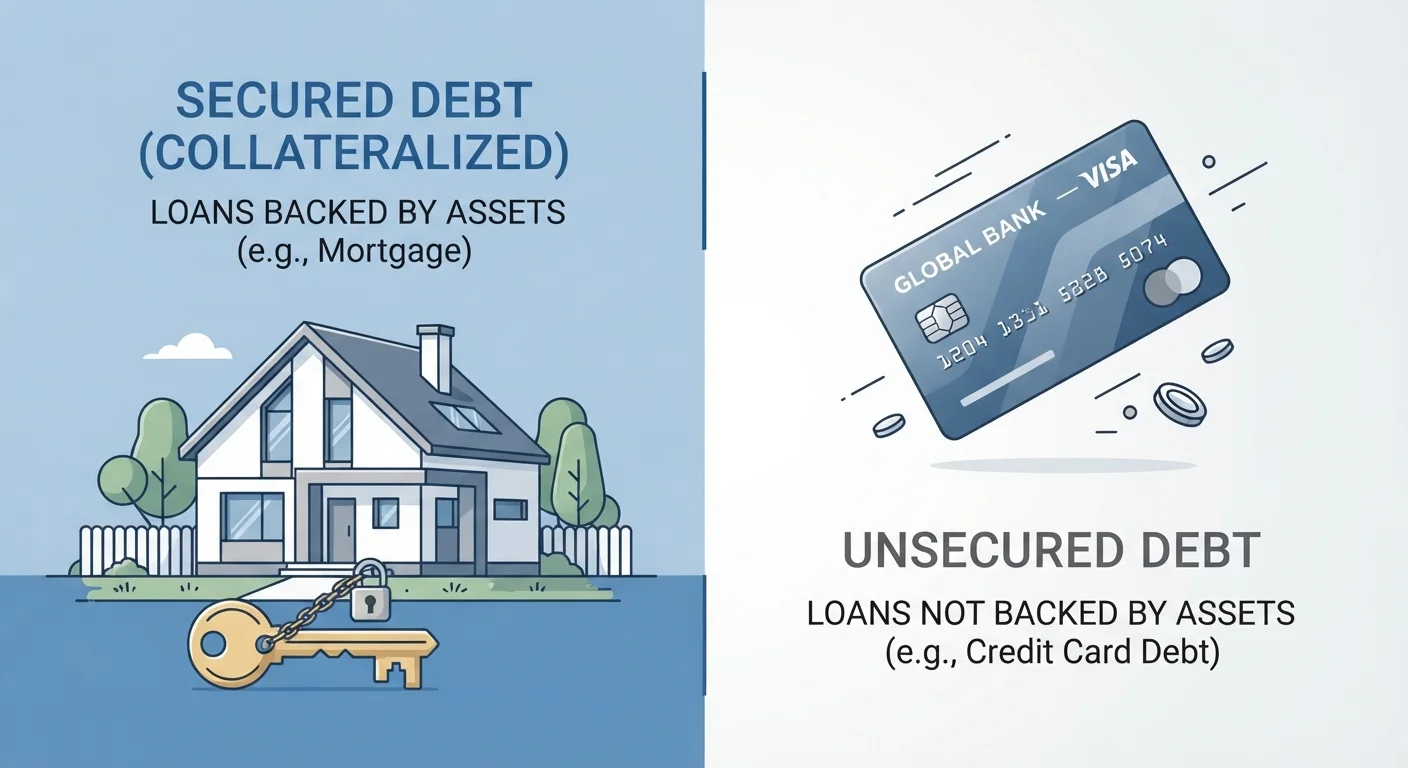
The core distinction is simple: secured debt is backed by a specific asset — called collateral — while unsecured debt is not. When you take out a mortgage, the home itself secures the loan. If you stop making payments, the lender has the legal right to foreclose and recover the property. The same logic applies to auto loans: default, and the lender can repossess the vehicle.
Unsecured debt works differently. When a lender extends a credit card line or approves a personal loan without collateral, they're betting entirely on your creditworthiness — your credit score, income, and repayment history. There's no specific asset the lender can immediately seize if you default.
Common examples of each type:
- Secured: Mortgages, home equity loans and lines of credit (HELOCs), auto loans, secured credit cards
- Unsecured: Credit cards, personal loans, medical bills, student loans, utility arrears
For a broader reference on borrowing terminology, see our debt and credit glossary.
| Criterion | Secured Debt | Unsecured Debt |
|---|---|---|
| Collateral required | Yes — specific asset pledged | No — based on creditworthiness |
| Typical interest rate | Lower (lender risk reduced) | Higher (lender risk elevated) |
| Common examples | Mortgage, auto loan, HELOC | Credit cards, personal loans, medical bills |
| Default consequence | Repossession or foreclosure of asset | Collection, judgment, wage garnishment |
| Treatment in Chapter 7 bankruptcy | Creditor retains lien; must reaffirm or surrender asset | Often dischargeable |
| Credit score impact of default | Severe — plus asset loss | Severe — but no direct asset seizure |
| Loan amount potential | Generally higher (tied to asset value) | Generally lower (tied to credit profile) |
How Lenders Use This Distinction — and What It Costs You
Collateral reduces a lender's risk. Because a secured lender has a concrete fallback — they can sell the asset to recover losses — they're typically willing to offer lower interest rates and higher loan amounts than unsecured lenders. Mortgage rates, for example, are consistently lower than personal loan rates for creditworthy borrowers, reflecting this reduced risk.
Unsecured lenders absorb more risk, so they compensate with higher rates. Credit card APRs frequently range well above 20%, while personal loan rates vary widely based on credit profile. The absence of collateral also means lenders scrutinize your debt-to-income ratio and credit score more closely before approving you.
~$1.14T
Total US credit card debt outstanding
According to Federal Reserve data, US revolving consumer credit — predominantly credit cards — exceeded $1.1 trillion, illustrating the scale of unsecured borrowing Americans carry.
~$12.6T
Total US mortgage debt outstanding
Federal Reserve figures show mortgage debt as by far the largest category of household debt, reflecting how widely secured borrowing underpins homeownership in the United States.
20%+
Average credit card APR
The Federal Reserve's consumer credit data consistently shows average credit card interest rates well above 20%, underscoring the higher cost of unsecured borrowing compared to secured alternatives.
One nuance worth understanding: secured credit cards require a cash deposit that typically becomes your credit limit. These aren't traditional collateral-backed loans, but the deposit functions similarly — the lender can apply it if you default. They're commonly used as a credit-building tool for borrowers with limited or damaged credit history.
What Happens When You Can't Pay
This is where the secured vs. unsecured distinction has the most immediate impact on your life. With secured debt, the consequences of default are direct and tangible: miss enough mortgage payments and you face foreclosure; stop paying an auto loan and your car gets repossessed. The lender's remedy is built into the loan structure.
With unsecured debt, lenders can't immediately seize an asset, but that doesn't mean they're powerless. After charge-off — typically after 180 days of non-payment for credit cards — the debt is often sold to a collection agency. Collectors can then pursue legal action, and if they obtain a court judgment, they may be able to garnish wages or levy bank accounts depending on your state's laws. Your rights in those interactions are defined by federal law; see how to handle debt collector contact for specifics.
State Law Affects Collector Remedies
Whether a creditor with an unsecured judgment can garnish wages or levy a bank account depends heavily on your state. Some states offer significant exemptions that limit garnishment, while others provide fewer protections. If a creditor has sued you or obtained a judgment, consulting a consumer law attorney or a nonprofit credit counselor can help you understand your specific exposure.
In bankruptcy, the type of debt matters significantly. Chapter 7 bankruptcy can discharge many unsecured debts, but secured creditors retain their claim on the collateral unless you reaffirm the debt or surrender the asset. Chapter 13 involves a repayment plan that can help you catch up on secured arrears. The formal options for unmanageable debt — including bankruptcy, settlement, and credit counseling — are covered in detail in comparing debt relief paths.
Applying This Knowledge to Your Repayment Strategy
Knowing whether a debt is secured or unsecured should directly inform how you prioritize payments. As a general principle, secured debts that protect critical assets — your home, your vehicle needed for work — warrant priority during a cash shortfall. Losing those assets can trigger a cascade of financial problems that makes every other debt harder to manage.
That said, high-interest unsecured debt (particularly credit cards) can cause serious long-term damage if only minimums are paid. Two structured approaches — the debt avalanche and debt snowball methods — offer frameworks for deciding which balances to attack first. Comparing those strategies can help you build a plan that fits your priorities and temperament.
If you're managing several obligations simultaneously, the type of each debt should anchor your overall picture. Approaches for juggling multiple debts offer structure for keeping progress consistent without losing sight of what's most at risk. And if simplifying repayment is the goal, debt consolidation may be worth examining — though it carries its own trade-offs depending on whether the new loan is secured or unsecured.
This article is for general informational and educational purposes only and does not constitute personalized financial, legal, or tax advice. Consult a qualified financial professional for guidance specific to your situation.