
Key Takeaways
- The debt avalanche targets the highest-interest debt first, minimizing total interest paid over time.
- The debt snowball targets the smallest balance first, delivering quick wins that reinforce consistent behavior.
- Research suggests many borrowers benefit more from the motivational structure of the snowball method.
- Both strategies require paying minimums on all debts while directing extra funds to one priority account.
- The mathematically superior method only works if you stick with it — consistency matters more than optimization.
Option A
Debt Avalanche
The mathematically optimal, interest-minimizing approach.
Best for: Disciplined borrowers who want to minimize total interest paid over the life of their debts.
Option B
Debt Snowball
The psychologically motivating, momentum-building approach.
Best for: Borrowers who need early wins to stay engaged and sustain momentum through a long repayment journey.
If you have high-rate debt (e.g., credit cards above 20% APR) and strong financial discipline
Debt Avalanche
Attacking the highest-interest balances first directly reduces what you owe to lenders over time, making it the more cost-efficient choice when discipline is not in question.
If you've struggled to stay motivated with debt payoff attempts in the past
Debt Snowball
Eliminating small balances quickly creates genuine psychological momentum, which research indicates improves follow-through for many borrowers.
If your debts carry similar interest rates across the board
Debt Snowball
When interest rate differences are minimal, the avalanche's mathematical advantage shrinks, making the snowball's motivational edge more valuable.
If you carry a large, high-rate balance dwarfing your other debts
Debt Avalanche
A single oversized high-rate debt can cost significantly more over time if not prioritized — the avalanche keeps that cost from compounding unchecked.
How Each Strategy Works
Both strategies share the same mechanical foundation: pay the minimum on every debt each month, then direct any extra dollars to one specific account. The strategies differ only in which account gets that priority payment.
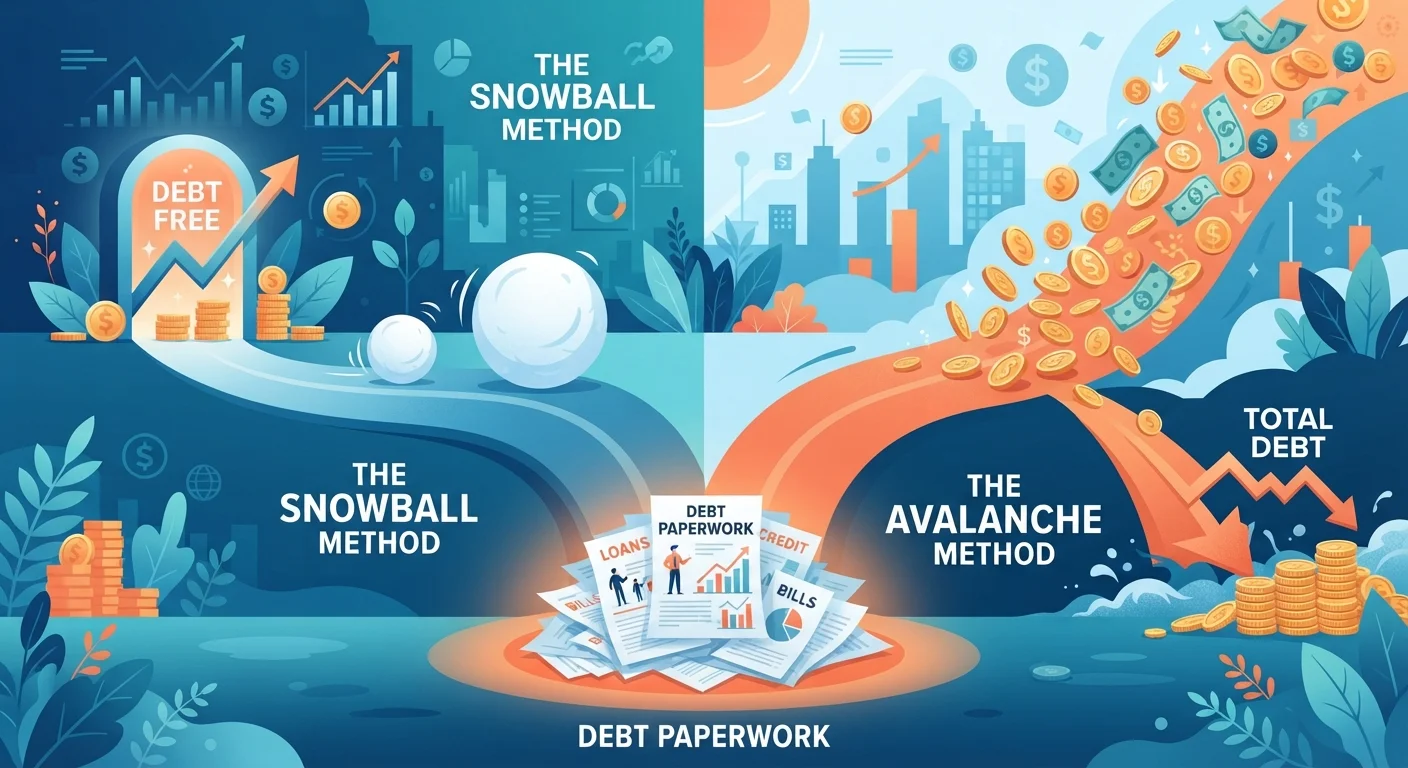
Debt Avalanche: You rank your debts from highest to lowest annual percentage rate (APR). Every extra dollar goes toward the highest-rate balance first. Once that debt is eliminated, you redirect the freed-up payment — plus any additional amount — to the next highest-rate debt. This continues until all balances reach zero.
Debt Snowball: You rank your debts from smallest to largest balance, regardless of interest rate. Every extra dollar targets the smallest balance. Once cleared, the freed-up payment rolls into the next smallest balance, building momentum like a snowball gaining mass downhill.
Neither method requires a minimum extra-payment threshold to begin. Even an additional $25 per month applied consistently to one target debt accelerates your payoff timeline compared to paying minimums across all accounts. For a broader view of structuring repayment across multiple obligations, see our guide to managing multiple debts at once.
| Criterion | Debt Avalanche | Debt Snowball |
|---|---|---|
| Payoff priority | Highest APR first | Smallest balance first |
| Total interest paid | Generally lower | Generally higher |
| Time to first payoff | Potentially longer | Faster early wins |
| Motivational structure | Delayed gratification | Frequent milestones |
| Best execution requirement | High discipline sustained | Momentum builds naturally |
| Mathematical optimality | Yes, when fully completed | No, but completion rates improve |
| Cash flow relief (freed minimums) | Slower to accumulate | Faster account elimination |
The Real Cost Difference
The avalanche's primary advantage is straightforward: interest compounds daily on most revolving debt. Eliminating a 24% APR balance before a 12% APR balance means fewer days of expensive compounding. Over a multi-year payoff, this difference can amount to hundreds or even thousands of dollars — the exact figure depends on your specific balances and rates.
The snowball, by contrast, may leave higher-rate balances accruing longer than necessary. The trade-off is behavioral: studies in consumer finance research — including work published in the Journal of Marketing Research — have found that borrowers who use a balance-focused approach are more likely to maintain consistent payments over time, potentially outperforming those who start an avalanche but lose motivation mid-course.
~$1,000+
Potential interest savings with avalanche vs. snowball
The exact savings vary by balance size and rate spread; on a $15,000 multi-card debt mix, the difference can reach four figures over a full payoff period.
15–17%
Average credit card APR in the US (approximate historical range)
Federal Reserve consumer credit data has historically shown average revolving credit APRs in the mid-to-high teens, though rates for new accounts have risen in recent years.
Higher completion
Snowball adherence vs. rate-based strategies
Consumer finance research has found that targeting smaller balances — rather than highest rates — correlates with greater repayment follow-through and account closure rates.
The honest takeaway: the avalanche is cheaper on paper, but only if you execute it fully. A partially completed avalanche may cost more than a completed snowball. Your personal track record with financial commitment is relevant information here.
Choosing the Right Method for Your Situation
There is no universal answer, but a few factors can sharpen your decision:
- Interest rate spread: If your highest-rate debt carries an APR 10 or more percentage points above your others, the avalanche's savings are harder to ignore. If rates are clustered closely together, the snowball's motivational benefit may outweigh the marginal cost difference.
- Number of accounts: Many small balances make the snowball particularly effective — each closed account simplifies your financial picture and reduces the cognitive load of tracking multiple minimums.
- Income stability: Borrowers with irregular income may find the snowball's early victories create a useful buffer of eliminated minimum payments, freeing up cash flow during lean months.
- Personal psychology: Be honest about past behavior. If you've abandoned repayment plans before, the snowball's structured wins may be the missing ingredient.
It is also worth considering whether either method is appropriate given your broader financial picture. Debt consolidation, for instance, can sometimes reduce your effective interest rate before you begin a structured payoff — see our overview of debt consolidation trade-offs for context. And if your debt load feels genuinely unmanageable, formal options exist beyond DIY strategies — our comparison of bankruptcy, settlement, and credit counseling can help orient you. Finally, whichever payoff path you choose, pairing it with a sound savings philosophy strengthens your overall financial position — our comparison of paying yourself first vs. budgeting what's left explores complementary approaches.
Hybrid Approaches Are Valid
Some borrowers use a hybrid method: knocking out one or two tiny balances quickly (snowball logic) to simplify their debt landscape, then switching to avalanche order for the remaining, larger accounts. This is not a formal strategy, but it can make practical sense when a small balance with a moderate rate is almost paid off anyway. There is no rule requiring you to pick exactly one method and never deviate.
This article is for general informational and educational purposes only and does not constitute personalized financial advice. Consult a qualified financial professional before making decisions about your specific debt situation.