
Key Takeaways
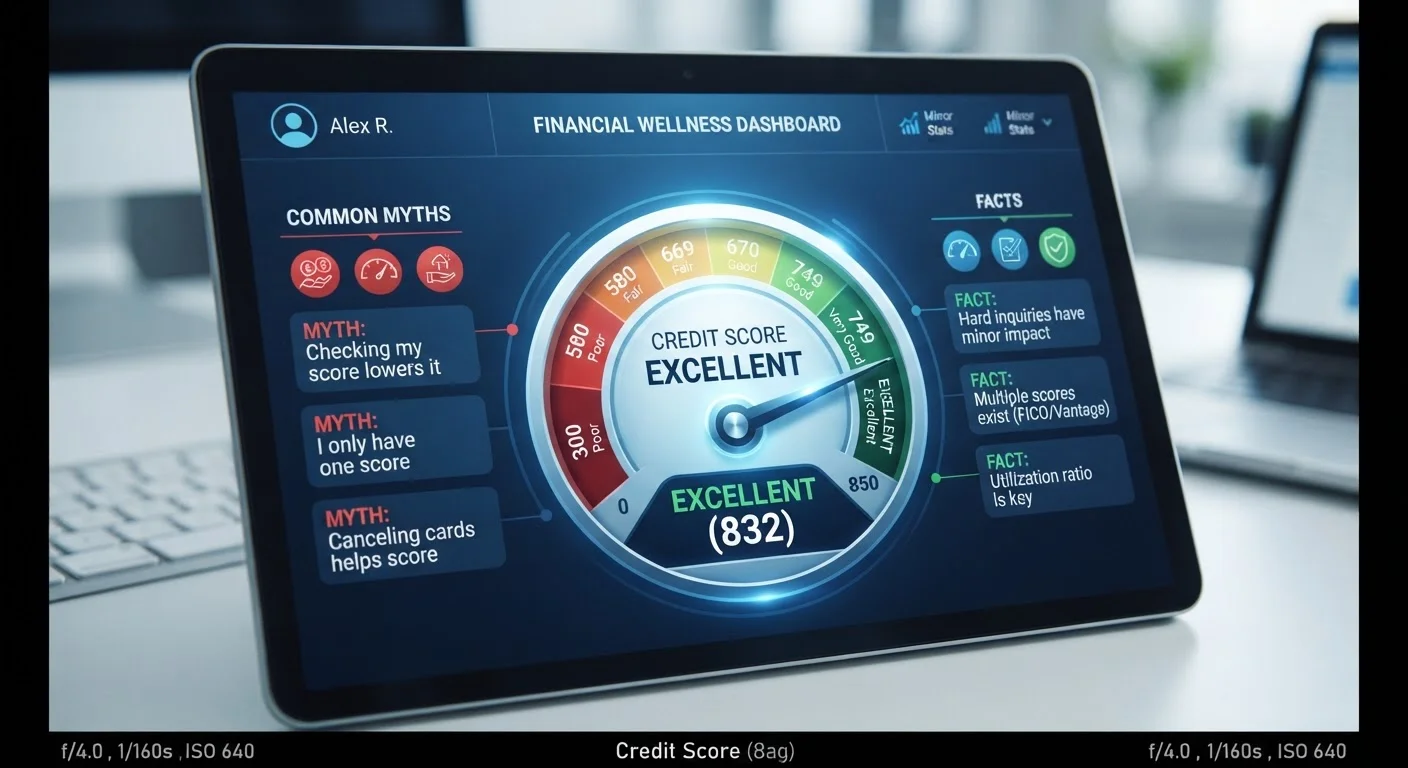
- Checking your own credit score never lowers it — only hard inquiries from lenders can.
- Closing old credit cards can actually hurt your score by reducing available credit and history length.
- Carrying a balance does not improve your credit score; it only adds unnecessary interest charges.
- Income has no direct effect on your credit score — lenders verify it separately.
- A single missed payment can damage your score significantly, but recovery is possible with consistent habits.
Why These Myths Persist — And What They Cost You
Credit scores sit at the intersection of everyday financial decisions and long-term financial health, yet most Americans learned what they know about them through word-of-mouth, not verified sources. These gaps in understanding have real consequences: people avoid checking their scores out of fear, pay unnecessary interest thinking it helps them, or close accounts that were quietly anchoring their credit age.
The good news is that credit scoring is well-documented. The FICO model — used in the vast majority of US lending decisions — publishes its factor categories openly. The Consumer Financial Protection Bureau (CFPB) provides public guidance on how scores work. There is no mystery here, only misinformation that's easy to correct once you have the right framework.
The myth-and-fact pairs below address the most damaging misconceptions directly. Read them alongside our deeper explainer on what your credit score actually measures if you want the full picture of how each factor is weighted.
Myth
Checking your own credit score will lower it.
Fact
Checking your own score is a soft inquiry and has zero impact on your credit score.
This is one of the most persistent myths in personal finance, and it stops people from monitoring their credit regularly. When you check your own score — whether through a free service, your bank, or AnnualCreditReport.com — it registers as a soft inquiry. Soft inquiries are invisible to lenders and do not affect your score at all.
Only hard inquiries, triggered when a lender pulls your report to evaluate a credit application, can temporarily reduce your score — typically by a modest amount. Reviewing your own report frequently is good financial hygiene, not a liability. See how to conduct a thorough annual checkup to make the most of your free reports.
Myth
Carrying a credit card balance each month helps build your score.
Fact
Carrying a balance adds interest costs but provides no credit score benefit whatsoever.
This myth may originate from a misunderstanding of credit utilization — the ratio of your outstanding balances to your total credit limits. Lenders and scoring models want to see activity on your accounts, but they do not reward you for paying interest. Paying your statement balance in full each month demonstrates responsible use without costing you a dollar in interest.
In fact, high balances can hurt your score by pushing up your utilization ratio. FICO data consistently shows that consumers with the highest scores keep utilization below 10%. Utilization is one of the fastest-moving factors in your score — keeping balances low matters far more than carrying them.
Myth
Closing old or unused credit cards will improve your score.
Fact
Closing cards typically lowers your score by reducing available credit and shortening your credit history.
The instinct to tidy up your wallet is understandable, but closing accounts has two negative consequences. First, it reduces your total available credit, which raises your utilization ratio even if your spending doesn't change. Second, it can shorten the average age of your accounts — a factor that influences roughly 15% of your FICO score.
Unless a card carries an annual fee that outweighs its value, keeping it open and making occasional small purchases (paid off in full) is usually the better strategy. If you're building credit from the ground up, starting with the right accounts matters as much as maintaining them.
Myth
Your income directly affects your credit score.
Fact
Credit scoring models do not consider income, employment status, or net worth.
Your credit score is calculated entirely from data in your credit report: payment history, amounts owed, credit age, account mix, and new credit. Income is not part of that report. A high earner who misses payments will have a lower score than a modest earner who pays on time, every time.
Lenders do assess income separately during the underwriting process — typically through pay stubs or tax returns — to evaluate your debt-to-income ratio. But that evaluation is distinct from your credit score. For a full breakdown of what actually goes into the number, see how each factor is weighted.
Myth
You only have one credit score.
Fact
You have dozens of credit scores, calculated by multiple bureaus using different models and versions.
The three major credit bureaus — Equifax, Experian, and TransUnion — each maintain their own credit file on you, and those files can differ. Multiple scoring models (FICO 8, FICO 9, VantageScore 3.0, and others) can be applied to each file, producing different results. Mortgage lenders, auto lenders, and card issuers may use different model versions depending on their industry and preferences.
The score you see through a free monitoring app is likely a consumer-facing version, which may differ from what a lender pulls. Reviewing your full credit report — not just a single score — gives you the most accurate picture. Learn what each section of your report contains so you know exactly what lenders see.
Putting Accurate Knowledge Into Practice
Correcting your mental model is the first step. Acting on that correction is what moves the needle.
35%
Of your FICO score tied to payment history
According to FICO's published scoring factor breakdown, on-time payment history is the single largest component of a standard FICO score.
~5 points
Typical score dip from a single hard inquiry
FICO indicates that a new hard inquiry generally lowers a score by fewer than five points for most consumers, and the effect fades within a year.
30%
Of FICO score driven by amounts owed
FICO's published weighting shows that amounts owed — including credit utilization — is the second-largest factor after payment history.
The single highest-impact habit remains consistent on-time payment. Payment history accounts for approximately 35% of a FICO score — more than any other factor. Setting up autopay for at least the minimum due protects you from accidental misses, while paying the full statement balance eliminates interest entirely.
Beyond payment history, keeping your utilization low is the lever you can pull most quickly. Paying down balances before your statement closes — not just by the due date — can reduce the balance your issuer reports to the bureaus that month. Pair that discipline with a regular review of your credit reports for errors and signs of fraud, and you have a solid, evidence-based strategy.
This article is for general informational and educational purposes only and does not constitute personalised financial or credit advice. Consult a qualified financial professional for guidance specific to your situation.