

Key Takeaways
- The gap between saving intentions and saving behavior is a universal human cognitive pattern, not a personal character flaw.
- Present bias, mental accounting, and status quo inertia are the three main psychological forces working against consistent saving.
- Structural changes — like automation — reliably outperform willpower-based strategies for building savings habits.
- Small, concrete commitments tied to specific triggers are more effective than broad, open-ended savings goals.
- Understanding your own behavioral patterns is the prerequisite for designing a savings system that actually works.
The Intention-Action Gap
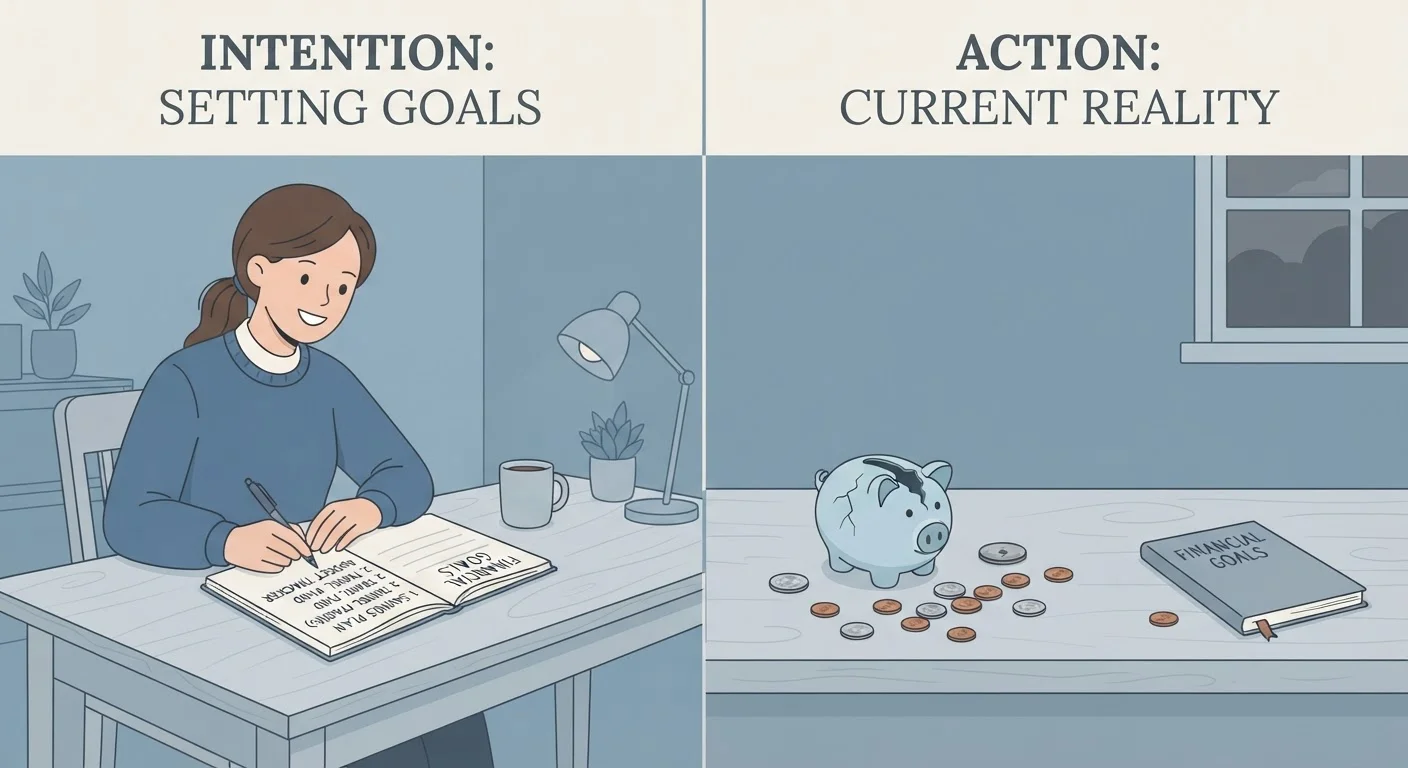
The intention-action gap is the well-documented disconnect between what people plan to do with their money and what they actually do. Most Americans genuinely intend to save more, yet consistently fall short — not because of laziness or moral failure, but because of how the human brain is wired to prioritize present rewards over future ones. Behavioral economics studies this gap systematically and offers practical tools to close it.
Researchers refer to this phenomenon as the "present bias" — a cognitive tendency formalized in hyperbolic discounting models, where future rewards are devalued at a steeper rate than classical economic theory predicts.
Why Good Intentions Aren't Enough
Most people who aren't saving enough aren't indifferent to their financial future — they're caught in a gap between what they plan to do and what they actually do. This isn't a character flaw. It's a predictable outcome of how human cognition works, and behavioral economics has been mapping it carefully for decades.
The core problem is present bias: the brain assigns disproportionately high value to immediate rewards compared to future ones. When payday arrives, the abstract future benefit of saving competes against concrete present pleasures — a dinner out, a new purchase, paying down a stressful bill. The future almost always loses that contest, regardless of how sincere your earlier intention was.
This same dynamic plays out across many areas of life, not just money. The research on why adults abandon online courses reveals a nearly identical pattern: high initial motivation, followed by dropout when the immediate cost of effort outweighs the still-abstract future payoff. The psychology is the same; only the domain changes.
57%
Americans unable to cover a $1,000 emergency
According to a Bankrate survey, more than half of U.S. adults could not pay for a $1,000 unexpected expense from savings alone.
~40%
Increase in 401(k) enrollment after auto-enrollment
Research cited by the Pension Research Council found that automatic enrollment dramatically increased retirement plan participation, particularly among lower-income workers.
3x
Greater savings rates with commitment devices
Studies on the Save More Tomorrow program found that participants who pre-committed to saving future raises accumulated savings rates several times higher than non-participants over multi-year periods.
The Three Forces Sabotaging Your Savings
Understanding which specific mechanisms undermine saving gives you something concrete to work with. Three in particular account for most of the intention-action gap:
1. Present Bias and Hyperbolic Discounting
As described above, future rewards are systematically devalued. A dollar today feels worth more than a dollar next year, even when you intellectually understand that isn't rational. This bias compounds over time: the further away the benefit, the more steeply discounted it becomes.
2. Mental Accounting
People don't treat all money the same way. A $500 tax refund gets spent on something discretionary; a $500 paycheck gets budgeted. A windfall feels like "bonus" money. This psychological categorization — called mental accounting — can easily redirect funds that you nominally planned to save. It also explains why people hold cash savings while carrying high-interest debt: the accounts feel emotionally distinct even when the math clearly favors paying down the debt.
3. Status Quo Bias and Inertia
Whatever you're doing now has a strong psychological advantage. Changing a default — like setting up a new savings transfer — requires a decision, which requires energy. Inertia means most people never make that decision, so default behaviors (spending what's available) persist. This is why automatic enrollment in workplace retirement plans has dramatically increased participation rates: the default was changed for people, not willpower.
Use Automation to Defeat Present Bias
Schedule a savings transfer to coincide exactly with your payday — ideally the same day. When money moves before it hits your spending account, the decision has already been made. Even $25 or $50 per paycheck is enough to establish the habit and remove the behavioral friction that derails most saving intentions.
What Actually Bridges the Gap
Knowing these biases exist is useful. Designing around them is what actually changes behavior.
Automation is the most powerful tool available. When savings transfers happen automatically — triggered by your paycheck — the decision is made once, not repeatedly. There's no moment for present bias to intervene. Setting up automatic transfers is arguably the single highest-leverage action most savers can take.
Reframing mental accounts strategically also helps. Naming a savings account "Emergency Fund" rather than leaving it unlabeled makes withdrawals feel psychologically costlier — which is a feature, not a bug. Using separate accounts for distinct goals leverages the same mental accounting tendency that normally works against saving.
Commitment devices — pre-committing to future saving increases tied to raises or bonuses — sidestep present bias by making the decision before the money arrives. Programs like "Save More Tomorrow," originally studied by economists Shlomo Benartzi and Richard Thaler, showed that pre-committing workers to save a portion of future raises produced significant savings rate increases over time, with minimal resistance.
It's also worth questioning assumptions you hold about saving — some of the most persistent saving myths can make the problem feel bigger or smaller than it actually is.
“The Save More Tomorrow program shows that people can be helped to help themselves. By pre-committing to save more in the future, they sidestep the present-bias problem entirely.”
— Richard Thaler, Nobel Prize-winning economist and co-developer of the Save More Tomorrow program
Building a System That Works With Your Brain
There are two foundational philosophies for structuring savings, and understanding them can sharpen how you apply behavioral insights in practice. Paying yourself first versus budgeting what's left reflect different assumptions about human psychology — one trusts automation and pre-commitment; the other trusts discipline and planning. For most people, the behavioral evidence favors the former.
The practical takeaway: stop relying on willpower as the mechanism. Willpower is a finite resource that depletes with stress, fatigue, and decision overload — conditions that are routine in most adults' lives. The people who save consistently tend to have systems that work automatically, not unusually strong self-control.
Start small and make it automatic. A $25 or $50 weekly auto-transfer establishes the habit and removes the friction. Increase the amount as your income grows. The goal isn't perfection from day one — it's removing the decision point where your brain's present bias reliably wins.
This article is for general informational and educational purposes only and does not constitute personalized financial advice. Consider consulting a qualified financial professional for guidance specific to your situation.