

Key Takeaways
- Human perception of speed is unreliable and influenced by context, familiarity, and visual cues.
- Drivers consistently underestimate speed when transitioning from high-speed roads to slower environments.
- Deliberate habits - like checking the speedometer regularly - can compensate for perceptual blind spots.
- Stopping distance increases exponentially with speed, making even small misjudgments consequential.
- Fatigue and distraction make speed perception errors significantly worse.
Why Your Brain Gets Speed Wrong
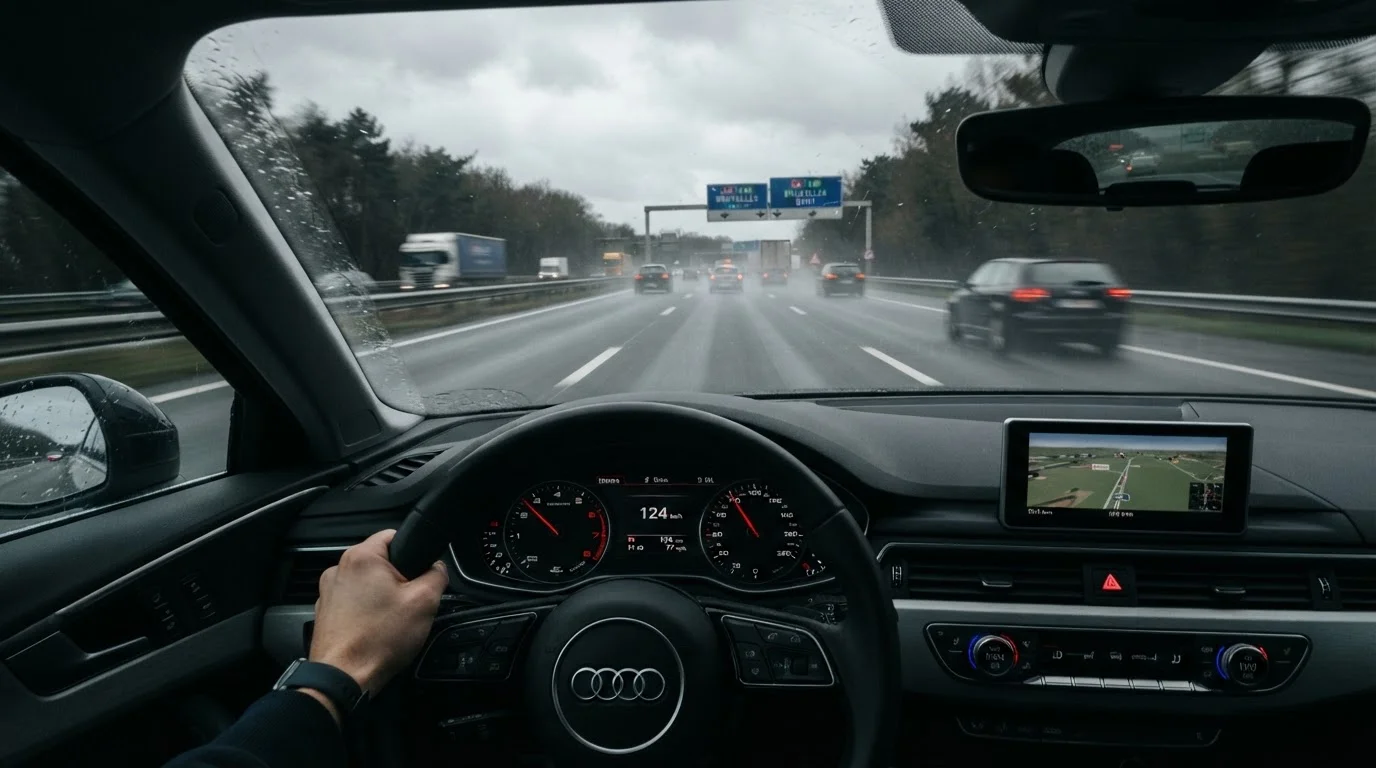
Speed perception is not a precise sense - it's an inference your brain constructs from visual flow, vibration, engine sound, and familiarity with a route. Each of those inputs can mislead you. Wide, straight roads with few roadside objects make speed feel lower than it is. A familiar commute can feel slower simply because your brain has stopped paying close attention to it.
This matters because most drivers treat speed judgment as automatic and reliable. It isn't. The science behind stopping distance illustrates exactly why small speed errors are dangerous: stopping distance doesn't increase linearly with speed, it grows exponentially. At 40 mph versus 30 mph, the physics shift dramatically against you.
Speed Misjudgment Can Be Fatal
Research consistently links speeding - including unintentional speeding - to a significant share of fatal crash involvement. The danger isn't always the driver who deliberately races; it's the one who simply doesn't realize how fast they're going. Treating speed perception as a skill to actively manage, not a passive sense, is essential for safety.
Understanding that speed perception is a cognitive process - one that degrades with familiarity, fatigue, and distraction - is the first step toward managing it deliberately rather than passively.
The Most Common Speed Misjudgment Mistakes
Most speed-related errors don't come from recklessness. They come from perceptual gaps that feel invisible while they're happening. The following mistakes are among the most common and the most correctable.
Relying on how speed 'feels' instead of reading the speedometer.
Why it happens: The brain infers speed largely from peripheral visual flow and vibration cues, both of which adapt over time - making a constant speed feel progressively slower the longer you maintain it.
Underestimating speed after transitioning from a highway to a surface street.
Why it happens: After sustained high-speed travel, your perception recalibrates so that lower speeds feel even slower than they are - a well-documented phenomenon sometimes called 'velocity adaptation.'
Misjudging the closing speed of oncoming or merging vehicles.
Why it happens: Drivers reliably underestimate how fast a distant vehicle is approaching, especially when judging a head-on angle. Objects moving directly toward you expand slowly in your visual field at first, then rapidly - a perceptual illusion that distorts timing.
Driving at the same speed regardless of road environment or conditions.
Why it happens: Speed limits define a legal maximum, not an always-safe target. Drivers often anchor on the posted number and fail to adjust for curves, pedestrian activity, or reduced sight lines.
Ignoring how fatigue compounds speed perception errors.
Why it happens: Tired drivers have slower cognitive processing and reduced attention, which means speed cues are registered less accurately and reaction to speed changes is delayed.
Many of these errors compound each other. A driver who is fatigued, on a familiar road, transitioning from highway to city driving is subject to multiple perceptual distortions at once - a scenario that quietly raises crash risk without any single obvious trigger.
Building Habits That Compensate for Perception Gaps
Because perception can't be fully trusted, safer speed management relies on deliberate, repeated habits that override faulty intuition with objective information.
Highway-to-Urban Transitions Are High-Risk
After extended highway driving, your brain recalibrates to treat high speeds as 'normal.' Dropping to 35 mph on a surface street can feel far slower than it actually is. Give yourself a conscious reset - check the speedometer rather than trusting how the speed feels - whenever you exit a high-speed road.
Check the speedometer proactively, not reactively. Rather than glancing at it when you suspect you're over the limit, train yourself to check it on a regular cycle - especially on open roads where adaptation is most likely. This is one of the simplest interventions with consistent practical value.
Use following distance as a speed reality check. The two-second rule for following distance works partly because it forces you to observe your actual gap relative to the car ahead. If you're consistently closing gaps faster than you expect, your speed estimate is probably off.
Recalibrate deliberately at transitions. Every time you move from a high-speed environment to a lower-speed one, treat it as a conscious reset. Check your speed, resist the instinct to match the pace of surrounding traffic (which may also be traveling too fast post-highway), and hold a deliberate reduction for at least 60 seconds.
Safe speed management also connects to awareness in other challenging conditions. Whether navigating rain, snow, or fog or driving after dark, the underlying principle is the same: your senses can mislead you, and structured habits are your most reliable safeguard.
~29%
Fatal crashes involving speeding
According to the National Highway Traffic Safety Administration (NHTSA), speeding is consistently a factor in roughly 29% of all traffic fatalities in the United States.
2x
Stopping distance increase from 30 to 60 mph
Because stopping distance grows with the square of speed, doubling your speed roughly quadruples stopping distance - meaning small speed errors carry outsized consequences.