
Decoding the Monroney Sticker: What Every Line on a New Car's Window Label Means

| Legal basis | Automobile Information Disclosure Act of 1958 |
| Who may remove it | Only the buyer - removing before sale is a federal violation |
| Fuel economy figures issued by | U.S. Environmental Protection Agency (EPA) |
| Destination charge negotiable? | No - set by the manufacturer |
| Dealer add-ons negotiable? | Generally yes - often carry significant markup |
| Safety rating source | NHTSA and IIHS publish independent crash-test results |
What Is the Monroney Sticker and Why Does It Exist?
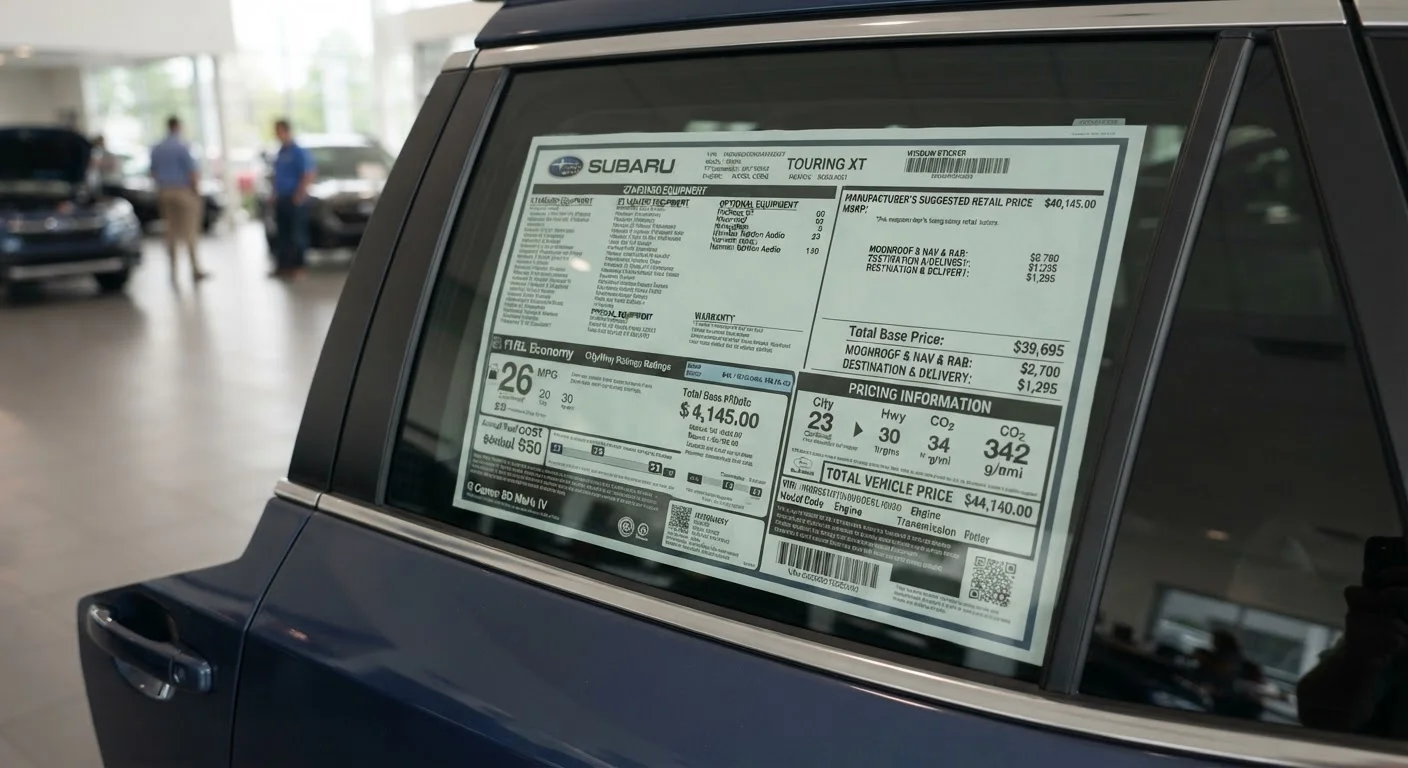
That printed label affixed to the window of every new car on a dealer lot isn't just decoration - it's a federally mandated disclosure document. Named after Senator Mike Monroney, who championed the Automobile Information Disclosure Act of 1958, the label requires manufacturers to publicly display pricing, equipment, and fuel economy data on each new vehicle. Removing it before sale - except by the buyer - is a federal violation.
The sticker's purpose is straightforward: give shoppers a standardized, trustworthy source of vehicle information so they can compare models and enter negotiations with accurate data. If you're buying your first car, understanding this document is one of the most practical things you can do before stepping into a dealership.
| Legal basis | Automobile Information Disclosure Act of 1958 |
| Who may remove it | Only the buyer - removing before sale is a federal violation |
| Fuel economy figures issued by | U.S. Environmental Protection Agency (EPA) |
| Destination charge negotiable? | No - set by the manufacturer |
| Dealer add-ons negotiable? | Generally yes - often carry significant markup |
| Safety rating source | NHTSA and IIHS publish independent crash-test results |
Breaking Down Each Section of the Label
Manufacturer and Model Information
The top of the sticker identifies the vehicle's make, model, trim level, model year, and the plant where it was assembled. The Vehicle Identification Number (VIN) - a 17-character code unique to that specific unit - also appears here. The VIN encodes the country of manufacture, engine type, and production sequence, among other details.
MSRP and Pricing Breakdown
The Manufacturer's Suggested Retail Price (MSRP) is the number most buyers focus on, but it's rarely the whole story. The sticker lists the base price separately from optional packages and individual add-ons. Each option carries its own line-item price, so you can see exactly what you're paying for - or what you could negotiate to remove. A destination charge (also called freight) appears as a fixed, non-negotiable fee covering transportation from the factory to the dealer.
Standard Equipment
This section lists everything included in the vehicle's base trim at no additional cost - engine specs, transmission type, safety features, infotainment capabilities, and more. Reading this carefully helps you avoid paying for options in an expensive package when the feature you actually want is already standard.
Optional Packages and Add-Ons
Dealers often add dealer-installed options - accessories or protection packages not originating from the factory. These appear either on the Monroney sticker itself or on a separate supplemental sticker. Unlike factory packages, dealer add-ons are frequently negotiable and sometimes carry significant markup. Scrutinize these lines carefully.
Fuel Economy Ratings
EPA-estimated fuel economy figures for city, highway, and combined driving appear prominently. These estimates are produced under standardized laboratory conditions and serve as a useful comparison tool, though your real-world mileage will vary based on driving habits, load, and conditions. The label also estimates annual fuel cost based on assumed average mileage and a national average fuel price - treat this as a ballpark, not a guarantee.
Monroney Sticker
The federally required window label on all new cars sold in the United States, disclosing pricing, equipment, fuel economy, and other vehicle details. Removing it before the buyer takes possession is prohibited by federal law.
MSRP
Manufacturer's Suggested Retail Price - the price the automaker recommends dealers charge for a vehicle. It is a starting point for negotiation, not a fixed sale price.
Destination Charge
A fixed fee added to the vehicle price covering transportation from the manufacturing plant to the dealership. This charge is set by the manufacturer and is not negotiable.
VIN
Vehicle Identification Number - a unique 17-character alphanumeric code assigned to every motor vehicle. It encodes the manufacturer, country of origin, engine type, and production sequence.
EPA Fuel Economy Rating
Fuel efficiency estimates produced by the U.S. Environmental Protection Agency under standardized test conditions, expressed in miles per gallon (MPG) for city, highway, and combined driving.
Dealer-Installed Option
An accessory or service package added by the dealership rather than the factory. These appear on a supplemental sticker and are often negotiable in price.
Emissions and Safety Ratings
Where applicable, the sticker includes the vehicle's emissions certification tier and may reference government safety ratings. For full crash-test ratings, you'll need to consult the National Highway Traffic Safety Administration (NHTSA) or the Insurance Institute for Highway Safety (IIHS) directly - those agencies publish their findings independently.
How to Use the Sticker Before and During Negotiation
The Monroney sticker is your baseline - not your ceiling. MSRP is the manufacturer's suggested price, not the transaction price. Market conditions, inventory levels, and vehicle demand all affect what a dealer will actually accept. Use the sticker to understand what's built into the vehicle's cost structure, then research what similar vehicles are selling for in your region.
Pay close attention to the gap between the base price and the total MSRP. A large gap signals heavily optioned inventory; a small gap means a lightly equipped vehicle. Neither is inherently good or bad, but knowing which you're looking at keeps you grounded during negotiation. When you're ready to sell later, understanding this structure helps you frame value accurately - see our guide on setting a fair asking price for more.
Supplemental Stickers Are Not the Same Document
Many dealers attach a second sticker alongside the official Monroney label listing additional markup (sometimes called "market adjustment" or "dealer added value"). This supplemental sticker is not federally regulated in the same way and its charges are almost always negotiable. Don't treat the combined total as a fixed price - separate the two documents and evaluate each on its own terms.
Once you own the vehicle, the Monroney data becomes useful in a different way: the standard equipment list tells you exactly what your car includes, which matters when scheduling service. Pair that knowledge with a solid understanding of your maintenance intervals - our maintenance schedule guide walks through how to read those requirements clearly.