

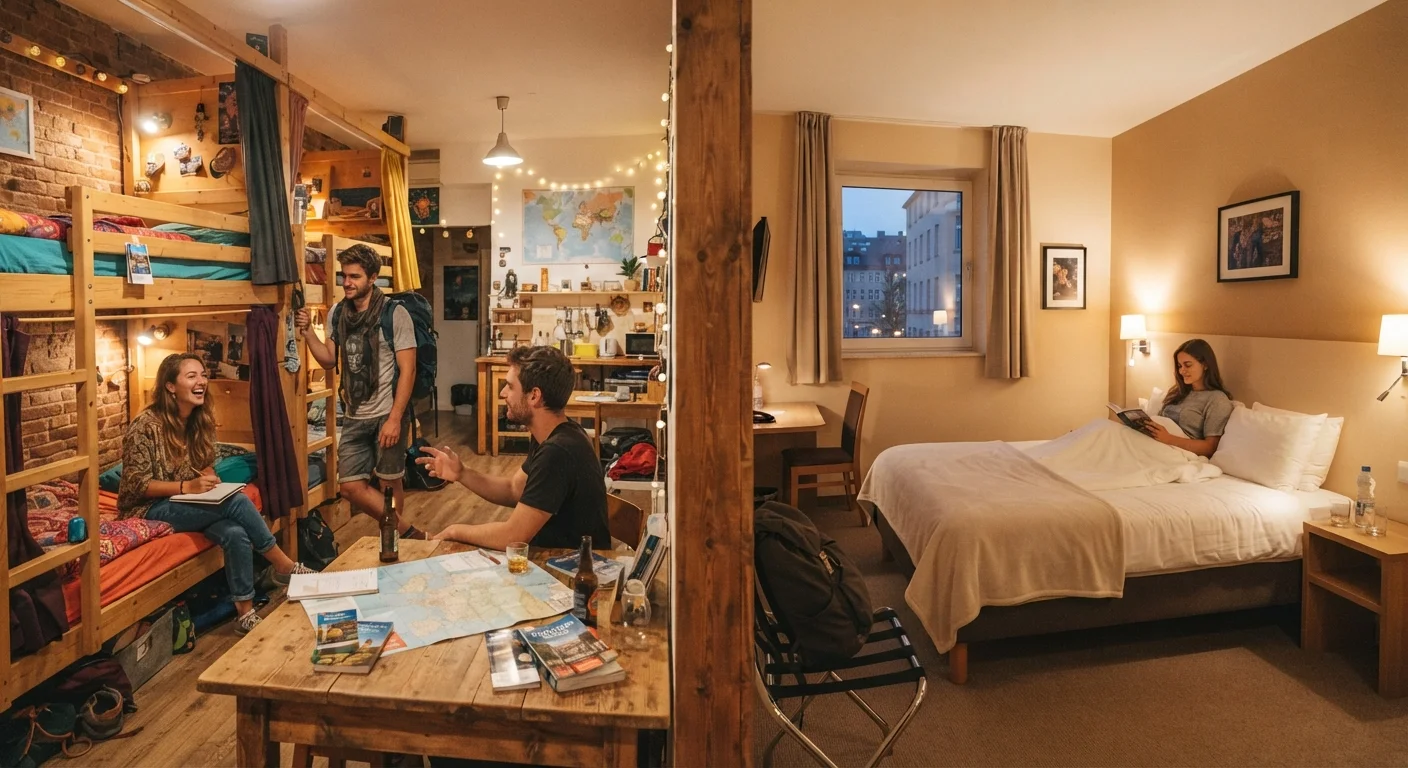
Key Takeaways
- Hostels typically cost less per night than budget hotels, especially for solo travelers booking dormitory beds.
- Budget hotels offer private rooms, more predictable amenities, and fewer shared spaces than hostels.
- Hostels foster spontaneous social connections; budget hotels prioritize quiet and personal space.
- Location, trip length, and travel companions are the biggest factors in choosing between the two.
- Both options can work well when matched to the right travel style and destination.
Option A
Hostels
The social, ultra-affordable communal experience.
Best for: Solo travelers, backpackers, and anyone who wants to meet fellow adventurers while keeping accommodation costs as low as possible.
Option B
Budget Hotels
The private, predictable comfort choice on a tighter budget.
Best for: Couples, light sleepers, business travelers, and families who want a private room without paying full-service hotel prices.
If you're a solo traveler stretching every dollar
Hostels
Dormitory beds are consistently cheaper per night and shared kitchens help cut meal costs further. The social atmosphere is a bonus, not a drawback.
If you're traveling as a couple or with a friend
Budget Hotels
Splitting a private room often lands at a comparable per-person cost to hostel beds, with the added benefit of full privacy and personal space.
If quality sleep and a reliable routine matter most
Budget Hotels
Dormitory environments can be noisy and unpredictable. Budget hotels offer a quieter, more controlled setting for light sleepers or early risers.
If you're on a long multi-city backpacking trip
Hostels
Hostels offer built-in community, local tips from other travelers, and amenities like luggage storage and communal kitchens that suit extended travel well.
If you're traveling with children or elderly companions
Budget Hotels
Private rooms, en-suite bathrooms, and predictable check-in processes make budget hotels far more practical for family or mixed-age groups.
What Actually Separates Hostels from Budget Hotels
At first glance, both hostels and budget hotels seem to occupy the same lane: affordable places to sleep. But the experience inside each is fundamentally different. Understanding those differences is the key to picking the right fit — not just the cheaper one.
Hostels are purpose-built for communal travel. Dormitory rooms typically house 4 to 12 guests in bunk beds, with shared bathrooms, common areas, and often a communal kitchen. Private rooms exist at many hostels, but the social infrastructure — bulletin boards, organized pub crawls, communal dinners — is the real draw. The price reflects that shared setup: dormitory beds in popular destinations can range from roughly $15 to $50 per night, depending on city and season.
Budget hotels are scaled-down versions of traditional hotels. You get a private room, usually a private bathroom, and standard amenities like Wi-Fi and a bed with fresh linens. There's little to no shared social space. The tradeoff is a higher nightly rate — often $60 to $120+ in major US and international cities — but also far more predictability and privacy.
For a broader look at how these compare to other lodging types, see boutique hotels, chain hotels, and vacation rentals as well.
| Criterion | Hostels | Budget Hotels |
|---|---|---|
| Typical nightly cost (solo) | $15–$50 (dorm bed) | $60–$120+ (private room) |
| Room privacy | Shared dorm (private rooms available) | Fully private room |
| Bathroom | Usually shared | Usually en-suite |
| Social atmosphere | High — communal by design | Low — minimal shared space |
| Kitchen access | Often included | Rarely available |
| Noise level | Variable, often higher | Generally quieter |
| Best for couples/families | Less practical | More practical |
| Geographic availability | Major travel hubs | Wide, including rural areas |
When Hostels Make More Sense
Hostels earn their place for a specific kind of traveler: someone who's prioritizing budget, flexibility, and human connection over creature comforts. If you're solo, your per-night cost in a hostel dorm will almost always beat a private hotel room. That gap compounds fast on longer trips — which is worth thinking through if you're stretching a travel budget across different trip lengths.
Communal kitchens are a serious advantage. Cooking even a few meals a week instead of eating out can save $30–$50 per day in expensive cities. Many hostels also provide free or low-cost social activities, which naturally reduces your daily spend on entertainment.
The social side deserves honest credit too. Seasoned hostel guests frequently cite chance encounters with other travelers as some of their most memorable trip moments — a spontaneous day trip, a restaurant recommendation, a travel companion for the next leg of a journey. That's hard to replicate in a private hotel room.
~40%
Hostel guests who are solo travelers
Industry surveys from hostel booking platforms consistently show solo travelers make up the largest share of hostel guests globally.
$30–$50
Daily savings from hostel kitchen use
Cooking meals in a communal hostel kitchen instead of dining out can produce significant daily savings in high-cost cities, based on typical meal price comparisons.
When Budget Hotels Are the Smarter Pick
Privacy, quiet, and predictability aren't luxuries — they're practical needs for many travelers. A light sleeper sharing a dorm with five strangers on different schedules can easily lose multiple nights of rest, which degrades the whole trip. Budget hotels eliminate that variable entirely.
For couples, the math often evens out. Splitting a $90 private room two ways lands at $45 per person — comparable to or better than a hostel bed once you factor in locker fees, towel rentals, and other hostel add-ons that quietly inflate the total. Families traveling with children will almost always find budget hotels more workable: private bathrooms, no shared dorm etiquette concerns, and simpler logistics overall.
Budget hotels also tend to be more geographically spread out, including in smaller cities and rural areas where hostels simply don't operate. If your destination is off the standard backpacker trail, a budget hotel may be your only affordable option. The city stay vs. countryside retreat breakdown explores this geography further.
Hostel Private Rooms: A Middle Ground Worth Knowing
Many modern hostels offer private rooms — sometimes called 'ensuite' or 'private dorm' options — that sit between a dorm bed and a budget hotel room in both price and comfort. These can be an excellent compromise if you want the hostel's social vibe and communal kitchen without sharing sleeping quarters. Prices and availability vary widely by property and destination, so it's worth comparing both options on booking platforms before deciding.
How to Decide: Key Questions to Ask Yourself
Rather than declaring one option universally superior, use these questions to triangulate the right call for your specific trip:
- Who are you traveling with? Solo traveler? Hostel often wins on cost. Couple or group? A private room frequently makes more sense.
- How long is the trip? A weekend city break and a month-long backpacking route have very different accommodation needs and budgets.
- How important is sleep quality? If you're an early riser, light sleeper, or have an early flight, a private room protects your schedule.
- Are you hoping to meet people? Hostels are social by design; budget hotels are not.
- What's the destination? Major backpacker hubs (Bangkok, Lisbon, Buenos Aires, Berlin) have outstanding hostel infrastructure. Smaller towns may not.
If you're new to navigating accommodation decisions, budget travel from scratch covers the core concepts worth understanding before you book anything. And before committing to a property, brush up on the key booking terms every traveler should know so you know exactly what you're agreeing to.