

Key Takeaways
- Group obedience classes provide structured socialization that private lessons cannot replicate.
- Dogs with fear, aggression, or severe anxiety may struggle in a group environment.
- Qualified instructors using positive reinforcement methods produce the most reliable results.
- Consistency at home between sessions determines how well skills transfer to daily life.
- Class size, environment, and trainer credentials all significantly affect the value of group training.
Built-in distraction training mirrors real-world conditions
Dogs learn to respond reliably around other animals and people, which private lessons in low-distraction environments cannot replicate as effectively.
Real-time feedback from a certified professional
Instructors can observe your handling technique directly and correct subtle errors — such as mistimed rewards or inconsistent cues — that owners often cannot self-diagnose.
Structured socialization opportunity for dogs
Calm, managed exposure to other dogs builds social confidence, particularly valuable for puppies during their critical developmental window.
More affordable than private training sessions
Group classes spread the cost of professional instruction across multiple participants, typically costing significantly less per session than one-on-one work.
Peer learning reinforces owner confidence
Watching other handlers work through the same challenges normalizes difficulty and gives owners additional practical strategies to try.
Not suitable for reactive or fearful dogs
Dogs with leash reactivity, aggression triggers, or severe anxiety can become overwhelmed in group settings, potentially reinforcing the very behaviors you're trying to resolve.
Limited individual attention per dog-owner team
With multiple teams per session, a trainer's time is divided, which means complex behavioral issues may not receive the focused guidance they require.
Pace may not match your dog's learning speed
Group curricula follow a set timeline. Dogs who need more repetition on a foundational skill may be moved forward before that skill is fully solid.
Instructor quality varies widely
The pet training industry has no universal licensing requirement in the US, meaning class quality depends heavily on the individual trainer's credentials and methodology.
Home reinforcement is essential but not guaranteed
Skills taught in class will fade without consistent practice at home. Owners who don't train between sessions typically see limited long-term behavior change.
Our Verdict
Group obedience classes are a strong starting point for most healthy, socially stable dogs, offering real-world distraction training, community support, and cost efficiency. However, dogs with reactivity, fear-based behaviors, or significant training gaps often need private sessions first. The quality of the instructor and the training methods used matter more than the format itself.
Best for owners of puppies or adult dogs with a baseline of social stability who want structured guidance, hands-on feedback, and the added benefit of training around real-world distractions.
What Group Obedience Classes Actually Involve
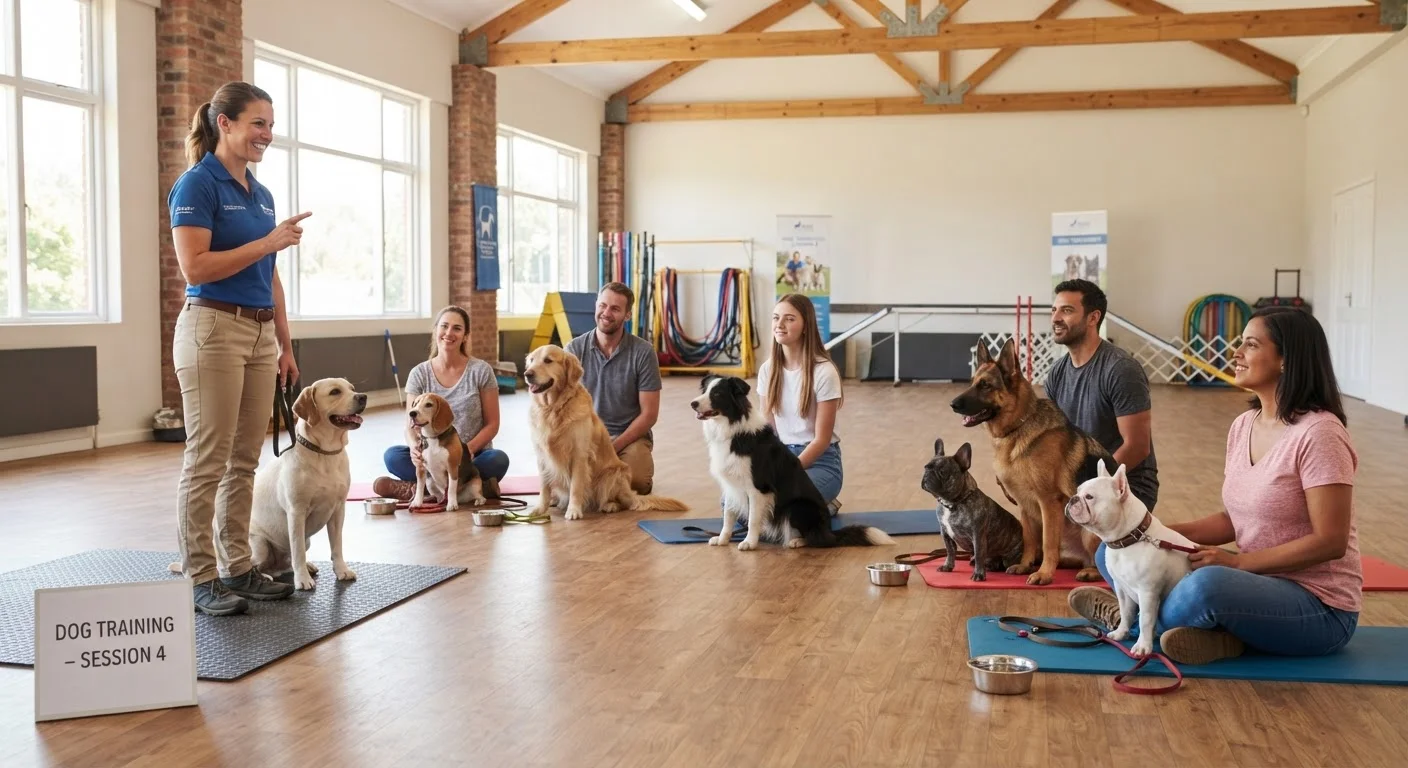
Group obedience classes bring together multiple dog-and-owner pairs — typically four to ten teams — to work through foundational skills like sit, stay, recall, and leash manners under the guidance of a certified trainer. Sessions usually run 45 to 60 minutes once a week for six to eight weeks.
The methods used vary by instructor, but classes grounded in positive reinforcement — rewarding desired behaviors rather than punishing unwanted ones — consistently align with current behavioral science. Understanding what you're signing up for before enrollment helps you gauge whether the format suits your dog's temperament and your own training goals.
The Advantages of Training in a Group Setting
Group classes offer benefits that extend well beyond basic command work.
Built-in distraction training mirrors real-world conditions
Dogs learn to respond reliably around other animals and people, which private lessons in low-distraction environments cannot replicate as effectively.
Real-time feedback from a certified professional
Instructors can observe your handling technique directly and correct subtle errors — such as mistimed rewards or inconsistent cues — that owners often cannot self-diagnose.
Structured socialization opportunity for dogs
Calm, managed exposure to other dogs builds social confidence, particularly valuable for puppies during their critical developmental window.
More affordable than private training sessions
Group classes spread the cost of professional instruction across multiple participants, typically costing significantly less per session than one-on-one work.
Peer learning reinforces owner confidence
Watching other handlers work through the same challenges normalizes difficulty and gives owners additional practical strategies to try.
One of the most underappreciated advantages is the built-in distraction training. Dogs must learn to focus on their handler while other dogs, people, and sounds compete for their attention — a condition that mirrors everyday life far more accurately than a quiet living room does. This kind of proofing, as trainers call it, builds reliability into learned behaviors.
Group settings also give owners direct, real-time feedback from a professional, along with the informal peer learning that comes from watching other handlers troubleshoot similar problems. Many owners report that observing someone else's dog struggle with the same command they're working on is unexpectedly instructive.
The Limitations Worth Knowing Before You Enroll
Group classes are not universally appropriate, and enrolling the wrong dog in the wrong class can set back training rather than advance it.
Not suitable for reactive or fearful dogs
Dogs with leash reactivity, aggression triggers, or severe anxiety can become overwhelmed in group settings, potentially reinforcing the very behaviors you're trying to resolve.
Limited individual attention per dog-owner team
With multiple teams per session, a trainer's time is divided, which means complex behavioral issues may not receive the focused guidance they require.
Pace may not match your dog's learning speed
Group curricula follow a set timeline. Dogs who need more repetition on a foundational skill may be moved forward before that skill is fully solid.
Instructor quality varies widely
The pet training industry has no universal licensing requirement in the US, meaning class quality depends heavily on the individual trainer's credentials and methodology.
Home reinforcement is essential but not guaranteed
Skills taught in class will fade without consistent practice at home. Owners who don't train between sessions typically see limited long-term behavior change.
Dogs displaying leash reactivity, fear-based aggression, or extreme anxiety are often poor candidates for group environments — at least initially. Forcing an already-stressed dog into a class setting can reinforce avoidance behaviors and make future training harder. For these dogs, a few private sessions to address the underlying issue is generally the more effective first step. See how training philosophies affect outcomes for context on choosing the right approach.
When to Try Private Sessions First
If your dog growls, lunges, or shuts down around unfamiliar dogs or strangers, a group class is likely premature. A certified applied animal behaviorist (CAAB) or a trainer with behavior modification experience can assess whether private work is needed before group enrollment. Addressing fear or reactivity in a lower-stress setting first often makes group classes more productive later.
Class size also matters more than many owners realize. A trainer managing eight dogs simultaneously has limited time per team. If your dog needs frequent individual attention or has a complex behavioral history, the group ratio may not give you enough instructional bandwidth.
How to Evaluate Whether a Group Class Is Right for Your Dog
Before enrolling, assess your dog's current social comfort level honestly. A puppy attending its first classes during the critical socialization window — generally up to around 16 weeks — gains enormous developmental benefit from positive group exposure. An adult rescue dog with an unknown history warrants a more cautious approach.
16 weeks
Puppy socialization window closes around
Veterinary behaviorists widely recognize that positive social exposure before approximately 16 weeks has an outsized impact on adult behavior.
4–10
Typical dogs per group class
Most professional trainers recommend classes with no more than six to eight teams to ensure adequate individual attention per dog-owner pair.
Trainer credentials are a meaningful filter. Look for instructors certified through recognized professional organizations such as the Certification Council for Professional Dog Trainers (CCPDT) or the Karen Pryor Academy. Ask directly about the methods used — trainers who cannot clearly articulate a positive reinforcement-based approach may rely on aversive techniques that contradict what behavioral science supports.
Finally, understand that what happens outside of class matters as much as what happens in it. Owners who practice skills for five to ten minutes daily between sessions see dramatically better results than those who wait for the next class to reinforce new behaviors.