

Key Takeaways
- 401(k) plans offer significantly higher annual contribution limits than IRAs — $23,000 vs. $7,000 for most workers in 2024.
- Employer matching in a 401(k) is essentially free money that should typically be captured before contributing elsewhere.
- Traditional IRAs and Roth IRAs provide different tax treatments; income limits apply to deductibility and Roth eligibility.
- IRAs generally offer a wider selection of investment options compared to most employer-sponsored 401(k) plans.
- Many savers can and should use both account types to maximize their tax-advantaged retirement savings.
Option A
401(k)
The employer-sponsored, high-contribution workhorse.
Best for: Employees who have access to a workplace plan, especially those with employer matching contributions.
Option B
IRA (Individual Retirement Account)
The flexible, individually controlled alternative.
Best for: Self-employed individuals, those without employer plans, or anyone wanting broader investment choices beyond what a workplace plan offers.
If your employer offers a 401(k) match
401(k)
Contribute at least enough to capture the full employer match before directing money elsewhere. Forgoing a match is leaving part of your compensation on the table.
If you want the widest investment flexibility
IRA
IRAs opened at a brokerage or financial institution typically offer a far broader investment menu than most workplace 401(k) plans, including individual stocks, ETFs, and mutual funds.
If you're a high earner wanting to maximize tax-advantaged contributions
401(k)
The 401(k)'s $23,000 limit (plus $7,500 catch-up for those 50+) dwarfs IRA contribution caps, making it the primary vehicle for aggressive savers.
If you're self-employed or your employer offers no retirement plan
IRA
A Traditional or Roth IRA is your most accessible tax-advantaged option. Self-employed individuals should also explore SEP-IRAs or Solo 401(k)s for even higher limits.
If you want tax-free income in retirement
IRA
A Roth IRA allows qualified withdrawals entirely tax-free — a powerful advantage if you expect to be in a higher tax bracket in retirement, subject to income eligibility limits.
How Each Account Works
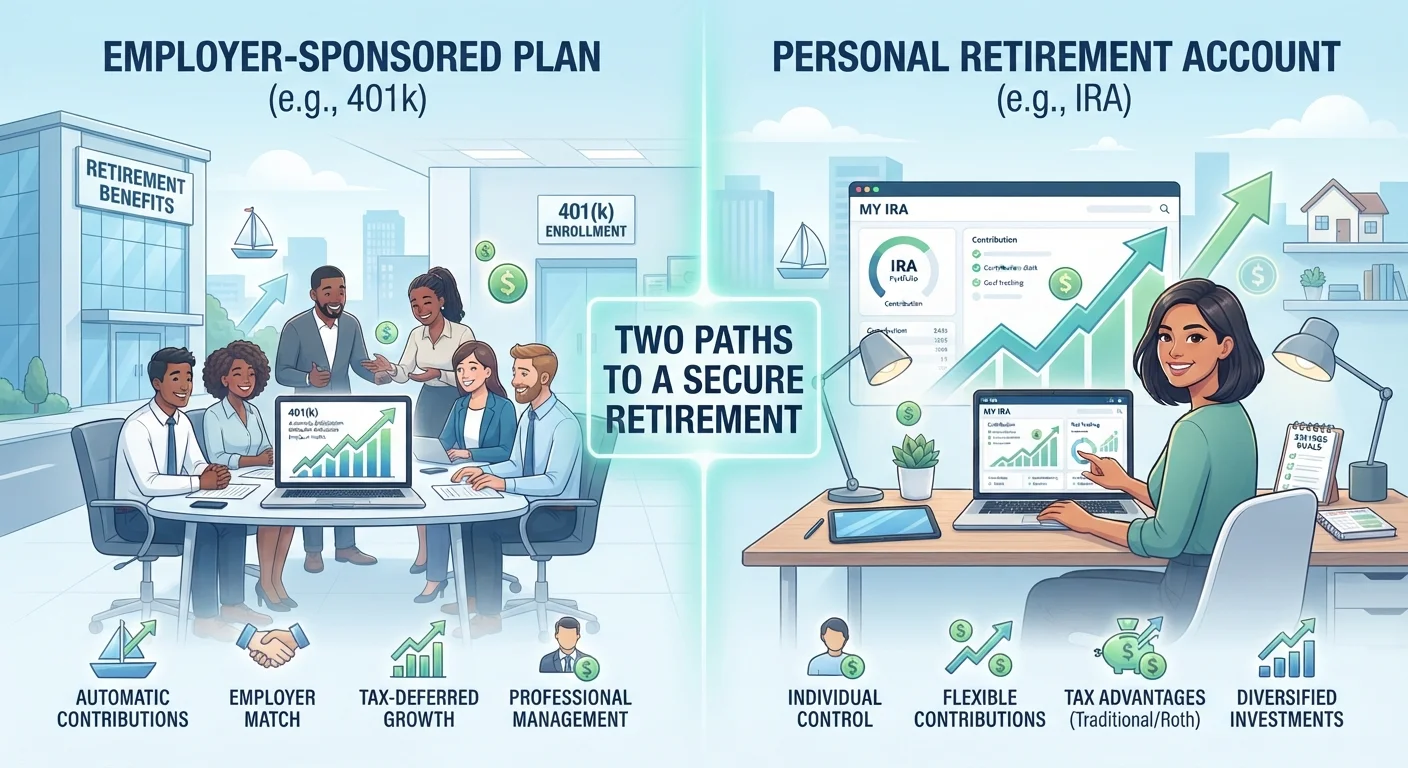
A 401(k) is an employer-sponsored defined-contribution plan. You elect to contribute a percentage of your paycheck on a pre-tax basis (Traditional 401(k)) or after-tax basis (Roth 401(k)), and many employers match a portion of your contributions up to a set limit. The plan is administered by your employer, and investment options are limited to what the plan sponsor makes available — often a curated menu of mutual funds.
An IRA (Individual Retirement Account) is opened and managed entirely by you, independent of any employer. There are two main types: the Traditional IRA, where contributions may be tax-deductible and growth is tax-deferred, and the Roth IRA, where contributions are made with after-tax dollars but qualified withdrawals in retirement are tax-free. You choose your own financial institution and, in most cases, have access to a much broader investment universe.
Both account types share the core purpose of building long-term retirement wealth with tax advantages, but their mechanics, limits, and rules differ in ways that matter enormously for your planning.
| Criterion | 401(k) | IRA |
|---|---|---|
| 2024 Contribution Limit | $23,000 ($30,500 if 50+) | $7,000 ($8,000 if 50+) |
| Employer Match | Often available | Not available |
| Who Opens It | Employer sets up; employee enrolls | Individual opens independently |
| Investment Options | Limited to plan menu | Broad (stocks, ETFs, mutual funds) |
| Income Limits | None to contribute | Apply for Roth and deductibility |
| Pre-tax Option | Yes (Traditional 401k) | Yes (Traditional IRA) |
| Tax-free Withdrawal Option | Yes (Roth 401k) | Yes (Roth IRA) |
| Required Minimum Distributions | Age 73 (Traditional); Roth 401k exempt from 2024 | Age 73 (Traditional); Roth IRA exempt |
Contribution Limits and Employer Matching
Contribution limits are among the starkest differences between these accounts. For 2024, the IRS sets the 401(k) employee contribution limit at $23,000 ($30,500 for workers age 50 and older, using the catch-up provision). IRA contributions are capped at just $7,000 ($8,000 for those 50+) across all IRAs you hold combined.
Employer matching dramatically amplifies the 401(k)'s value. A common structure is a 50% match on contributions up to 6% of your salary. On a $70,000 salary, that's up to $2,100 in free employer contributions per year — a 50% instant return on those dollars. No IRA equivalent exists.
$23,000
2024 401(k) employee contribution limit
Per IRS guidance for 2024; workers 50 and older can contribute up to $30,500 using the catch-up provision.
3.3×
401(k) limit vs. IRA limit
The 401(k)'s $23,000 cap is more than three times the $7,000 IRA ceiling, making it the primary vehicle for high-contribution savers.
~70%
Private-sector workers with access to a workplace plan
According to the Bureau of Labor Statistics, roughly 70% of private-sector workers have access to an employer-sponsored retirement plan, though participation rates are lower.
Roth IRA eligibility phases out at higher incomes — for 2024, the phase-out range begins at $146,000 for single filers and $230,000 for married filing jointly. Traditional IRA deductibility is also income-limited if you or your spouse have access to a workplace plan. A backdoor Roth IRA (making a nondeductible Traditional IRA contribution and then converting it) is a strategy some higher earners use, but it carries its own complexities — consult a qualified financial adviser before pursuing it.
Investment Choices and Fees
Most 401(k) plans offer a limited menu of investment options — typically 15 to 30 mutual funds selected by your employer's plan administrator. While this simplifies decision-making, it can also mean higher expense ratios or fewer low-cost index fund choices than you'd find on your own. Plan quality varies significantly by employer.
IRAs opened at a brokerage give you access to thousands of funds, ETFs, individual stocks, bonds, and in some cases alternative assets. This flexibility is valuable, but it also requires more active decision-making. If your 401(k) plan is high-quality with low-cost index funds, the investment advantage of an IRA may be minimal — evaluate your specific plan's options and fees.
For context on what lies outside these tax-advantaged accounts entirely, see our overview of taxable brokerage accounts — a useful complement once you've maximized retirement account contributions.
You Can Use Both Accounts Simultaneously
Contributing to a 401(k) does not prevent you from also contributing to an IRA in the same tax year, as long as you meet IRA income and eligibility rules. Many financial planners recommend using both accounts strategically — for example, capturing the employer match in your 401(k) first, then funding a Roth IRA for tax diversification in retirement. The two accounts complement each other rather than compete.
Withdrawals, RMDs, and Flexibility
Both account types impose a 10% early withdrawal penalty for distributions before age 59½, with certain exceptions (such as disability, qualified higher education expenses for IRAs, or specific hardship rules). Tax treatment on withdrawal depends on whether contributions were pre-tax or after-tax.
A key difference involves Required Minimum Distributions (RMDs). Traditional 401(k)s and Traditional IRAs both require RMDs beginning at age 73 under current law (as set by the SECURE 2.0 Act). Roth IRAs have no RMDs during the account owner's lifetime — a meaningful estate planning and retirement income flexibility advantage. Roth 401(k)s previously required RMDs, but SECURE 2.0 eliminated this requirement starting in 2024.
The practical guidance for most workers: contribute enough to your 401(k) to capture any employer match first, then consider maxing an IRA (especially a Roth if you're eligible), and return to the 401(k) to continue building if you have additional capacity. This sequencing typically extracts the most value from both account types without leaving tax-advantaged space unused.
This article provides general financial education and is not personalized investment, tax, or legal advice. Contribution limits, income thresholds, and rules are subject to IRS updates. Consult a licensed financial adviser or tax professional regarding decisions specific to your situation.