
Key Takeaways
- Minimum payments are typically calculated as a small percentage of your balance, not a fixed payoff amount.
- Interest accrues daily on most credit cards, so slow repayment dramatically multiplies total cost.
- Paying only the minimum on a $5,000 balance can extend repayment by a decade or more.
- Increasing your monthly payment by even a modest amount can cut years off your debt timeline.
- Credit utilization stays elevated when balances barely move, which can suppress your credit score.
The Math Behind Minimum Payments
Minimum payments are typically calculated as either a flat dollar amount (often $25–$35) or a small percentage of the outstanding balance — whichever is greater. Many issuers use 1%–2% of the balance plus any accrued interest and fees. This formula means your required payment shrinks as your balance shrinks, extending your repayment timeline indefinitely.
Consider a $5,000 balance at 20% APR with a 2% minimum payment floor. In month one, your minimum might be around $100. But as you chip away at the principal, the required payment falls — and so does the amount reducing your debt. The result: repayment can stretch beyond 15 years, and you could pay well over $7,000 in interest alone on that original $5,000. For foundational definitions on terms like APR and utilization, see the debt and credit glossary.
15+ years
Typical payoff timeline on minimum payments
A $5,000 balance at 20% APR paid at minimum-only rates can take 15 or more years to eliminate, depending on how the minimum is calculated.
~$7,000+
Interest paid on a $5,000 balance at minimums
Illustrative calculation based on a 20% APR card with a 2% minimum payment floor — actual figures vary by issuer terms and payment behavior.
30%
Credit utilization threshold to target
Credit scoring models generally reward borrowers who keep per-card and overall utilization below 30%, according to guidance from major credit bureaus.
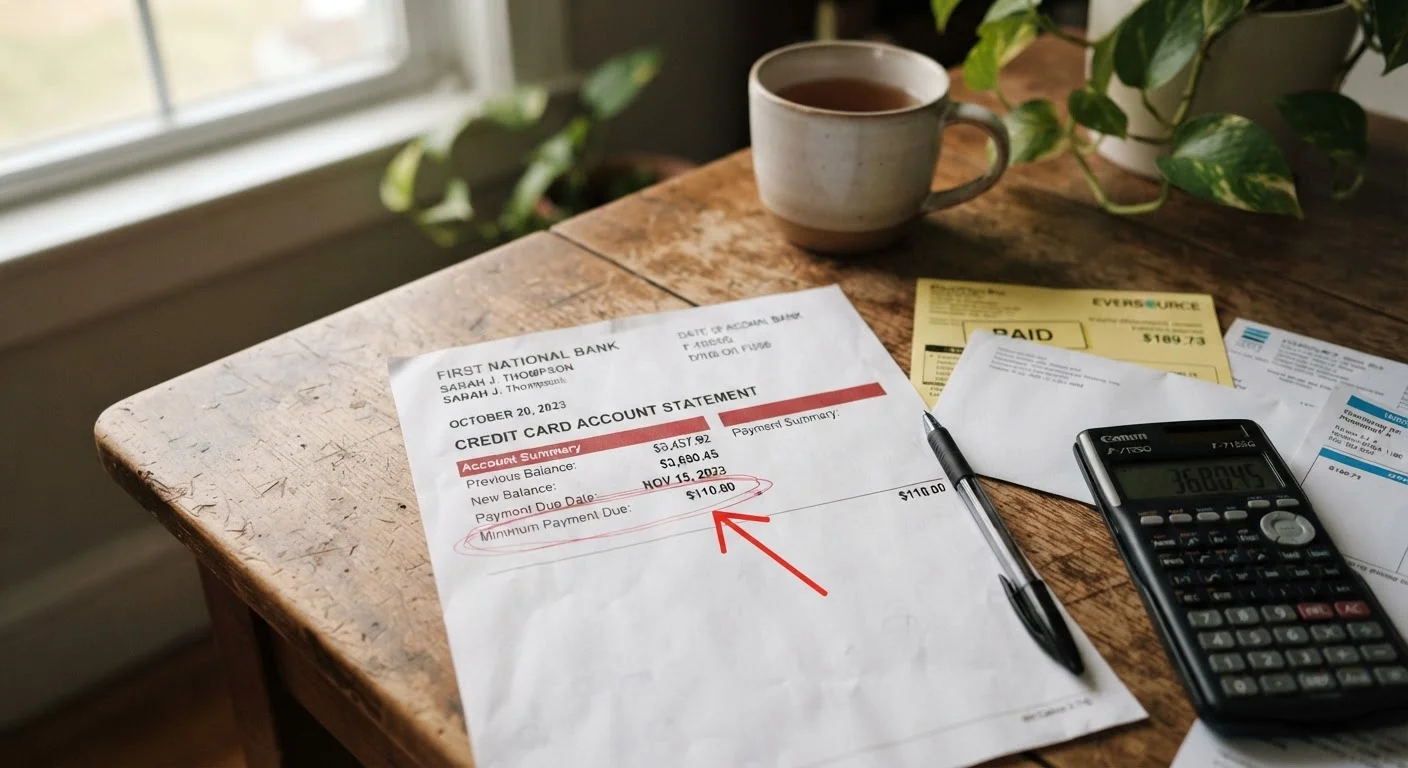
The Credit CARD Act of 2009 mandated that issuers print a minimum payment warning on every statement — showing the payoff timeline and total cost if you only make minimums. If you haven't studied that box on your statement, read it now.
Minimum Payments Are Not a Payoff Plan
Card issuers are required by the Credit CARD Act of 2009 to disclose on every statement how long it will take to pay off your balance making only minimum payments — and the number is often shocking. This disclosure exists precisely because minimum payments are designed to satisfy the lender's risk requirements, not to help you get out of debt efficiently. Treat that figure as a warning, not a benchmark.
Common Mistakes That Keep Balances Stuck
Most people carrying revolving credit card debt aren't making reckless decisions — they're making understandable ones that the structure of minimum payments quietly punishes. The mistakes below are among the most common, and each has a straightforward correction.
Treating the minimum payment as the 'right' amount to pay each month.
Why it happens: Minimum payments are prominently displayed on statements, and paying them keeps the account in good standing — so they can feel like an adequate target rather than a floor.
Underestimating how daily interest compounding erodes every payment.
Why it happens: Most people think in monthly terms, but credit card interest is typically calculated on a daily periodic rate — meaning interest accrues every single day on the outstanding balance.
Adding new charges to a card while paying only the minimum on the existing balance.
Why it happens: Ongoing card use feels separate from the existing balance, but new purchases generate their own interest and push the overall balance higher, neutralizing repayment progress.
Ignoring how high credit utilization harms your credit score over time.
Why it happens: Minimum payments keep the account current, so borrowers often assume their credit is protected — but utilization (the ratio of balance to limit) remains high when balances barely shrink.
Skipping a structured payoff strategy in favor of ad-hoc extra payments.
Why it happens: Without a clear framework, extra money gets applied inconsistently — sometimes to the highest-balance card, sometimes whichever statement arrived most recently, reducing overall efficiency.
If you're managing obligations across multiple cards or loan types simultaneously, structured approaches to handling multiple debts can help you stay organized and make consistent progress across all accounts.
For situations where debt has become genuinely unmanageable, formal options exist. Debt consolidation and options like credit counseling or debt settlement each carry distinct trade-offs that are worth understanding before committing.
This article is for general informational and educational purposes only and does not constitute personalized financial or legal advice. Consult a qualified financial professional regarding your specific circumstances.