
Key Takeaways
- Credit scores are calculated from five factors; payment history and utilization carry the most weight.
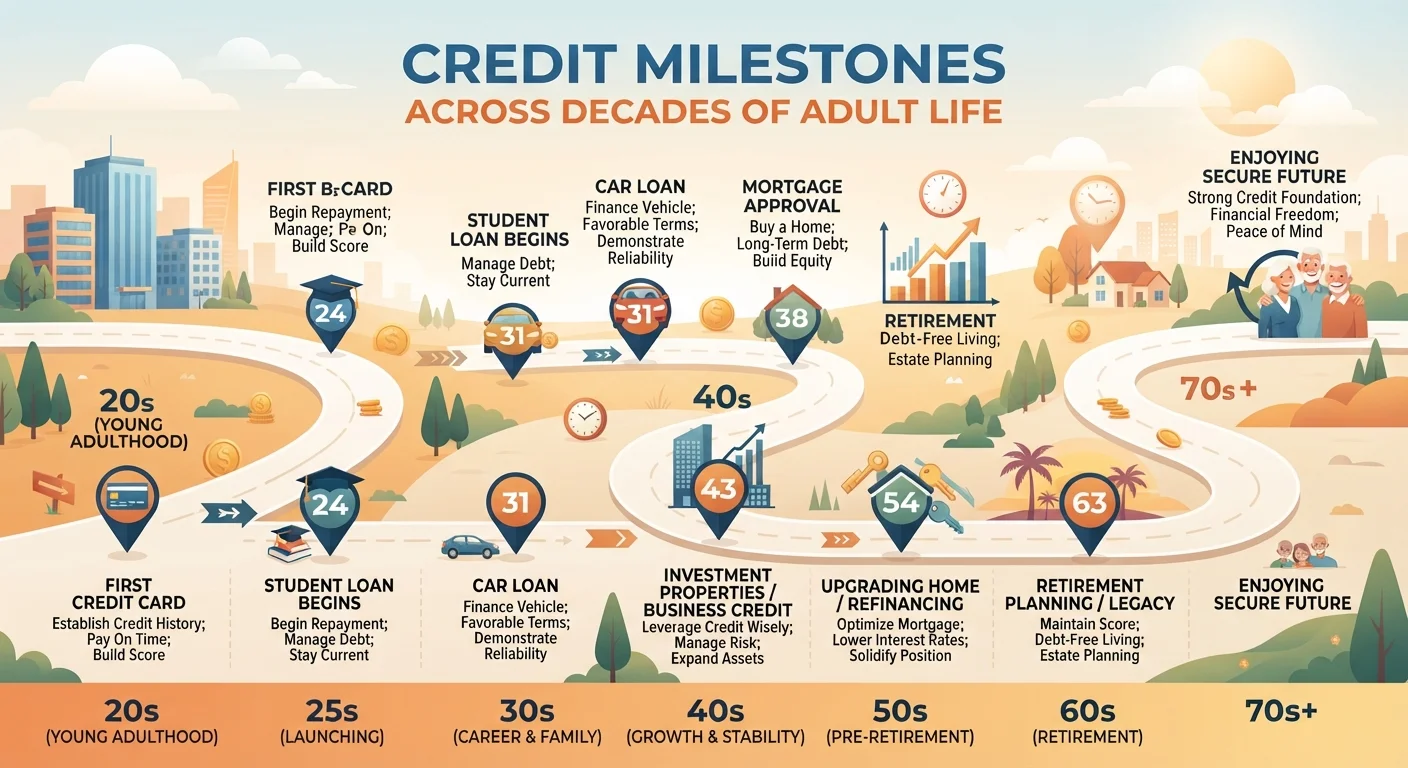
- Opening your first responsible account in your twenties can give you decades of positive history.
- Mortgage debt and other major loans in your thirties and forties demand careful utilization management.
- Retirees should keep at least one active account open to maintain a score for housing and insurance purposes.
- Negative marks such as late payments generally drop off credit reports after seven years.
- Monitoring your report regularly is the single best defense against identity theft and reporting errors.
Why Credit Is a Lifelong Asset
Most people think of their credit score as a number they check before applying for a loan. In reality, your credit profile functions more like a financial reputation — one that lenders, landlords, insurers, and even some employers consult throughout your life. A strong profile expands your options and lowers borrowing costs; a weak one constrains them, often at the worst moments.
Credit scores in the US are most commonly calculated using the FICO model, which ranges from 300 to 850. Scores of 670 and above are generally considered good; 740 and above unlocks the most competitive interest rates. According to FICO, the average US score has historically hovered in the mid-700s, but averages obscure wide variation across age groups and income levels.
Understanding your credit as a decades-long project — not a short-term problem to fix — changes how you approach every financial decision. See our guide to reading your credit report to understand exactly what lenders are looking at.
35%
Weight of payment history in FICO score
According to FICO's published scoring model, on-time payment history is the single largest factor in your credit score calculation.
7 years
How long most negative items stay on your report
Under the Fair Credit Reporting Act, the majority of negative credit entries — including late payments and collections — must be removed after seven years.
30%
Utilization threshold to avoid score damage
Credit experts generally recommend keeping revolving credit utilization below 30% of available limits; lower is better for score optimization.
Your Twenties: Laying the Foundation
The biggest advantage you have in your twenties is time. A credit account opened at 22 contributes to your length-of-credit-history calculation for the next four decades. The challenge is that most people in their twenties start with little or no credit history — making it difficult to qualify for their first account.
Practical entry points include secured credit cards (where a cash deposit serves as the credit limit), credit-builder loans offered by credit unions and community banks, or becoming an authorized user on a parent's longstanding account. Our article on credit-building from scratch walks through each option in detail.
Once you have an account, the two habits that matter most are paying on time, every time, and keeping your balance well below the credit limit — ideally below 30% of it. Those two behaviors alone account for roughly 65% of your FICO score.
Set up autopay for at least the minimum payment on every account. Payment history is the heaviest-weighted factor, and one missed payment can undo months of progress.
A single 30-day late payment can reduce a good FICO score by 60 points or more, according to FICO's published impact estimates, making automation the simplest form of credit protection.
When rate-shopping for a mortgage or auto loan, submit all your applications within a 14-day window. Most scoring models count these as a single inquiry rather than multiple hits.
FICO's rate-shopping window policy is specifically designed to allow consumers to compare lenders without penalty — but only if inquiries are clustered closely together.
Your Thirties and Forties: Managing Credit Under Pressure
Life in your thirties and forties typically brings larger financial obligations: mortgages, car loans, student debt carried over, and growing family expenses. These are the years when credit management becomes most consequential — and most stressful.
A mortgage is the most significant credit event most Americans experience. Taking one on will temporarily lower your average account age and generate a hard inquiry, causing a modest, short-lived score dip. Within a year of consistent payments, most borrowers see their score recover and often improve, because a mortgage adds a valuable installment loan to the mix of account types.
The risk in this phase is over-extension: opening multiple new accounts in a short window, carrying high balances on revolving credit, or missing payments during income disruptions. Building an emergency fund — covered in depth in our budgeting and saving hub — is one of the most underrated credit-protection strategies, because it prevents a temporary cash crunch from becoming a permanent credit blemish.
Avoid Over-Extension During Major Life Transitions
Opening several new credit accounts within a short period — common when furnishing a new home or managing a job change — generates multiple hard inquiries and lowers your average account age. Both effects are temporary, but stacked on top of higher balances they can push a score meaningfully lower. Space out new applications when possible and prioritize paying down existing revolving balances before adding new lines.
Your Fifties and Beyond: Preserving What You've Built
By your fifties, you may be paying down debt faster than you're taking on new credit. That's financially sound — but it creates a subtle credit risk. Closing paid-off accounts shortens your credit history and raises your overall utilization ratio, both of which can pull down a score you've spent decades building.
The counterintuitive advice: keep older accounts open and occasionally active, even if you're not carrying balances. A small recurring charge — paid in full monthly — keeps the account reporting positively without costing you interest.
In retirement, a credit score still matters for refinancing a home, qualifying for a rental, or even getting favorable rates on auto and homeowners insurance in states where insurers use credit-based insurance scores. Maintaining at least one or two active accounts through retirement preserves access to credit if an emergency arises.
Keep Older Accounts Active in Retirement
Rather than closing credit cards you no longer use regularly, consider putting a small recurring bill — such as a streaming subscription — on each card and paying it in full automatically. This keeps the account active and reporting, preserving your length-of-credit-history without costing you interest.
This article is for general informational purposes only and does not constitute personalized financial or credit advice. Consult a licensed financial professional for guidance tailored to your specific situation.
The Five Factors That Shape Your Score — At Every Age
Regardless of your life stage, your FICO score is built from the same five inputs:
- Payment history (35%): Whether you pay on time. A single 30-day late payment can drop a good score by 60–110 points, according to FICO data.
- Amounts owed / utilization (30%): How much of your available revolving credit you're using. Lower is better; above 30% begins to hurt.
- Length of credit history (15%): The age of your oldest account, newest account, and average age across all accounts.
- Credit mix (10%): Whether your profile includes both revolving credit (cards) and installment loans (auto, mortgage, student).
- New credit (10%): Recent hard inquiries and newly opened accounts. Multiple inquiries in a short period suggest elevated risk to lenders — with one important exception: mortgage, auto, and student loan rate-shopping inquiries within a 14–45 day window are typically treated as a single inquiry.
Understanding these weights helps you prioritize. If your score needs improvement, payment history and utilization are almost always the highest-leverage levers — not opening new accounts or worrying about credit mix.
“Credit scores are not a judgment on your worth as a person — they are a statistical tool. Once you understand what the model is measuring, you can work with it systematically rather than fear it.”
— Chi Chi Wu, Staff Attorney, National Consumer Law Center
Recovering From Credit Setbacks
A serious credit event — bankruptcy, foreclosure, charge-off, or a string of missed payments — is not permanent. Under the Fair Credit Reporting Act (FCRA), most negative items must be removed from your credit report after seven years. Chapter 7 bankruptcy stays for ten years. The practical impact of these items diminishes well before they disappear, as their weight in scoring models fades with time and the addition of new positive history.
Recovery follows a predictable sequence: stabilize (stop the bleeding by addressing what caused the setback), rebuild (open one manageable account and use it responsibly), then optimize (reduce utilization, extend history, diversify account types). Patience is the operative ingredient — no legitimate service can erase accurate negative information before its legal expiration, regardless of marketing claims to the contrary.
For anyone rebuilding while also trying to grow long-term wealth, see our guide to investing from scratch — credit recovery and wealth-building aren't mutually exclusive.
No Legitimate Service Can Delete Accurate Negative Information
If a company promises to erase verified late payments, collections, or bankruptcies before their legal expiration date, that promise is false. The CFPB and FTC have both warned consumers about credit repair scams that charge fees for outcomes they cannot legally deliver. Save your money — consistent on-time payments and responsible account management are the only proven path to credit recovery.
Protecting Your Credit Profile From Fraud and Errors
Identity theft and credit reporting errors are among the fastest ways a healthy profile can be damaged through no fault of your own. The Consumer Financial Protection Bureau (CFPB) consistently ranks credit and consumer reporting issues among the top complaint categories it receives each year.
Your core defenses are straightforward. First, review your credit reports regularly. Under federal law, you can access free reports from all three major bureaus — Equifax, Experian, and TransUnion — at AnnualCreditReport.com. Second, if you find an error, dispute it in writing with both the bureau and the furnisher (the creditor that reported the item); bureaus are generally required to investigate within 30 days. Third, consider placing a free security freeze with all three bureaus — this prevents new credit from being opened in your name without your explicit action to temporarily lift the freeze.
Our detailed walkthrough on reading your credit report covers how to spot errors and the exact steps to dispute them effectively.
Free Credit Freezes Are Now a Federal Right
Since 2018, federal law requires all three major credit bureaus to offer security freezes at no cost to consumers. A freeze does not affect your credit score and does not prevent you from using existing accounts — it only blocks new credit from being opened using your file. Lifting a freeze temporarily when you need to apply for credit is straightforward and typically takes effect within an hour when done online.