

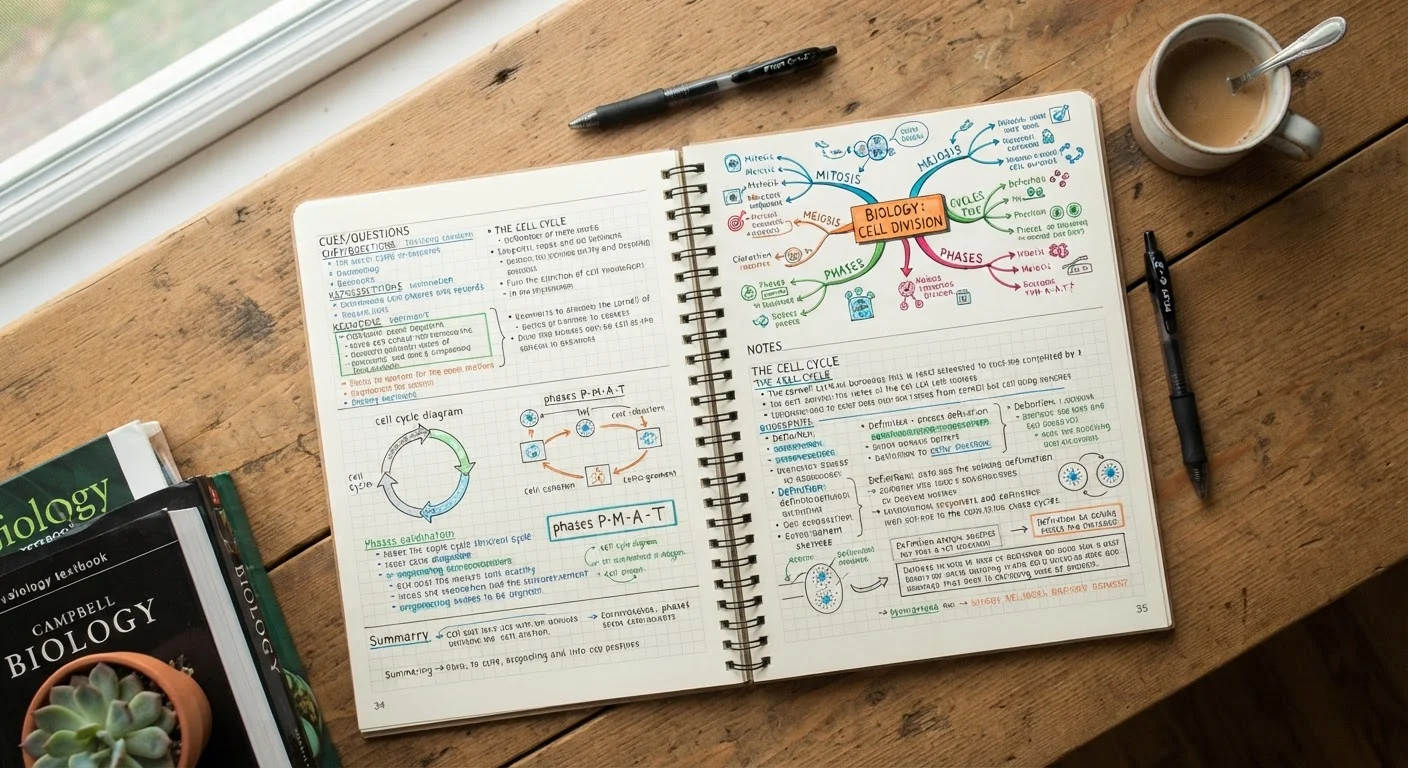
Key Takeaways
- No single note-taking method works best for every subject or every learner.
- The Cornell Method excels at review and self-testing; the Outline Method works well for structured lectures.
- Mind Maps are strongest for visual thinkers tackling conceptual or creative content.
- The Charting Method is especially effective when comparing categories or data-heavy material.
- Combining methods—such as outlining during a lecture and mapping afterward—can deepen retention.
Our Verdict
Each note-taking method has genuine strengths, and the best choice depends on the material's structure, your review habits, and the cognitive demands of your course. Rather than committing to one system forever, treat these methods as tools to be matched to the task. Experimenting across a semester is often the fastest path to finding what sticks.
| Best for | Recommended |
|---|---|
| Lecture-heavy courses requiring active review | Cornell Method |
| Structured, hierarchical content with clear subtopics | Outline Method |
| Conceptual, creative, or big-picture thinking | Mind Map |
| Comparative subjects like history, biology, or economics | Charting Method |
Why Your Note-Taking Method Matters
Notes are not simply a record of what was said — they are a thinking tool. Research in cognitive science consistently shows that how you organize information during learning shapes how well you can retrieve it later. Passive transcription, for example, produces pages of text but very little durable memory. Active systems that prompt you to organize, connect, and question material engage deeper processing.
Before comparing methods, it helps to understand the variables that determine which approach fits a situation: the structure of the source material, how you plan to review, and whether the goal is memorization, analysis, or synthesis. As you explore these options, also consider pairing your chosen method with a solid review schedule — see our guide to building a sustainable study schedule for practical planning principles.
The Four Most Widely Used Methods
Cornell Method: Divide your page into three zones — a narrow left column for cue questions, a wide right column for notes, and a summary strip at the bottom. During a lecture or reading, capture ideas in the right column. Afterward, write questions in the left column that your notes answer. This built-in self-testing structure makes the Cornell Method one of the most research-supported formats for long-term retention.
Outline Method: Use indentation to reflect hierarchy — main topics at the left margin, subtopics indented beneath them, and details further indented still. This method works best when the source material has clear, logical structure, such as a textbook chapter or a well-organized lecture. It is fast to write but requires the speaker or text to signal its own structure clearly.
Mind Map: Place a central concept in the middle of the page, then draw branching lines to related ideas, sub-ideas, and connections. Mind maps are non-linear and visually intuitive, making them well-suited to brainstorming, exploring relationships between concepts, or reviewing content that doesn't fit neatly into categories. They can be harder to produce in real time during a fast-paced lecture.
Charting Method: Build a grid with categories as column headers and instances as rows. This approach is highly efficient when your material involves comparing attributes — think biological classifications, historical events by date and cause, or economic models by assumptions and outcomes.
| Cornell Method | Outline Method | Mind Map | Charting Method | |
|---|---|---|---|---|
| Best content type | Lectures, dense readings | Structured, hierarchical topics | Conceptual, creative subjects | Comparative or data-heavy material |
| Speed during class | Moderate | Fast | Slow | Moderate |
| Review effectiveness | High — built-in self-testing | Moderate | Moderate | High for comparisons |
| Learning curve | Low to moderate | Low | Low | Low |
| Works well digitally | Yes | Yes | Best with mapping apps | Yes — spreadsheets work |
| Suits non-linear material | Partially | Poorly | Very well | Moderately |
Choosing and Combining Methods
The comparison above highlights trade-offs, but real-world studying rarely demands a single method throughout an entire course. Many learners find that layering methods produces stronger results: outline during a lecture to keep pace, then convert key sections into a mind map while reviewing to reinforce connections.
Try a Two-Pass Note-Taking Approach
Use the Outline Method during a lecture to capture information quickly, then revisit your notes within 24 hours and reorganize key sections into a Cornell or Mind Map format. This two-pass strategy reinforces the material through re-encoding while giving you a review-ready document. Even ten minutes of post-lecture restructuring can significantly improve recall. Pair this habit with memory techniques such as spaced repetition for maximum effect — our guide to memory techniques covers the most reliable cognitive tools.
It's also worth questioning assumptions about how you learn. The popular notion that students must match a fixed personal "learning style" is not well supported by research — the evidence points instead to matching the method to the material. Our article on learning style myths breaks this down with what the research actually recommends.
Once your notes are in good shape, your next leverage point is how you review them. Passive rereading offers limited benefit compared to active recall. The case for self-testing over rereading explains why quizzing yourself — a natural extension of the Cornell cue column — builds far more durable knowledge. For a comprehensive overview of these interconnected skills, see Studying Smarter: A Comprehensive Guide to Academic Skill-Building.