

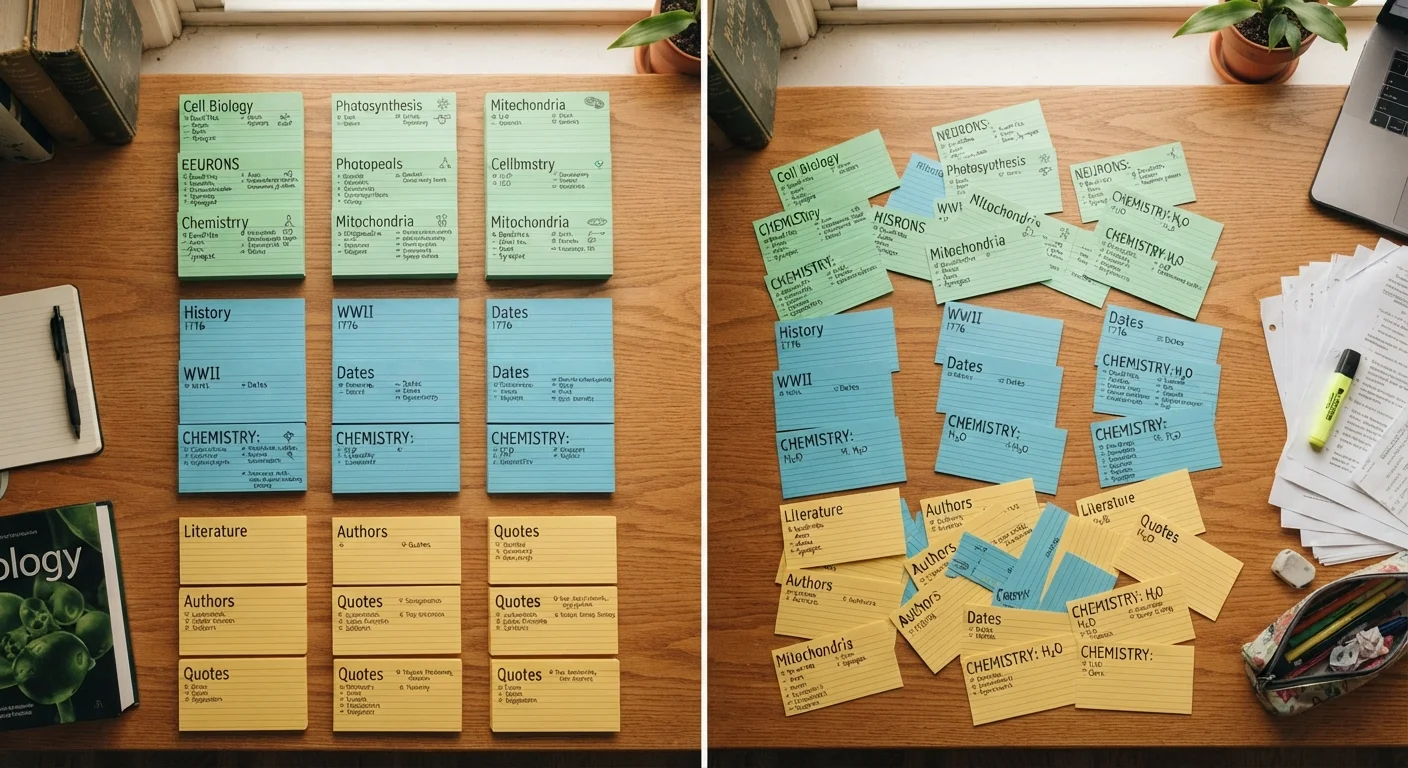
Key Takeaways
- Blocked practice groups similar problems together; interleaving mixes different problem types within a session.
- Interleaving typically produces better long-term retention and transfer, even though it feels more difficult.
- Blocked practice is most useful when a skill or concept is completely new to the learner.
- The 'desirable difficulty' of interleaving is a feature, not a flaw — struggle drives deeper encoding.
- Combining both methods strategically across a study schedule often outperforms using either alone.
Option A
Blocked Practice
The familiar, topic-by-topic approach most learners default to.
Best for: Building initial familiarity with a brand-new concept or skill before progressing to varied challenges.
Option B
Interleaved Practice
The deliberately mixed approach that feels harder but pays off long-term.
Best for: Developing durable, transferable skills when preparing for real-world tasks or mixed-format tests.
If you are encountering a concept for the very first time
Blocked Practice
Initial exposure benefits from focused, repetitive contact with one idea so foundational patterns can form before variation is introduced.
If you are preparing for an exam or real-world application with mixed problem types
Interleaved Practice
Mixed practice forces you to identify which strategy fits each problem — exactly the skill tested under real conditions.
If you want to maximise long-term retention and skill transfer
Interleaved Practice
Research consistently shows interleaving produces stronger performance on delayed tests, even when it slows immediate progress.
If you are teaching or tutoring someone who feels overwhelmed by a subject
Blocked Practice
Reducing cognitive load early in learning helps build confidence and a working mental model before introducing complexity.
If you are a motivated adult learner with some prior knowledge of the subject
Interleaved Practice
Prior knowledge provides enough scaffolding to tolerate the difficulty of switching, making interleaving efficient and rewarding.
What Each Method Actually Means
Most learners structure practice the same way without realizing it: finish all the chapter-one problems, move to chapter two, then chapter three. That is blocked practice — grouping repetitions of the same skill or problem type together before shifting to the next one.
Interleaved practice works differently. Instead of exhausting one topic before moving on, you mix problem types within a session. A math student might work one equation from algebra, then one from geometry, then one from statistics — cycling through categories rather than completing each in isolation.
Both approaches have real value, but research in cognitive psychology consistently shows they are not interchangeable. Understanding when each applies is one of the most practical things a learner can do. For a broader look at how timing affects study outcomes, see our comparison of spaced repetition and massed practice.
| Criterion | Blocked Practice | Interleaved Practice |
|---|---|---|
| Structure | One topic or skill at a time | Mixed topics within each session |
| Difficulty during practice | Feels smoother and more comfortable | Feels harder and more effortful |
| Short-term performance | Higher during the practice session | Lower during the practice session |
| Long-term retention | Weaker on delayed tests | Stronger on delayed tests |
| Skill transfer | Limited to familiar problem formats | Generalises to new contexts |
| Best stage of learning | Early / beginner stage | Intermediate to advanced stage |
| Learner confidence | Builds confidence quickly | May feel discouraging initially |
The Science Behind Interleaving's Advantage
The counterintuitive finding — replicated across dozens of studies — is that interleaving feels harder during practice but produces significantly better results on later tests. Researchers call this a desirable difficulty: a type of cognitive friction that strengthens learning even as it slows short-term performance.
The leading explanation is discrimination learning. When problems are blocked, your brain never has to figure out which strategy applies — context makes it obvious. When problems are interleaved, you must retrieve the correct approach from memory each time, strengthening the connections between problem type and solution method. That retrieval effort is closely related to retrieval practice, another evidence-backed technique that works through similar mechanisms.
~215%
Interleaving advantage on delayed tests
A widely cited study by Rohrer and Taylor (2007) found students who used interleaved practice outperformed blocked practice peers by roughly 215% on a delayed mathematics test.
Higher during
Blocked practice perceived effectiveness
Research by Kornell and Bjork (2008) found learners consistently rate blocked study as more effective — yet perform worse on later evaluations, illustrating the gap between perceived and actual learning.
Multiple domains
Subjects where interleaving shows benefits
Benefits of interleaved practice have been documented in mathematics, music, medical diagnosis, motor skills, and foreign language vocabulary across published cognitive science literature.
Blocked practice is not without merit. Studies suggest it is genuinely better for absolute beginners because it reduces cognitive overload when foundational patterns have not yet formed. The practical takeaway: start with blocked practice to build a mental model, then shift to interleaving once the basics feel accessible.
Putting It Into Practice: A Realistic Framework
Applying these findings does not require redesigning your entire study life — it requires deliberate sequencing. Here is a straightforward approach:
- Begin a new topic with blocked practice. Spend one or two focused sessions working exclusively on the new concept until you can explain or solve it without constant reference to notes.
- Introduce interleaving as soon as basic competence develops. Mix the new material with two or three older topics in subsequent sessions. The discomfort you feel is a signal that real learning is occurring.
- Use mixed practice sets before assessments. In the final stretch before a test or practical evaluation, randomize problem types to simulate the conditions you will actually face.
Interleaving Is Not Random Chaos
Effective interleaving is purposeful, not arbitrary. The topics you mix should be related enough that contrasting them is meaningful — for example, alternating between related mathematical operations rather than mixing calculus with grammar exercises. The goal is to force your brain to discriminate between similar strategies, which is where the learning benefit comes from. If the topics have no conceptual relationship, mixing them adds confusion without the retrieval benefit.
Integrating interleaving works best within a well-structured overall schedule. Our guide to building a study schedule you will actually follow offers practical planning principles that complement this approach, including for learners balancing study alongside full-time work.