

Key Takeaways
- Synchronous learning happens in real time; asynchronous learning lets you engage on your own schedule.
- Each format shapes how you interact, retain information, and stay motivated — not just when you log on.
- Your work schedule, learning style, and course goals all influence which format will serve you better.
- Many programs now blend both formats; understanding each helps you evaluate any program more clearly.
- Neither format is universally superior — the right choice depends on your specific situation.
Our Verdict
Synchronous learning is stronger for accountability, real-time feedback, and collaborative skill-building. Asynchronous learning wins on flexibility, self-directed pacing, and accessibility for busy or distributed learners. For most adults, the decision hinges on schedule constraints, the nature of the subject matter, and how much structure they need to stay on track.
| Best for | Recommended |
|---|---|
| Learners who need accountability and thrive on direct interaction | Synchronous Learning |
| Working adults with unpredictable or demanding schedules | Asynchronous Learning |
| Those studying collaborative or discussion-heavy subjects | Synchronous Learning |
| Self-motivated learners prioritizing flexibility and review ability | Asynchronous Learning |
What Each Format Actually Means
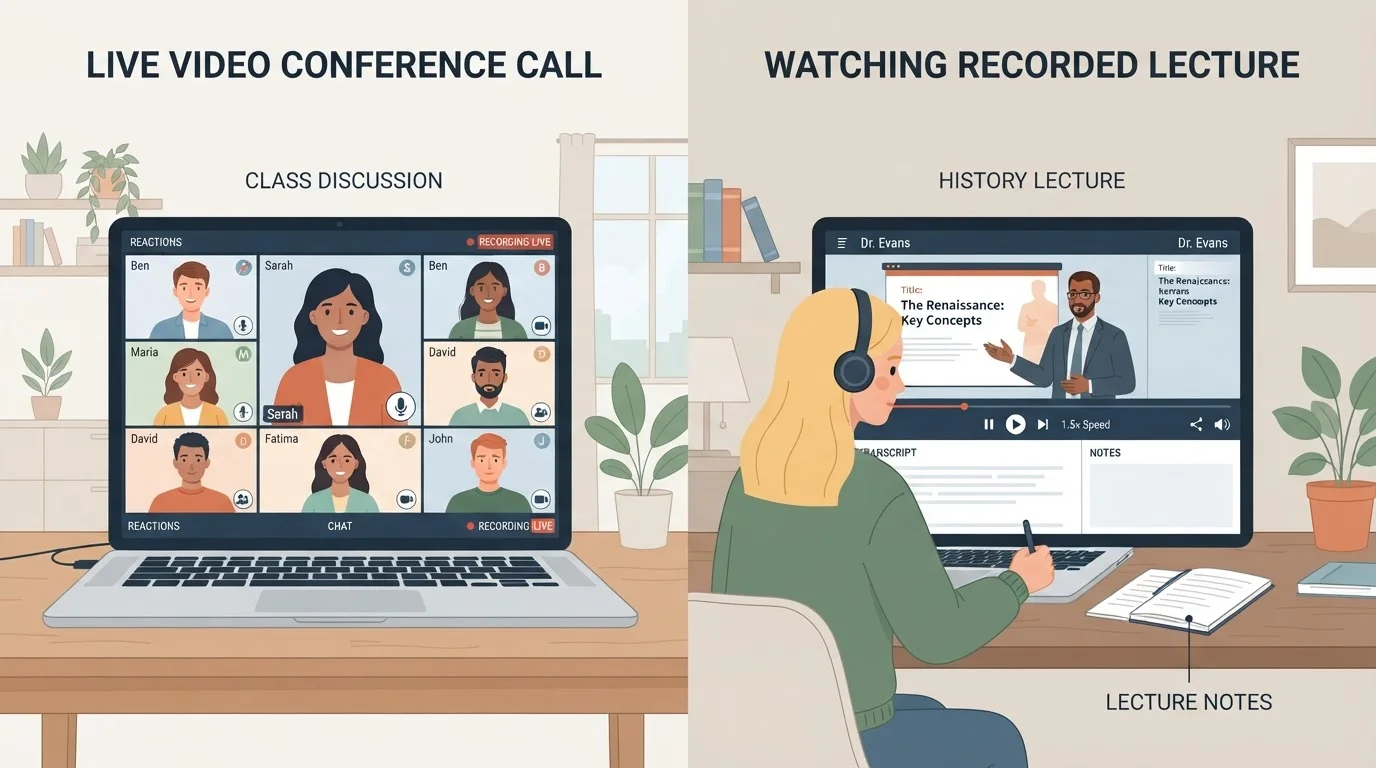
Synchronous learning requires all participants to be present at the same time — think live video lectures, real-time Q&A sessions, or instructor-led workshops on a fixed schedule. Asynchronous learning removes that time constraint: recorded videos, discussion boards, and downloadable materials let you engage whenever it suits you.
The distinction matters beyond logistics. Format shapes the entire learning experience — how feedback reaches you, how peers influence your thinking, and how much ownership you take over your progress. For a broader look at how structural choices affect outcomes, see the trade-offs of learning entirely online.
How Each Format Affects Learning Quality
Synchronous sessions create conditions that are genuinely hard to replicate in recorded formats. When an instructor can read confusion in the room — or in a chat feed — they adjust in real time. Peer discussion develops through spontaneous exchange rather than delayed posts. These dynamics support subjects where nuance, debate, or rapid iteration matter most, such as negotiation, clinical reasoning, or case-based analysis.
Asynchronous formats offer a different kind of depth. Learners can pause, rewatch, and process material at their own cognitive pace — an advantage that research on spaced practice supports. There's also a documented equity argument: removing fixed session times reduces barriers for learners across time zones, caregiving responsibilities, or variable work shifts.
The trade-off is engagement risk. Without scheduled touchpoints, asynchronous learners must supply their own motivation and structure. Completion rates for self-paced courses are, on average, considerably lower than for structured programs — though this reflects learner context and goal-setting as much as format design.
~15%
Average completion rate for MOOCs
Research published in academic journals on massive open online courses consistently finds completion rates hovering around 15%, highlighting the engagement challenge in fully asynchronous, open-enrollment formats.
73%
Online learners citing flexibility as top reason to enroll
According to Babson Survey Research Group data on online education, schedule flexibility is the most commonly cited motivation among adults choosing online over in-person formats.
Side-by-Side Comparison
The table below maps both formats across the criteria most relevant to adult learners making enrollment decisions.
| Criterion | Synchronous Learning | Asynchronous Learning | |
|---|---|---|---|
| Schedule flexibility | Fixed times required | Learn on your own schedule | |
| Instructor feedback | Immediate, in-session | Delayed, via messages or forums | |
| Peer interaction | Real-time, spontaneous | Threaded, reflective | |
| Accountability structure | Built-in via attendance | Self-supplied; easy to defer | |
| Accessibility for busy learners | Lower — time zone & schedule conflicts | Higher — no fixed session required | |
| Ability to review content | Limited unless recorded | Full replay and re-engagement | |
| Best subject fit | Discussion, collaboration, debate | Technical skills, conceptual mastery |
For a related comparison that overlaps with this question, self-paced vs. cohort-based courses explores how program structure — not just delivery timing — shapes the learning experience.
Choosing Based on Your Situation
Before defaulting to whichever format seems more convenient, consider three factors:
- Schedule reliability: If your work hours are fixed and predictable, synchronous options become feasible. If they shift week to week, asynchronous removes a significant friction point.
- Subject matter: Technical skills with clear right-and-wrong answers (coding syntax, accounting principles) adapt well to self-paced formats. Subjects requiring interpretation, persuasion, or collaborative problem-solving often benefit from live interaction.
- Your accountability patterns: Be honest about what keeps you moving. If deadlines and social pressure help you follow through, synchronous cohorts provide that scaffolding. If you work best without external pacing, asynchronous formats give you room to build that habit.
If you're navigating this decision as part of a career change, the stakes of format choice rise. See what career changers should prioritize in online learning for guidance on aligning format to outcome.
Test Your Self-Motivation Before Committing
If you're considering a fully asynchronous program, try a short free course in the same format first. Notice whether you complete modules without a deadline pushing you. This simple experiment can save you significant time and money before enrolling in a longer program. Pairing asynchronous study with deliberate scheduling techniques — such as blocking specific study times in your calendar — can meaningfully close the accountability gap.
When Blended Formats Change the Calculus
Many programs now combine both approaches — recorded content for foundational concepts, live sessions for application and feedback. This hybrid model can capture the flexibility of asynchronous delivery while preserving the accountability of scheduled interaction. When evaluating a program, ask specifically which elements are live and which are recorded, and how the two connect.
Format also interacts with content depth. Microlearning vs. deep-dive courses explores how lesson length and structure affect what you actually retain — a consideration that applies regardless of whether your course is synchronous or asynchronous.
Before enrolling in any program, review what to look for in an online learning platform, including how each platform structures its live and recorded components and what completion support it offers.