

Key Takeaways
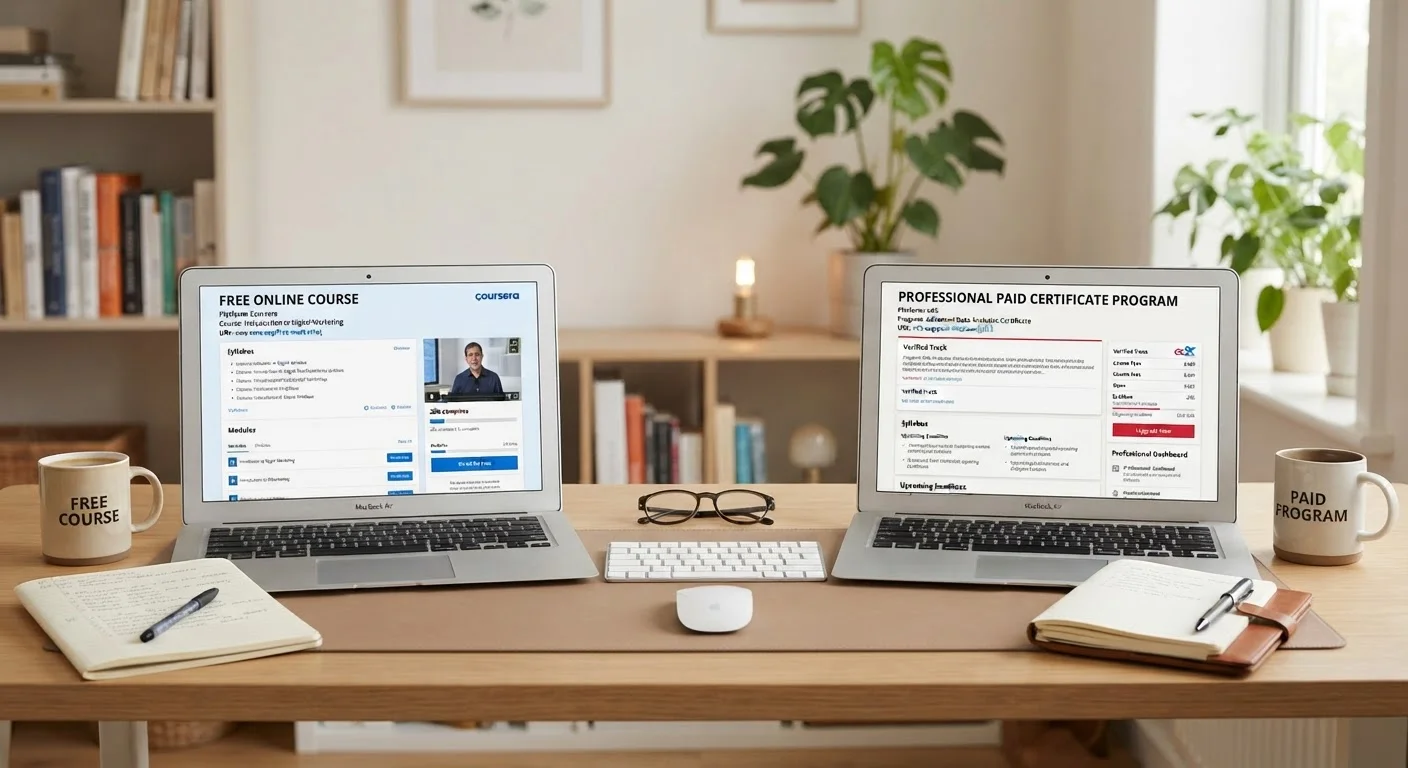
- Free courses offer accessible content but typically lack graded feedback, instructor access, and recognized credentials.
- Paid programs generally provide structured curricula, mentorship, and certificates that employers can verify.
- The right choice depends on your specific goal — exploration, skill-building, or career advancement.
- Credential recognition and employer perception vary significantly between free and paid options.
- Audit options on paid platforms can blur the line, offering free content without the formal credential.
Our Verdict
Free courses are genuinely valuable for exploration, foundational learning, and low-stakes skill-building. Paid programs tend to deliver greater accountability, depth, and credential weight — factors that matter most when education ties directly to career outcomes. Neither format is universally superior; the decision hinges on what you need the learning to do for you.
| Best for | Recommended |
|---|---|
| Exploring a new subject before committing time or money | Free online courses |
| Building job-ready skills with verifiable credentials | Paid programs |
| Supplementing existing knowledge on a flexible schedule | Free online courses |
| Career changers needing structured, employer-recognized credentials | Paid programs |
The Curriculum Gap: Depth vs. Breadth
Free courses tend to prioritize breadth — they introduce concepts, survey a field, or cover foundational skills at a pace that anyone can follow. That accessibility is a genuine strength. Platforms that offer open courseware from universities give learners real exposure to academic content without a tuition bill.
Paid programs, by contrast, tend to build toward a defined learning outcome. Curricula are sequenced deliberately, with later modules building on earlier ones. Assignments are designed to be completed, not just watched. This structure matters more than it might seem: research on online learning consistently finds that unstructured engagement — clicking through videos without deadlines or feedback — produces lower knowledge retention and lower completion rates.
Before enrolling anywhere, it's worth evaluating the syllabus against your actual goal. Our framework for assessing any course before enrolling walks through what curriculum depth, instructor credentials, and platform transparency actually look like in practice.
| Free Online Courses | Paid Programs | |
|---|---|---|
| Cost | No tuition; optional paid upgrades | Ranges from modest fees to thousands |
| Curriculum depth | Introductory to moderate; varies widely | Structured, sequenced toward defined outcomes |
| Instructor access | Rarely available; forum-based Q&A | Often included; office hours or mentorship |
| Graded feedback | Usually absent or peer-only | Typically included; instructor or automated |
| Credential recognition | Completion certificates; rarely verified | Varies; accredited programs carry more weight |
| Completion accountability | Self-directed; high dropout rates | Deadlines and milestones improve follow-through |
| Best use case | Exploration, supplemental learning | Skill certification, career advancement |
Support, Feedback, and Accountability
One of the starkest practical differences between free and paid programs is what happens when you get stuck. Free courses rarely include direct instructor access. Discussion forums exist on many platforms, but response quality and timeliness vary widely. There is no one whose job it is to help you succeed.
Paid programs — particularly those with cohort-based structures — typically build in feedback loops: graded assignments, instructor office hours, peer review, or dedicated mentors. These touchpoints aren't just motivational; they're pedagogically meaningful. Feedback on applied work helps learners identify and correct misunderstandings that passive video-watching doesn't surface.
Evaluate Feedback Mechanisms Before Enrolling
Before committing to any program — free or paid — look specifically at how the course handles learner feedback. Does it include graded assignments? Peer review with rubrics? Instructor responses? These mechanisms, more than content volume or price, predict whether you'll actually build transferable skills. A short, well-structured paid course with real feedback will often outperform a sprawling free curriculum with none.
If your learning goal involves applying a skill — writing, coding, data analysis, design — the presence or absence of substantive feedback is arguably more important than the price tag. For a deeper look at how program format shapes accountability, see our comparison of self-paced vs. cohort-based course structures.
Credentials and Employer Recognition
Free courses rarely produce credentials that carry weight with hiring managers. Completion certificates exist on many platforms, but they typically are not verified, accredited, or tied to any standardized assessment. Listing a free course completion on a resume is permissible, but it signals effort and interest — not demonstrated competency.
Paid programs vary considerably in credential strength. A paid certificate from a non-accredited provider may carry little more employer recognition than a free alternative. Conversely, programs offered through accredited institutions or industry-recognized bodies — such as professional certification programs in project management, data science, or cybersecurity — can carry meaningful signal.
~5–15%
Average MOOC completion rate
Research published in journals including Computers & Education consistently finds that massive open online courses — many of which are free — see completion rates in the single digits to low teens.
40%+
Learners who cite credentials as primary motivation
Surveys by major online learning platforms have found that a significant share of paid program enrollees cite earning a recognized credential as their primary reason for choosing a paid option over a free one.
The honest framing: the value of any credential is determined by who recognizes it, not by what it cost you. Understanding what accreditation status and credential recognition actually mean before you pay is essential due diligence. For career changers in particular, credential weight can be the deciding factor — see our guidance on what to prioritize when switching fields through online education.
Making the Call: Matching Format to Goal
A useful decision framework comes down to three questions: What do you need to be able to do at the end? Who needs to recognize that you can do it? And how much structure do you need to get there?
- Exploratory learning: Free courses are a low-risk way to test interest in a subject before investing further.
- Skill-building for personal use: Either format can work; choose based on the depth of curriculum and your own track record with self-directed study.
- Career advancement or transition: Paid programs with verifiable credentials and structured feedback generally offer the clearest return. See how professional certifications compare to traditional degrees in career outcomes for additional context.
One often-overlooked middle path: many paid platforms allow learners to audit courses for free, accessing video content without graded work or credentials. Auditing can be a smart way to evaluate curriculum quality before committing — but recognize that the audit experience is meaningfully different from full enrollment.
This article is for general informational and educational purposes only. Individual learning outcomes vary based on prior knowledge, effort, and program quality. Consult program providers and employers directly to verify credential recognition relevant to your situation.