

Key Takeaways
- Graduate certificates typically take 6-18 months to complete, while master's degrees usually require 1.5-3 years.
- Master's degrees generally carry more weight for roles requiring research, leadership, or licensure.
- Graduate certificates can be strategic for targeted skill-building or career pivoting in specific fields.
- Cost differences can be significant, but return on investment depends heavily on your industry and goals.
- Employer recognition varies widely - verifying how your target field values each credential is essential.
Our Verdict
Neither a graduate certificate nor a master's degree is universally superior - the stronger choice depends on your career goals, target field, available time, and financial situation. In fields where depth, research, or licensure matter, the master's degree typically delivers more durable career value. In fast-moving technical or specialized fields, a targeted graduate certificate can offer a faster, lower-cost path to advancement.
| Best for | Recommended |
|---|---|
| Adults seeking rapid skill-building or a career pivot in a technical field | Graduate Certificate |
| Those pursuing leadership, research, or licensed professional roles | Master's Degree |
| Learners with limited time or budget who want to test a new field | Graduate Certificate |
| Anyone whose target employer or profession explicitly requires a master's credential | Master's Degree |
What Each Credential Actually Is
Before comparing outcomes, it helps to understand what each credential represents structurally. A graduate certificate is a focused, post-baccalaureate program typically comprising 4-6 graduate-level courses (roughly 12-18 credit hours). It targets a specific skill set or professional domain - think data analytics, project management, healthcare administration, or instructional design. Programs are often completed in under a year.
A master's degree is a fuller academic credential, usually requiring 30-60+ credit hours of coursework, and sometimes a thesis, capstone project, or comprehensive exam. It signals both depth and breadth within a discipline. The time commitment ranges from about 18 months for accelerated programs to three or more years for part-time study.
Both credentials are offered by accredited colleges and universities, though the accreditation status - and what that means for employers - varies. For a closer look at how accreditation affects credential value, see what to look for before enrolling in an online program.
Cost, Time, and Flexibility Compared
| Graduate Certificate | Master's Degree | |
|---|---|---|
| Typical Duration | 6-18 months | 1.5-3 years |
| Credit Hours | 12-18 credit hours | 30-60+ credit hours |
| Typical Cost Range | $5,000-$15,000 | $20,000-$60,000+ |
| Depth of Study | Narrow, skill-focused | Broad and deep within field |
| Licensing Eligibility | Rarely qualifies | Often required for licensure |
| Employer Recognition | Field- and program-dependent | Broadly recognized across sectors |
| Best Use Case | Targeted upskilling or career pivot | Leadership, research, or licensed roles |
The cost gap between these credentials is real but not uniform. Graduate certificates at public universities may run $5,000-$15,000 total, while master's programs can range from $20,000 to well over $60,000 depending on institution and field. However, employer tuition reimbursement, graduate assistantships, and field-specific scholarships can narrow that gap considerably for master's students.
Flexibility is increasingly comparable, as most institutions now offer both credentials fully online or in hybrid formats. That said, graduate certificates tend to have fewer prerequisites and more open enrollment windows, making them more accessible to working adults on short notice.
Stack Credentials Strategically
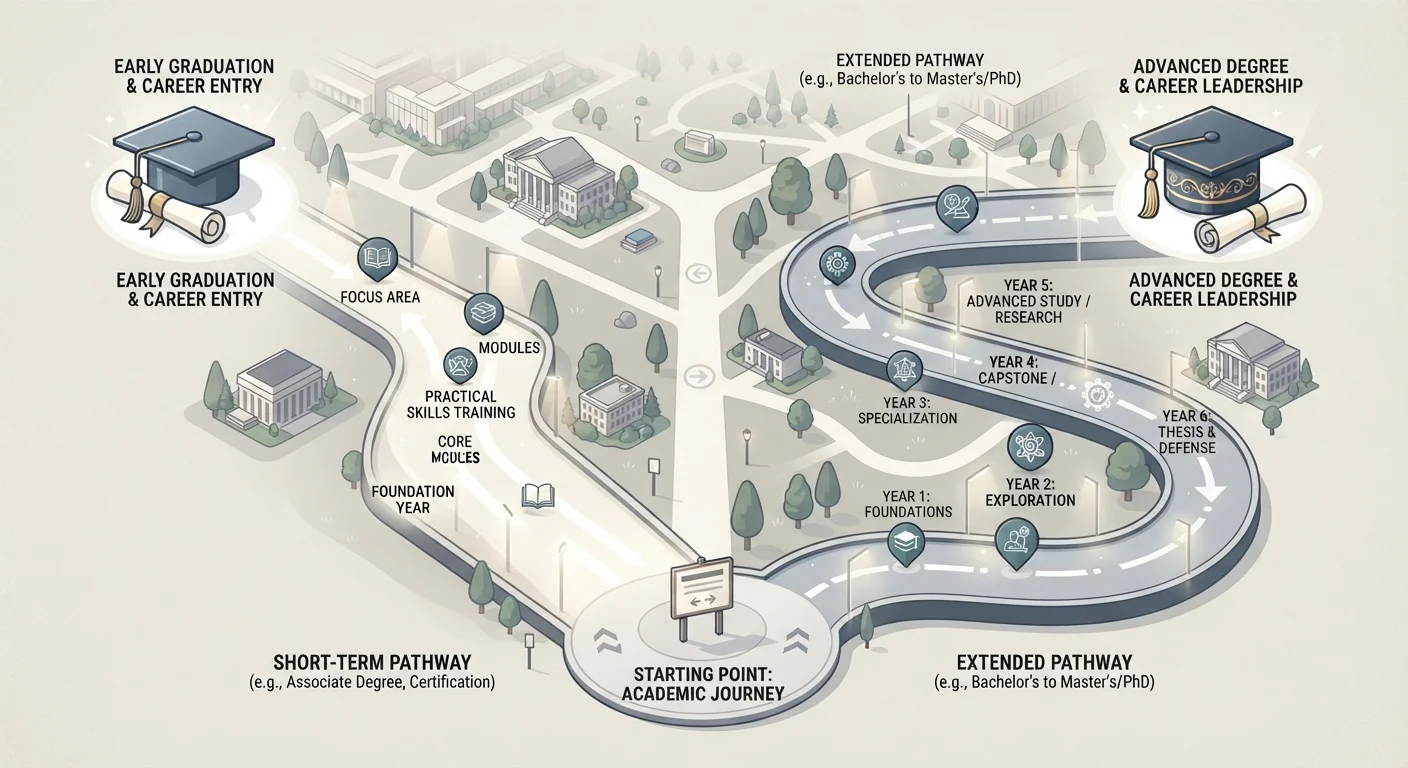
Some graduate certificates can count as credit toward a related master's degree at the same institution. If you're uncertain about committing to a full master's program, enrolling in a certificate first can let you sample graduate-level coursework, build momentum, and potentially apply those credits later. Confirm this pathway with your target institution's admissions office before enrolling.
Career Value: Where Each Credential Carries Weight
Career impact is where this comparison gets field-specific. In clinical, counseling, and education fields, a master's degree is often a licensing prerequisite - not just a preference. Social workers, school counselors, and speech-language pathologists, for example, typically require a master's to practice. A graduate certificate alone will not satisfy those requirements.
In technology, data, and business fields, employer expectations are more varied. A graduate certificate in cybersecurity or UX design from a respected program can be highly competitive, particularly when paired with a relevant undergraduate degree and a demonstrable portfolio. However, senior leadership and research-oriented roles in these fields often still prefer or require a master's.
For adults changing careers entirely, a graduate certificate can serve as a lower-risk entry point to test a new field before committing to a full degree. This strategic approach is explored further in online learning strategies for career changers.
It's also worth noting that not all graduate certificates carry equal weight. Program reputation, institutional accreditation, and how the credential is perceived in your target sector all matter. Why online certificates are not all created equal offers a useful framework for evaluating quality before you enroll.
Verify Credential Recognition Before Enrolling
Not every graduate certificate carries professional weight in every industry. Some employers - particularly in regulated fields like healthcare, law, and education - may not recognize a graduate certificate as equivalent to graduate-level degree training. Before investing time and money, research how hiring managers in your specific field and geographic region view the credential you're considering.
How to Make the Decision That Fits Your Goals
Three questions can structure your thinking:
- Does your target role require a master's? Check job postings, licensing boards, and professional associations in your field. If a master's is listed as required - not preferred - a certificate won't substitute.
- What is your timeline and financial situation? If you need to upskill quickly or have limited resources, a targeted graduate certificate from an accredited institution may deliver faster return. For long-term career trajectories, the investment in a master's often compounds over time.
- Is the credential recognized by employers in your sector? This requires research, not assumptions. Talk to hiring managers, scan job postings, and consult professional networks in your field.
For a broader look at how credential type shapes career outcomes, comparing professional certifications and college degrees provides useful context on weighing educational investment against career payoff.
Finally, some learners use a graduate certificate as a stepping stone - completing it first, then applying those credits toward a master's program. Not all institutions allow this transfer, so confirm the policy before enrolling if that path interests you.