

Key Takeaways
- A tripped breaker is a safety feature, not a nuisance - it signals that a circuit was overloaded or shorted.
- Most homes built after the 1970s use circuit breakers; older fuse-based panels may need professional evaluation.
- A 100-amp panel may be undersized for homes with modern appliances; 200 amps is the current standard.
- Breakers that trip repeatedly without an obvious cause require a licensed electrician's inspection.
- Never ignore burning smells, buzzing sounds, or scorch marks near your panel - treat them as urgent warning signs.
Electrical Panel (Breaker Box)
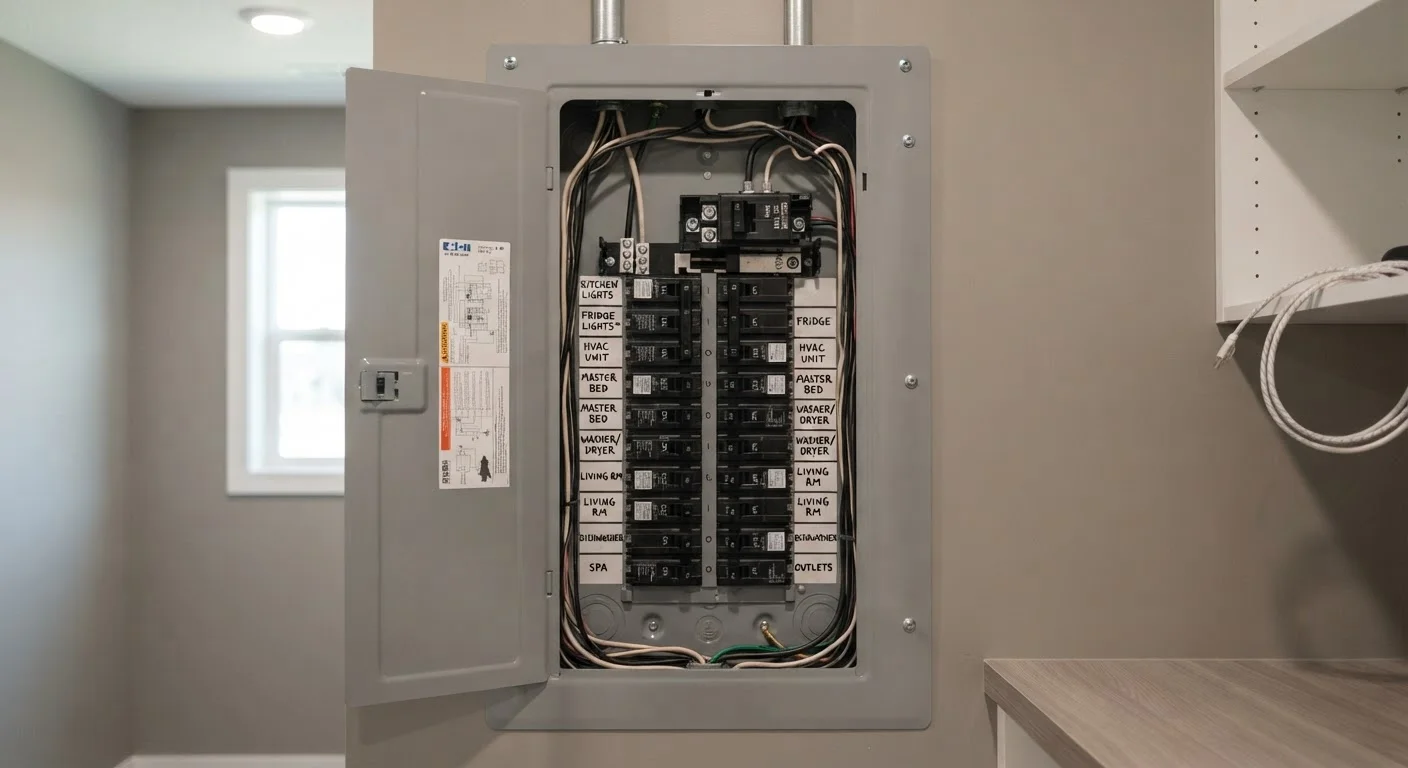
An electrical panel - also called a breaker box or load center - is the metal cabinet that distributes incoming electricity from the utility company into individual circuits throughout your home. Each circuit is protected by a circuit breaker: a switch designed to automatically shut off power when current exceeds a safe level. Think of it as the brain of your home's electrical system.
Panels are rated by amperage capacity (commonly 100A, 150A, or 200A for residential homes) and must be matched to the total electrical demand of the circuits they serve. Most modern panels use thermal-magnetic breakers that trip on both overload and short-circuit conditions.
How Your Electrical Panel Actually Works
Electricity enters your home through a utility meter and feeds into your electrical panel, where it splits into individual branch circuits - each serving a specific area or appliance. Every circuit runs through its own breaker, which is calibrated to a specific amperage, typically 15 or 20 amps for general outlets, and higher for large appliances like dryers (30A) or electric ranges (50A).
When a circuit draws more current than its breaker allows - whether from too many devices running at once or a fault in the wiring - the breaker trips, cutting power to that circuit. This is intentional protection. The alternative, unchecked current flow, generates heat that can ignite insulation and cause house fires.
Know Your Panel Brand and Age
Certain electrical panel brands from past decades have been identified as having design deficiencies that can pose safety concerns. If your home has an older panel and you're unsure of its status, a licensed electrician can identify the make and model and advise whether it warrants evaluation or replacement.
Each breaker in your panel should be clearly labeled to identify which area or appliance it controls. If your panel labels are incomplete or illegible, mapping your circuits is a worthwhile weekend task that pays dividends during any troubleshooting or emergency.
Reading the Warning Signs
Your panel communicates problems in a few distinct ways, and learning to recognize them can prevent small issues from becoming costly or dangerous ones.
- Frequent tripping on one circuit: If the same breaker trips repeatedly, the circuit is likely overloaded. Try redistributing loads - for example, running a space heater and a hair dryer on separate circuits. Persistent tripping even at low loads suggests a wiring fault.
- Breakers that won't stay reset: If a breaker immediately trips again after you reset it, there may be a short circuit or a faulty breaker itself. Stop resetting it and call an electrician.
- Burning smell or discoloration: Scorch marks, a burning smell, or a warm panel exterior are urgent signs. These indicate arc faults or overheating connections - fire hazards that require immediate professional attention.
- Buzzing or crackling sounds: A healthy panel operates silently. Audible sounds suggest arcing electricity or a failing breaker.
- Flickering lights throughout the home: Isolated flickering may be a loose bulb. Widespread flickering, especially correlated with appliance use, can signal a panel capacity issue or a loose main connection.
Do a Visual Inspection Once a Year
Set a reminder to visually inspect your panel annually. Open the door, look for scorch marks, corrosion, or any breakers stuck in a middle position (partially tripped). Check that all breakers are clearly labeled. This quick check costs nothing and can surface problems early.
Panel Capacity and When It May Be Undersized
Older homes were built when electrical demand was a fraction of what it is today. A 60-amp panel - common in mid-20th century construction - was adequate for incandescent lighting and a few appliances. Modern households with electric vehicle chargers, central air conditioning, large kitchen appliances, and home offices routinely require 200-amp service.
200A
Standard residential panel capacity today
The National Electrical Code and most utility companies now consider 200-amp service the baseline for new residential construction in the US.
~40%
Home fires involving electrical failures or malfunctions
According to the U.S. Fire Administration, electrical fires represent a significant share of residential home fires, many of which originate in wiring, outlets, and distribution equipment.
Signs your panel capacity may be a limiting factor include: lights dimming when the HVAC kicks on, no room for additional breakers, or reliance on extension cords and power strips as a permanent solution. If you're planning a significant renovation or addition, panel capacity should be part your early planning conversation with a licensed electrician. Upgrading a panel is a job that also requires a permit and inspection in virtually all US jurisdictions - your local authority having jurisdiction (AHJ) sets the rules.
An energy-efficient home is a connected system. Your electrical panel's capacity also affects how well your heating and cooling equipment performs. See our guide on signs your HVAC system is overworked if you're noticing performance issues alongside electrical concerns.
What Homeowners Can and Cannot Do Safely
There is a clear line between safe homeowner tasks and work that must be left to a licensed electrician.
Safe for homeowners: Resetting a tripped breaker, labeling circuits, testing GFCI outlets, replacing a standard outlet or switch on a de-energized circuit (where local codes permit), and monitoring for warning signs.
Requires a licensed electrician: Any work inside the panel enclosure, adding new circuits, replacing breakers, upgrading panel amperage, addressing repeated faults, or any work near the main service entrance. Even with the main breaker switched off, the conductors connecting to the utility remain energized - these are utility-controlled and cannot be de-energized by the homeowner.
Permits are typically required for panel upgrades, new circuit additions, and service changes. Unpermitted electrical work can create problems with homeowner's insurance and home resale. Always verify requirements with your local building department before starting any project.
This article is for general educational purposes only. Electrical work carries serious risks of shock, fire, and injury. Always consult a licensed electrician for assessment, repairs, or upgrades to your home's electrical system, and verify local permit requirements before beginning any work.