

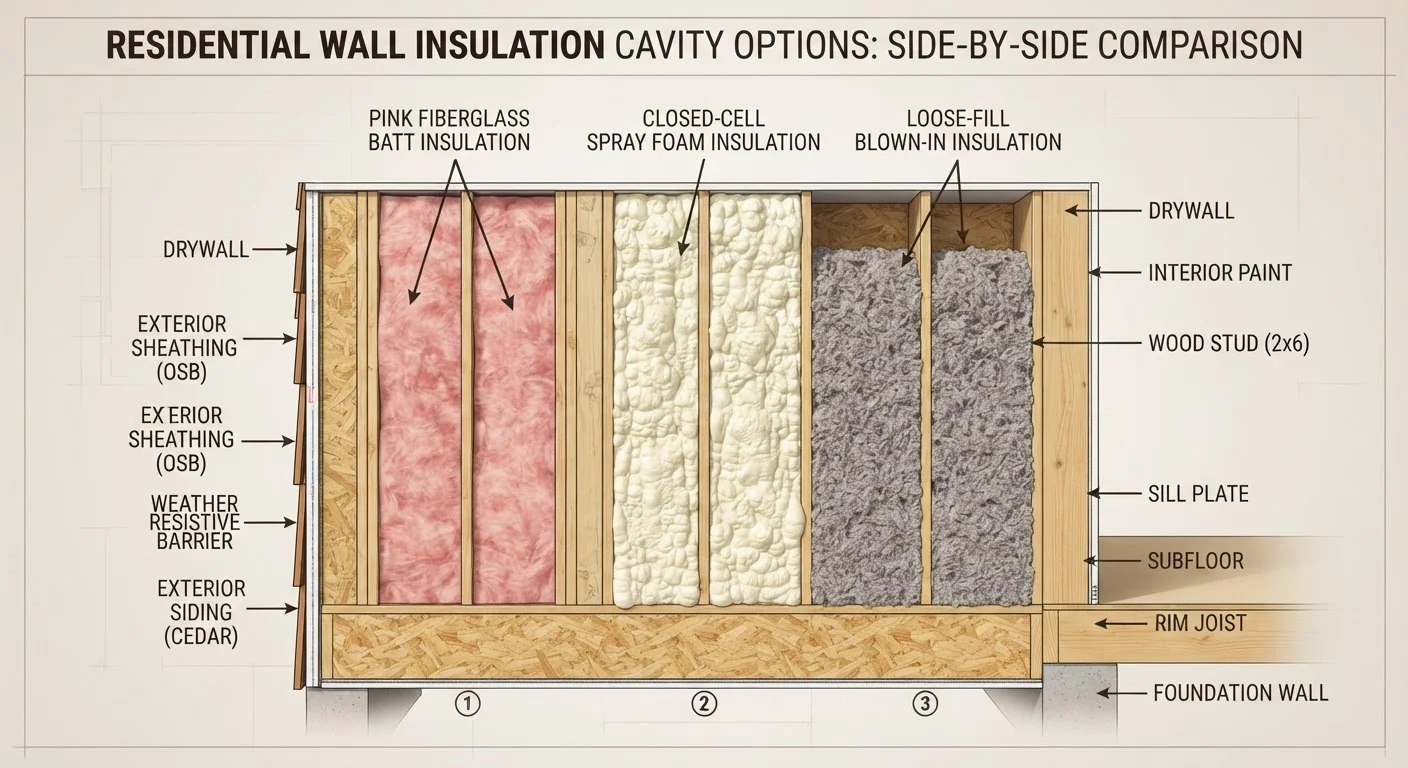
| Batt insulation R-value (fiberglass) | ~R-3.0 to R-4.3 per inch (U.S. Department of Energy) |
| Closed-cell spray foam R-value | ~R-6.0 to R-7.0 per inch (U.S. Department of Energy) |
| Blown-in cellulose R-value | ~R-3.2 to R-3.8 per inch (U.S. Department of Energy) |
| Recommended attic R-value (most US climate zones) | R-38 to R-60 (ENERGY STAR / U.S. DOE) |
| Cellulose recycled content | Up to 85% post-consumer recycled paper (Cellulose Insulation Manufacturers Association) |
| DIY suitability | Batts and attic blown-in: moderate; spray foam systems: professional recommended |
Why Insulation Type Matters
Choosing the right insulation isn't just about stuffing material into a wall cavity - it's about matching the product's physical properties to your specific application, climate zone, and budget. Each insulation type behaves differently when it comes to air sealing, moisture resistance, and ease of installation. Getting this wrong can lead to thermal bridging, condensation problems, or simply underperforming walls that drive up energy bills.
The three most common residential insulation types - batt, spray foam, and blown-in - each have a distinct set of strengths. Use this guide as a quick-reference lookup to understand what each offers and where it makes the most sense. For a broader approach to reducing energy loss throughout your home, see our room-by-room weatherproofing guide.
| Batt insulation R-value (fiberglass) | ~R-3.0 to R-4.3 per inch (U.S. Department of Energy) |
| Closed-cell spray foam R-value | ~R-6.0 to R-7.0 per inch (U.S. Department of Energy) |
| Blown-in cellulose R-value | ~R-3.2 to R-3.8 per inch (U.S. Department of Energy) |
| Recommended attic R-value (most US climate zones) | R-38 to R-60 (ENERGY STAR / U.S. DOE) |
| Cellulose recycled content | Up to 85% post-consumer recycled paper (Cellulose Insulation Manufacturers Association) |
| DIY suitability | Batts and attic blown-in: moderate; spray foam systems: professional recommended |
Batt Insulation
Batt insulation - typically fiberglass or mineral wool - comes in pre-cut panels sized to fit standard stud and joist spacing. It's one of the most cost-accessible DIY-friendly options and is widely available at home improvement stores.
- R-value range: Approximately R-3.0 to R-4.3 per inch for fiberglass; R-3.7 to R-4.2 per inch for mineral wool
- Best applications: Open wall cavities, attic floors between joists, and floor assemblies with standard framing
- Key limitations: Batts must be cut and fitted carefully around obstructions; gaps or compression significantly reduce effective R-value. They provide little air-sealing benefit on their own.
Installation note: Proper fit is critical. Batts that are jammed, folded, or compressed lose thermal performance. Always wear gloves, eye protection, and a dust mask when handling fiberglass batts.
R-value
A measure of thermal resistance - how well a material resists the flow of heat. Higher R-values indicate better insulating performance. Required R-values vary by climate zone and building assembly.
Thermal bridging
Heat transfer that occurs through more conductive materials (like wood studs or metal framing) that bypass insulation. It reduces the overall effective R-value of a wall assembly.
Vapor retarder
A material that slows the movement of moisture vapor through a building assembly. Closed-cell spray foam acts as a Class II vapor retarder, which is important in cold and mixed climates.
Air barrier
A continuous layer in a building assembly that prevents air movement through walls, ceilings, and floors. Spray foam doubles as an air barrier, while batts and blown-in typically do not without additional measures.
Spray Foam Insulation
Spray polyurethane foam (SPF) expands on contact to fill irregular gaps and cavities, making it uniquely effective as both an insulator and an air barrier. It comes in two main formulations: open-cell and closed-cell.
- Open-cell foam: Softer, less dense, approximately R-3.5 per inch. Vapor-permeable, so it's often used in climate zones where some moisture movement is acceptable.
- Closed-cell foam: Dense, rigid, approximately R-6.0 to R-7.0 per inch. Acts as a vapor retarder and provides structural rigidity. Better suited for crawl spaces, rim joists, and exterior-facing applications.
- Best applications: Rim joists, cathedral ceilings, crawl spaces, and anywhere air infiltration is a primary concern
Important: Full spray foam application is generally not a DIY task. Professional installers use specialized equipment and must follow safety protocols during application. Small canned foam (for gaps and cracks) is different from full-cavity spray foam systems. Permits or inspections may be required in some jurisdictions - verify with your local building department.
Permits and Professional Installation
Full-cavity spray foam application typically requires professional equipment and trained installers. Depending on your jurisdiction, certain insulation projects - especially those affecting fire-rated assemblies or conditioned crawl spaces - may require a building permit and inspection. Always check with your local building department before starting any significant insulation work.
Blown-In (Loose-Fill) Insulation
Blown-in insulation - made from cellulose, fiberglass, or mineral wool - is machine-blown into place, making it ideal for irregular spaces and hard-to-reach areas. It conforms around existing framing, wiring, and ducts better than batts.
- R-value range: Approximately R-2.2 to R-3.8 per inch depending on material and settling
- Best applications: Existing attics, enclosed wall cavities (requires drilling access holes), and spaces with many obstructions
- Key advantages: Cellulose is made largely from recycled content; blown-in generally covers obstructions more uniformly than batts
- Key limitations: Cellulose can settle over time, reducing effective depth; moisture management is critical
Many home improvement retailers offer blower machine rentals when you purchase a sufficient quantity of material, making this a viable DIY project for attic top-ups. Enclosed wall applications typically require a contractor with the appropriate equipment and expertise.
R-38 to R-60
Recommended attic insulation for most US climate zones
According to U.S. Department of Energy guidelines, most US homes should target this range for attic insulation to meet energy efficiency standards.
Up to 15%
Estimated home heating/cooling energy lost through the attic
The U.S. EPA notes that air sealing and insulating attics can be one of the highest-impact improvements for residential energy efficiency.