
Intermittent Fasting vs. Calorie Restriction: How the Two Approaches Compare

Key Takeaways
- Both approaches can support weight management primarily by reducing overall calorie intake.
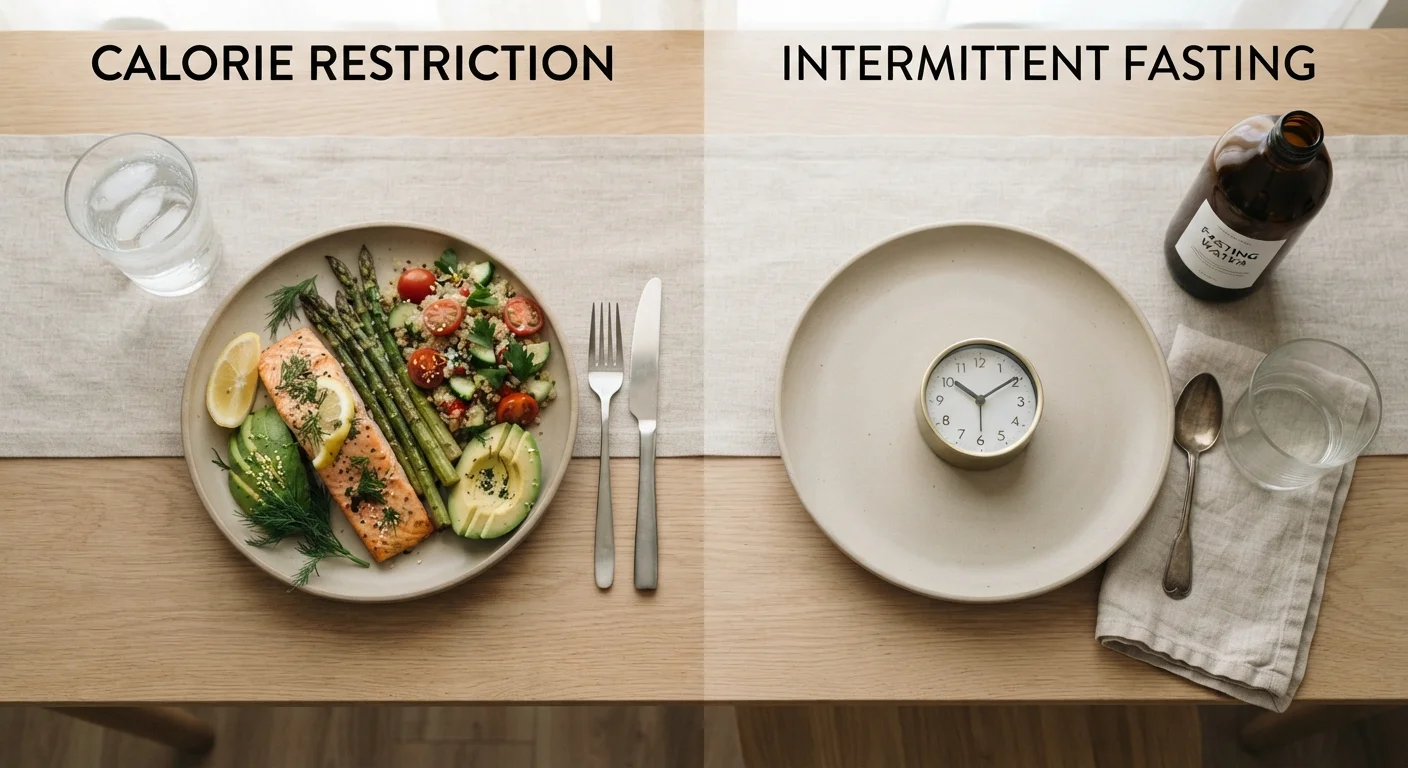
- Intermittent fasting focuses on when you eat; calorie restriction focuses on how much you eat.
- Research suggests both methods produce similar weight outcomes when calories are matched.
- Individual adherence and lifestyle fit are the strongest predictors of long-term success.
- Neither approach is universally suitable - certain populations should consult a healthcare provider first.
Option A
Intermittent Fasting (IF)
The time-structured eating pattern.
Best for: People who prefer flexibility in what they eat and find meal timing easier to manage than portion tracking.
Option B
Calorie Restriction (CR)
The evidence-backed energy-deficit approach.
Best for: People who thrive with structured daily guidelines and want granular control over their nutritional intake.
If you find calorie counting tedious or unsustainable
Intermittent Fasting (IF)
IF eliminates the need to track every gram consumed. Restricting your eating window often naturally reduces intake without detailed logging.
If you need precise nutritional structure and accountability
Calorie Restriction (CR)
CR allows you to fine-tune macronutrient balance and ensures you're meeting micronutrient targets alongside an energy deficit.
If you have an irregular daily schedule or social commitments around meals
Calorie Restriction (CR)
CR allows flexible meal timing, making it easier to adapt to varying schedules without breaking a fasting window.
If you have a history of disordered eating or anxiety around food rules
Neither - consult a professional
Both approaches involve deliberate restriction and may be triggering for some individuals. A registered dietitian can help identify a safer path.
What Each Approach Actually Involves
Intermittent fasting (IF) is an umbrella term for eating patterns that cycle between defined periods of eating and fasting. Common formats include the 16:8 method (16 hours fasting, 8 hours eating), the 5:2 approach (normal eating five days, significant calorie reduction two days), and alternate-day fasting. IF does not prescribe specific foods - it structures when you eat.
Calorie restriction (CR) works differently. It involves reducing daily energy intake below your total energy expenditure - typically by 10-30% - while maintaining consistent meal timing. CR requires tracking or estimating food intake and is the foundation of most traditional dietary weight-loss protocols. The focus is on how much you eat across the day.
Despite their structural differences, the two approaches often converge in practice: many people doing IF end up in a calorie deficit simply because their eating window is compressed.
What the Research Shows
A significant body of research has examined both strategies. A 2022 review published in the New England Journal of Medicine and multiple randomized controlled trials have found that when calorie intake is equated, IF and CR produce comparable weight loss outcomes. Neither approach has demonstrated a clear metabolic advantage over the other under controlled conditions.
~Similar
Weight loss outcomes when calories are matched
Multiple randomized trials comparing IF and CR find no significant difference in weight loss when total calorie intake is equivalent.
Up to 30%
Typical calorie reduction in CR protocols
Standard calorie restriction protocols often target a 10-30% reduction below total daily energy expenditure, according to dietary research guidelines.
16:8
Most commonly studied IF protocol
The 16-hour fast, 8-hour eating window is the most researched intermittent fasting format across clinical trials in adults.
Where IF research shows more promise is in areas beyond simple weight loss. Some studies suggest IF may improve insulin sensitivity and certain cardiometabolic markers - though researchers note these effects are not always independent of weight loss itself. CR research, meanwhile, has a longer evidence base and is well-established for reducing risk factors associated with metabolic syndrome.
It's worth noting that much of the IF research has been conducted over short timeframes, and long-term comparative data - particularly beyond two years - remains limited. The scientific community continues to investigate whether timing-based effects are meaningful beyond energy deficit alone.
Emerging Research vs. Established Evidence
Intermittent fasting is a rapidly evolving area of nutritional science. While early findings are encouraging, many studies involve small sample sizes and short durations. Calorie restriction has a more extensive evidence base spanning decades. This doesn't make IF inferior - it means the science is still catching up. Treat enthusiasm for either approach with appropriate nuance.
Side-by-Side: Key Differences at a Glance
Understanding how the two approaches differ across practical dimensions can help you identify which aligns better with your lifestyle, health history, and goals.
| Criterion | Intermittent Fasting | Calorie Restriction |
|---|---|---|
| Core mechanism | Restricts eating to defined time windows | Reduces total daily energy intake |
| Requires food tracking | Generally not required | Typically necessary for accuracy |
| Meal timing flexibility | Fixed eating window required | Flexible - eat anytime within the day |
| Dietary composition rules | None specified | None specified; quantity is primary focus |
| Evidence base | Growing but largely short-term | Extensive; decades of research |
| Hunger management | Can be challenging during fasting hours | Hunger may persist throughout the day |
| Social meal compatibility | May conflict with social dining schedules | Generally compatible with social eating |
For a deeper look at why rigid restriction can sometimes work against long-term goals, see our guide on why restrictive diets often backfire.
Choosing an Approach That Fits Your Life
Research consistently points to adherence as the most reliable predictor of dietary success. The approach you can sustain over months - not the one with the most theoretical benefit - is the one most likely to serve your health goals. This means personal factors like social eating habits, work schedules, hunger patterns, and relationship with food matter enormously.
Neither IF nor CR is appropriate for everyone. Pregnant or breastfeeding individuals, people with a history of disordered eating, those managing chronic conditions, and older adults with specific nutritional needs should consult a qualified healthcare provider or registered dietitian before making significant dietary changes. The same caution applies to children and adolescents.
Both approaches can be part of a balanced, health-supporting lifestyle when implemented thoughtfully and without extreme restriction. The goal is not deprivation - it's developing eating habits that are nourishing, realistic, and sustainable over the long term.
This article is for general informational and educational purposes only and does not constitute medical or nutritional advice. Always consult a qualified healthcare professional before making significant changes to your diet, particularly if you have an existing health condition.