

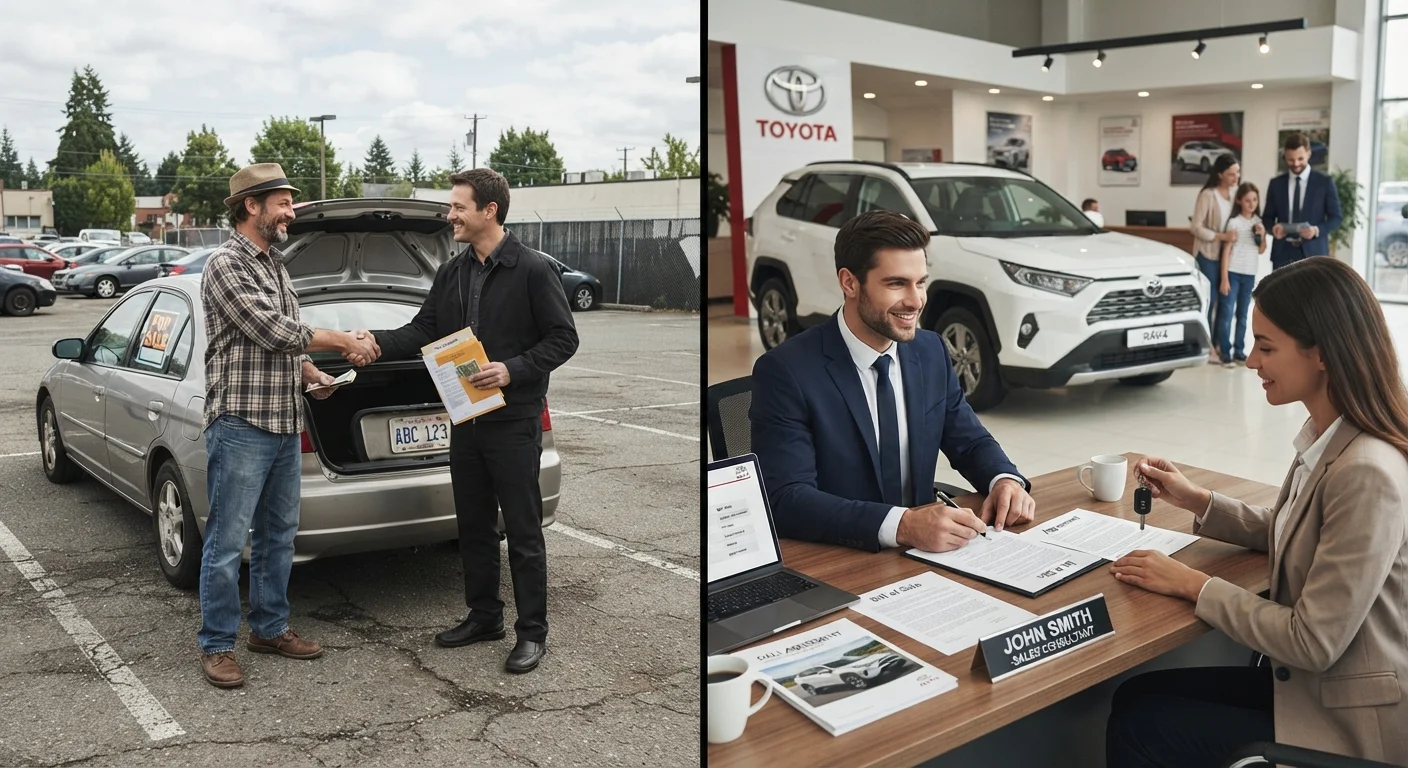
Key Takeaways
- Private sales often yield more money for sellers but require significantly more personal effort and legal responsibility.
- Dealerships handle titling, taxes, and financing paperwork in-house, reducing administrative burden on buyers and sellers.
- Buyers in private transactions have fewer consumer protections and typically receive no warranty.
- Payment security and fraud risk are meaningfully higher in private party deals.
- State-specific title transfer and disclosure laws apply differently depending on which channel you use.
- Neither route is universally better - the right choice depends on your timeline, risk tolerance, and vehicle situation.
Option A
Private Party Sale
The hands-on, potentially higher-yield route.
Best for: Sellers wanting maximum return and buyers seeking a negotiable, no-pressure transaction.
Option B
Dealership Sale or Purchase
The structured, full-service transaction channel.
Best for: Those who prioritise convenience, legal protection, and financing options over squeezing every dollar.
If you want the highest possible payout for your vehicle
Private Party Sale
Selling privately eliminates the dealer's margin, typically netting the seller a meaningfully higher return than a trade-in or dealer consignment.
If you need financing, warranties, or a streamlined title process
Dealership Sale or Purchase
Dealerships consolidate financing, warranty options, and DMV paperwork under one roof, making the process significantly less complicated.
If you have an outstanding loan on the vehicle you're selling
Dealership Sale or Purchase
Dealers are practiced at coordinating lien payoffs during the transaction; private buyers are often uncomfortable with the added complexity.
If you're a first-time buyer wanting legal safeguards
Dealership Sale or Purchase
Franchised dealers operate under stricter state consumer protection regulations, and many offer certified pre-owned programs with inspections and limited warranties.
If you're a confident buyer who has already researched the vehicle thoroughly
Private Party Sale
An informed buyer who arranges an independent inspection and understands as-is terms can get solid value buying privately with manageable risk.
The Real Differences Start After the Price Is Set
Most people frame the private-vs-dealer decision purely around money - and price does matter. But once you move past the sticker, the two channels diverge sharply in legal obligations, paperwork burden, payment logistics, and risk exposure. Understanding those differences is what separates a smooth transaction from a costly lesson.
Whether you're buying or selling, the channel you choose shapes every step that follows. For sellers, see our guide to pricing your car competitively as a foundation before deciding where to list it.
| Criterion | Private Party Sale | Dealership |
|---|---|---|
| Typical seller return | Higher (no dealer margin) | Lower (dealer profit built in) |
| Warranty for buyer | None (as-is in most states) | Limited or certified options available |
| Title & DMV paperwork | Both parties handle independently | Dealer manages filings |
| Financing options | Buyer arranges separately | On-site lending available |
| Fraud / payment risk | Higher; fewer safeguards | Lower; institutional process |
| Outstanding loan handling | Complex; parties must coordinate | Dealer coordinates payoff |
| Consumer legal protections | Limited (as-is rules apply) | State dealer laws apply |
| Time and effort required | High - listing, vetting, negotiating | Lower - consolidated transaction |
Legal Responsibilities: Who Is on the Hook for What
When a licensed dealer sells a vehicle, they operate under state dealer licensing laws, federal disclosure requirements, and - for franchised new-car dealers - manufacturer warranty obligations. That regulatory layer gives buyers a formal complaints process and, in many states, lemon-law protections.
Private sellers face a different legal landscape. In most states, private sales are completed "as-is," meaning the seller bears no implied warranty of merchantability unless they make specific written representations about the vehicle's condition. However, private sellers are not off the hook entirely: knowingly concealing a material defect - a flooded title, a rolled-back odometer, or a safety-critical mechanical fault - can expose a seller to civil liability or fraud claims regardless of any "as-is" language.
Title transfer works the same way legally but differs in execution. Dealers handle DMV filings, lien releases, and tax remittance as part of the closing process. In a private sale, both parties must coordinate that themselves. Our detailed guide on vehicle title transfer responsibilities walks through exactly what each party must do and the common pitfalls to avoid.
As-Is Does Not Mean Fraud-Proof
"As-is" protects sellers from implied warranty claims but does not shield them from liability for deliberate misrepresentation. If a seller knows about a salvage title, flood damage, or a tampered odometer and fails to disclose it, they can face civil lawsuits or criminal fraud charges depending on state law. Always disclose known defects in writing as part of the bill of sale.
Payment, Fraud Risk, and Financing
Payment is one of the most underappreciated differences between channels. At a dealership, payment is institutionalised - financing is arranged through lenders, and cashier's checks or electronic transfers flow through established processes with verification built in.
Private transactions require both parties to arrange secure payment independently. Cash works but creates risk for the seller carrying it. Cashier's checks can be counterfeited convincingly. Electronic transfers (such as Zelle or wire transfers) are increasingly common but offer limited recourse if fraud occurs. Buyers should always verify funds have cleared before releasing a title; sellers should conduct the transaction in a safe, public location.
~$2,000+
Typical private sale premium over trade-in
Consumer automotive research consistently shows private party sale prices running several thousand dollars above dealer trade-in offers for the same vehicle, though the gap varies by market conditions and vehicle type.
0.5-1.5%
Higher interest rate on private-party auto loans
Lenders generally price private-party auto loans at a modest premium over dealer-arranged financing, reflecting the additional verification work and slightly higher perceived risk.
Financing is another wedge. Dealers can offer on-the-spot loan origination through their lending partners. Private-party auto loans exist through banks and credit unions but typically carry slightly higher interest rates and require more borrower legwork - and the lender will need to confirm the vehicle's value independently.
If the car being sold still carries an outstanding loan, the complexity rises sharply. Dealers routinely coordinate payoff of seller loans at closing. In a private sale, buyers are understandably hesitant to hand over funds before a lien is released. Our article on selling a car with an outstanding loan explains how to navigate that process without putting either party at risk.
Time, Effort, and the Convenience Trade-Off
Dealership transactions compress a lot of complexity into a single afternoon, even if that afternoon involves signing a thick stack of forms. A trade-in, for instance, can be bundled directly into a new purchase, with tax offsets in most states reducing what you owe on the new vehicle. For a clear look at when a trade-in makes more practical sense than a private listing, see our comparison of trade-in timing vs. private sale.
Private sales demand more of your calendar. Listing the vehicle, fielding inquiries, screening buyers, arranging test drives, and negotiating in real time can stretch across days or weeks. Sellers must also understand their disclosure obligations and prepare a proper bill of sale. For buyers, due diligence is entirely self-directed - arranging a pre-purchase inspection by an independent mechanic is strongly advisable, and skipping it is one of the most common missteps. Our piece on first-time buyer mistakes at dealerships covers similar blind spots on the dealer side of the equation.
The fundamental trade-off is consistent: private sales generally offer sellers higher returns and buyers lower prices, but both parties absorb more risk, more administrative work, and more exposure to fraud. Dealerships cost more but provide structure, consumer protections, and streamlined logistics. Neither channel is inherently superior - the right choice depends on your vehicle, your timeline, and how much complexity you're prepared to manage.